Why Cover Letters Matter for Teachers
A cover letter is your first introduction to a potential employer and a crucial element of your teaching job application. It provides a platform to highlight your skills, experience, and passion for education, going beyond the confines of your resume. In a competitive job market, a well-crafted cover letter can significantly increase your chances of securing an interview. It allows you to personalize your application and demonstrate your genuine interest in the specific school or district. Furthermore, it showcases your written communication skills, a vital aspect of teaching. A compelling cover letter can make you stand out from other qualified candidates by providing context to your resume and expressing your unique qualities and aspirations as an educator. Therefore, putting effort into crafting a strong cover letter is an investment in your career and a demonstration of your professionalism and commitment.
Highlighting Your Skills and Experience
Your cover letter is the perfect space to showcase the skills and experiences that make you an exceptional teacher. Instead of simply listing your qualifications, focus on demonstrating how your skills align with the specific needs of the school. Start by identifying the key skills the school is seeking, often found in the job description. These might include classroom management, curriculum development, differentiated instruction, or experience with specific age groups or subjects. Then, provide concrete examples of how you’ve successfully utilized these skills in your previous teaching roles. Describe situations where you’ve effectively managed a challenging classroom, created engaging lesson plans, or adapted your teaching methods to meet the diverse needs of your students. Use action verbs to paint a vivid picture of your accomplishments, emphasizing the positive outcomes of your efforts. By highlighting your relevant skills and providing evidence of your success, you’ll convince the hiring committee of your ability to excel in the role.
Quantifying Your Achievements

Don’t just tell them you’re good; show them! Use data and quantifiable results to demonstrate the impact you’ve had as an educator. Instead of saying ‘I improved student test scores,’ state ‘I increased student test scores by 15% in my first year.’ Similarly, quantify your experience. Instead of saying ‘I worked with diverse learners,’ you could say ‘I have successfully implemented differentiated instruction strategies for over 100 students with diverse learning needs.’ Include specific numbers or statistics to make your achievements more compelling. This could involve the number of students you’ve taught, the percentage of students who met or exceeded learning objectives, or the number of professional development workshops you’ve attended. Providing this kind of concrete evidence not only strengthens your application but also offers the hiring committee tangible proof of your capabilities. By quantifying your accomplishments, you move beyond general statements and highlight the value you’d bring to their school.
Tailoring Your Letter to the School
One of the biggest mistakes you can make is sending a generic cover letter. To truly impress, you must tailor each cover letter to the specific school and position. Begin by researching the school’s mission, values, and any recent achievements or initiatives. Visit their website, read their strategic plan, and check their social media accounts. Use this information to demonstrate your understanding of the school’s unique needs and how your skills and experience align with their goals. For example, if the school emphasizes project-based learning, highlight your experience with this instructional approach. If they have a focus on diversity and inclusion, showcase your commitment to creating an inclusive classroom environment. Address your letter to the hiring manager by name, if possible, which shows that you’ve taken the time to do your research. Mention specific programs, initiatives, or aspects of the school that appeal to you, and explain why you’re interested in joining their team. This level of personalization demonstrates your genuine interest and makes a lasting impression.
Crafting a Compelling Opening
The opening paragraph of your cover letter is your first and often only chance to grab the reader’s attention. It should be concise, engaging, and immediately convey your enthusiasm for the position. Avoid generic phrases like ‘I am writing to express my interest.’ Instead, try to open with a powerful statement or an anecdote that highlights your passion for teaching. You can start by mentioning a specific accomplishment that demonstrates your teaching ability or referencing a recent event or initiative related to the school. Clearly state the position you’re applying for and how you heard about it. Briefly mention why you’re a great fit for the role, and what excites you most about the opportunity. The first paragraph sets the tone for the entire letter, so make it count. A strong opening will entice the reader to continue and learn more about your qualifications and suitability for the position. It is your chance to stand out from the stack of applications.
Showcasing Your Passion for Education

Teaching is a calling, and your cover letter should reflect your passion for education. Share your philosophy of teaching, and explain what inspires you to make a difference in the lives of your students. Discuss your commitment to creating a supportive and engaging learning environment where students feel valued and motivated. Mention any specific teaching philosophies or educational approaches that resonate with you, such as inquiry-based learning, differentiated instruction, or project-based learning. Talk about your belief in the power of education to transform lives, and express your desire to foster a love of learning in your students. Use anecdotes or examples to illustrate your passion. Share a moment that ignited your passion, a project you led, or a student you helped to succeed. The more you can express your enthusiasm, the more convincing your cover letter will be and the more likely you are to catch the attention of the hiring committee.
Demonstrating Classroom Management Skills
Classroom management is a critical aspect of teaching, and you need to demonstrate your skills in this area. Explain your approach to creating a structured, positive, and productive learning environment. Describe strategies you use to establish clear expectations, build rapport with students, and address challenging behaviors. Provide specific examples of how you’ve successfully managed classrooms, and the results you’ve achieved. Mention any classroom management systems you have experience using. Highlighting your ability to foster a safe, respectful, and engaging learning atmosphere will reassure the hiring committee that you can effectively manage a classroom and create a positive learning experience. Your classroom management skills are essential for student success. You need to explain how you can create a productive and positive learning environment.
Structuring Your Letter for Maximum Impact
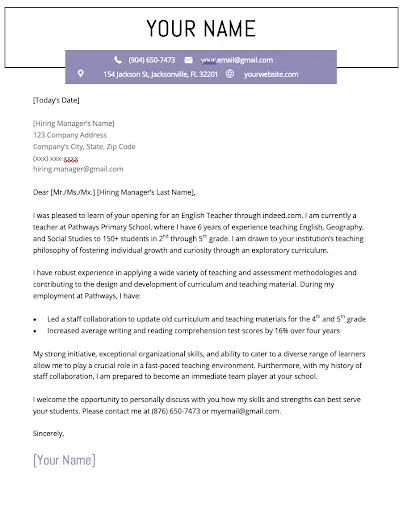
The way you structure your cover letter is crucial for making a strong impression. Follow a clear, logical format that’s easy to read and highlights your key qualifications. Start with a compelling opening that immediately grabs the reader’s attention. Then, in the body of your letter, emphasize your skills, experience, and achievements, using concrete examples to support your claims. Tailor the content to the specific job requirements and the school’s values. Keep your letter concise, ideally one page long. Ensure your paragraphs are well-organized and easy to follow. Use headings and bullet points to break up large blocks of text and highlight key information. Close with a strong call to action, reiterating your interest in the position and expressing your enthusiasm for the opportunity to interview. Proofread carefully before sending your letter to ensure there are no grammatical errors or typos.
Example 1 Elementary Teacher

Dear [Hiring Manager Name],
I am writing to express my enthusiastic interest in the Elementary Teacher position at [School Name], as advertised on [Platform]. With five years of experience creating engaging and supportive learning environments for young learners, I am confident I can significantly contribute to your school’s mission. In my previous role at [Previous School], I increased student reading comprehension scores by 18% within one year by implementing a differentiated reading program. I am passionate about fostering a love of learning in young children, and I’m adept at incorporating innovative strategies. I am eager to bring my creativity and dedication to [School Name].
Sincerely, [Your Name]
Example 2 High School Teacher
Dear [Hiring Manager Name],
I am writing to express my interest in the High School Teacher position at [School Name], as advertised on [Platform]. With eight years of experience teaching English literature and developing students’ critical thinking abilities, I am confident I can contribute to [School Name]’s academic excellence. In my role at [Previous School], I spearheaded a collaborative project, resulting in a 20% increase in student participation. I am enthusiastic about creating a challenging and supportive learning environment. I am eager to join [School Name] and bring my skills and enthusiasm to the students.
Sincerely, [Your Name]
Example 3 Special Education Teacher
Dear [Hiring Manager Name],
I am writing to express my keen interest in the Special Education Teacher position at [School Name], as advertised on [Platform]. With my dedicated experience in special education, I am confident in my ability to contribute to the well-being and academic advancement of students with diverse needs. At [Previous School], I developed and implemented individualized education plans (IEPs) for over 20 students, leading to improved academic outcomes and enhanced social-emotional development. I am passionate about advocating for students and ensuring they reach their full potential. I am excited to bring my experience and dedication to the team.
Sincerely, [Your Name]
Example 4 Substitute Teacher

Dear [Hiring Manager Name],
I am writing to express my interest in the Substitute Teacher position at [School Name], as advertised on [Platform]. I am a certified teacher eager to support the school’s educational goals. With experience in various grade levels and subjects, I am well-equipped to seamlessly step in and maintain the continuity of instruction. I have experience managing diverse classrooms and maintaining a positive learning atmosphere. I am adept at quickly building rapport with students and implementing lesson plans. I am excited to join [School Name] to make a positive impact on the student’s learning. I am available starting [date].
Sincerely, [Your Name]
Example 5 Teacher with Experience
Dear [Hiring Manager Name],
I am writing to express my interest in the Teacher position at [School Name], as advertised on [Platform]. I am an experienced and enthusiastic educator. I have a proven track record of improving student outcomes and creating engaging learning environments. I am proficient in curriculum development, classroom management, and differentiated instruction. I am eager to share my knowledge and skills with the students. I have been a lead teacher for 10 years, and I have a master’s degree in education. I am looking forward to interviewing for the position.
Sincerely, [Your Name]
Essential Tips for Your Cover Letter
Proofreading and Editing

Before submitting your cover letter, take the time to proofread and edit it carefully. Typos, grammatical errors, and awkward phrasing can undermine your credibility and leave a negative impression on the hiring committee. Read through your letter multiple times, and ask a friend, colleague, or career counselor to review it as well. Pay close attention to spelling, grammar, punctuation, and sentence structure. Ensure that your letter is clear, concise, and easy to read. A polished, error-free cover letter demonstrates your attention to detail and your commitment to excellence.
Formatting Your Letter
Proper formatting is key to presenting your cover letter in a professional and visually appealing way. Use a standard font such as Times New Roman or Arial, with a font size of 11 or 12 points. Maintain consistent spacing throughout your letter, and use clear headings and subheadings to break up the text. Ensure that your letter is well-organized and easy to follow. Left-justify your text, and use a business letter format with your contact information at the top, the date, the hiring manager’s information, and a formal salutation (e.g., ‘Dear Mr./Ms. [Last Name]’). Keep your letter concise, ideally one page long. Ensure your letter is visually appealing, and you can do this by using a good font, adding headings, and leaving white space. Make your cover letter look professional, and easy to read. This will show that you are professional and care about details.
Following Up After Submission
After submitting your cover letter and resume, follow up with the hiring manager to express your continued interest and inquire about the status of your application. A polite and timely follow-up demonstrates your enthusiasm and your commitment to the position. You can send a brief email or make a phone call a week or two after the application deadline. In your follow-up, briefly reiterate your interest in the position and mention a specific skill or experience that makes you a strong candidate. Thank the hiring manager for their time and consideration, and inquire about the next steps in the hiring process. A well-timed follow-up can help you stay top-of-mind and increase your chances of getting an interview. However, avoid being overly persistent. A single, polite follow-up is usually sufficient.
Key Takeaways

A well-crafted cover letter is an essential tool in your job search. By focusing on your skills, quantifying your achievements, tailoring your letter to each school, and expressing your passion for education, you can create a cover letter that stands out. Remember to highlight your skills and experience, quantify your achievements, demonstrate your classroom management, and showcase your passion. Follow the formatting tips and proofread carefully. Always tailor your letter to the school and role. Use these strategies to create a compelling cover letter and increase your chances of landing an interview. Your cover letter should be a reflection of your best self, so always make sure it is accurate. If you take the time to make a good cover letter, it will show in the end.