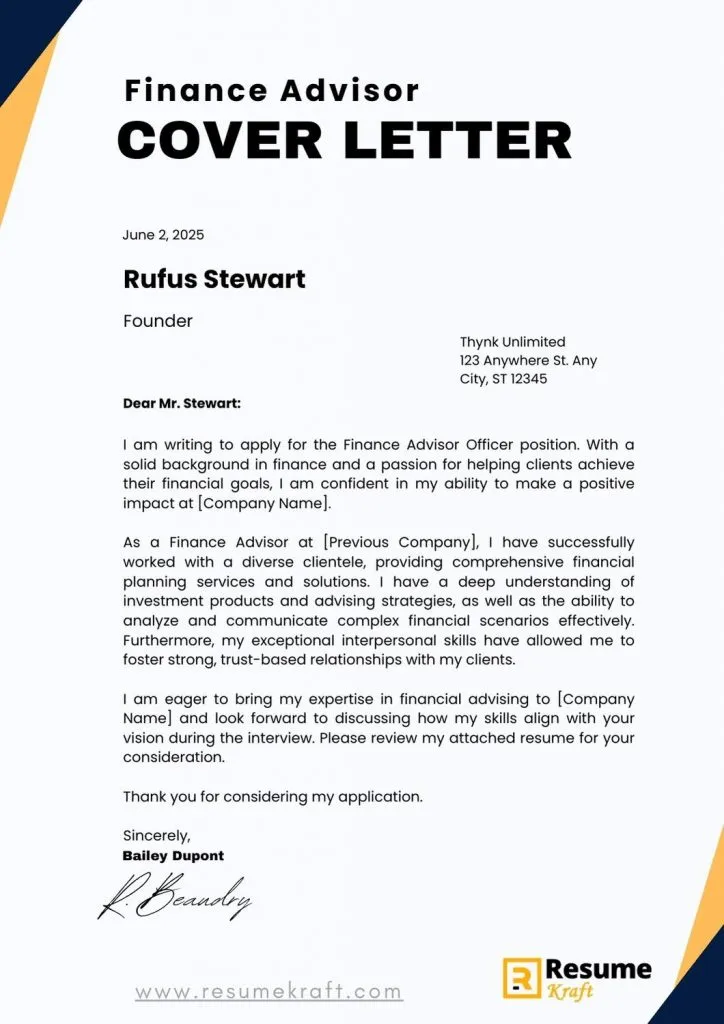
Why a Strong Cover Letter Matters for Financial Advisors
In the competitive world of financial advising, a well-crafted cover letter is your first opportunity to make a lasting impression. It’s not merely a formality; it’s a crucial tool that can significantly increase your chances of landing an interview. Unlike a resume, which provides a snapshot of your experience, a cover letter allows you to tell a compelling story, highlighting your unique value proposition and demonstrating why you are the perfect fit for the role. A strong cover letter showcases your personality, communication skills, and genuine interest in the position. It helps you differentiate yourself from other candidates and gives the hiring manager a reason to delve deeper into your qualifications. A cover letter that resonates with the reader can transform your application from ordinary to exceptional, ultimately paving the way for your success in the financial advising field.
Highlighting Your Expertise
Your cover letter is the ideal place to showcase your specific expertise in financial advising. This means going beyond a list of your qualifications and instead, articulating how your skills align with the needs of the employer and the expectations of the role. Begin by clearly stating your area of specialization, whether it’s retirement planning, investment management, estate planning, or a combination of these. Describe your experience with different financial products and services, such as stocks, bonds, mutual funds, insurance, and annuities. Emphasize your ability to understand and interpret financial statements, analyze market trends, and develop comprehensive financial plans. Illustrate how you have consistently delivered value to clients by providing sound financial advice and achieving their financial goals. Remember to use concrete examples and quantifiable results to make your claims more persuasive and credible.
Quantify Your Achievements

One of the most effective ways to impress a potential employer is to quantify your achievements. Rather than simply stating that you have a proven track record, provide specific numbers that demonstrate your success. For example, instead of saying ‘Increased client assets,’ specify by what percentage, such as ‘Increased client assets under management by 30% within three years.’ Or, instead of stating you improved client satisfaction, state ‘Improved client satisfaction scores by 15%.’ Use numbers to illustrate your ability to generate revenue, reduce costs, or enhance operational efficiency. Providing concrete data adds credibility to your claims and allows the hiring manager to quickly grasp the impact of your contributions. Make sure that the numbers you provide are relevant to the job requirements and highlight your most impressive accomplishments. By quantifying your achievements, you demonstrate your ability to deliver results and provide tangible value to the company.
Showcase Your Certifications
Financial advising is a field where credentials and certifications are paramount, so be sure to prominently showcase any relevant certifications in your cover letter. Include certifications such as Certified Financial Planner (CFP), Chartered Financial Analyst (CFA), or Chartered Financial Consultant (ChFC). These credentials demonstrate that you have met specific educational, experience, and ethical requirements and can inspire client confidence. Make sure to mention the issuing organization or institution for each certification. Briefly explain what each certification entails and how it benefits clients. For example, the CFP certification signifies your commitment to upholding the highest standards of financial planning ethics. You can also provide the year the certification was obtained, which helps demonstrate you are up-to-date with industry standards. If you are in the process of obtaining a certification, mention the expected completion date.
Tailoring Your Cover Letter to the Job
Generic cover letters rarely make a positive impact, so it’s important to tailor each letter to the specific job and company you are applying to. This shows the hiring manager that you have taken the time to understand the company’s needs and that you genuinely want to work for them. Start by thoroughly researching the company and the role. Then, carefully analyze the job description, identifying the key skills, qualifications, and experience the employer is seeking. Use this information to customize your cover letter. Highlight the skills and experiences that are most relevant to the job requirements and provide examples that demonstrate your ability to meet the employer’s expectations. Explain why you are interested in the specific company and how your values align with theirs. Also, consider addressing any specific challenges or goals the company has mentioned in its mission statement or recent announcements and explain how you can help them achieve those goals.
Researching the Company

Before you start writing your cover letter, dedicate time to researching the company. Visit their website, read their mission statement, and explore their social media profiles. Find out about their recent news, financial performance, and company culture. This research will help you understand the company’s values, goals, and priorities. Pay attention to the language used in the company’s communications. Consider the company’s clients or target market. This research will inform the language and tone of your cover letter. Use the company’s name and the names of key people, such as the hiring manager, in your cover letter. If possible, mention specific projects, initiatives, or accomplishments of the company that resonate with you. Tailoring your cover letter in this way shows the hiring manager that you are genuinely interested in the company and have invested time in understanding their business.
Customizing Your Skills Section
One of the most impactful ways to customize your cover letter is to tailor the skills section. Review the job description carefully and identify the skills that the employer is looking for. These might include technical skills, such as financial modeling and portfolio management, and soft skills, such as communication, problem-solving, and leadership. Once you have identified the key skills, customize your cover letter to emphasize those skills. Provide specific examples of how you have demonstrated these skills in previous roles. Describe the situations, actions, and results that showcase your abilities. Use keywords from the job description in your cover letter to help your application pass through applicant tracking systems (ATS). By customizing your skills section, you can demonstrate that you possess the skills and experience the employer is seeking and increase your chances of securing an interview.
Expressing Your Passion for Finance
Your cover letter is the perfect opportunity to express your passion for finance and the financial advising profession. Authenticity and enthusiasm can be contagious, and demonstrating these traits can set you apart from other candidates. Explain why you are drawn to the financial industry and what motivates you to work as a financial advisor. Share your interest in helping people achieve their financial goals and the satisfaction you derive from building strong client relationships. Mention any specific areas of finance that excite you, such as investment strategy or retirement planning. Show your commitment to staying up-to-date with industry trends and regulations. Let your personality shine through by using a confident and professional tone. This will give the hiring manager a glimpse of who you are and why you are passionate about the financial advising field.
Demonstrating Client-Focused Approach

Financial advising is fundamentally a client-centric profession, so it’s essential to demonstrate your client-focused approach in your cover letter. This includes highlighting your commitment to putting the client’s needs first and your ability to build strong, long-lasting relationships. Provide examples of how you have successfully worked with clients to understand their financial goals, assess their risk tolerance, and develop tailored financial plans. Describe your experience in providing ongoing support, monitoring their portfolios, and making necessary adjustments to help them achieve their objectives. Mention your ability to communicate complex financial information in a clear, concise, and easy-to-understand manner. Also, emphasize your commitment to ethical practices and your dedication to acting in the best interest of your clients. A client-focused approach shows you possess the interpersonal skills, empathy, and dedication required to be a successful financial advisor.
Highlighting Your Communication Skills
Effective communication is a cornerstone of success in financial advising. Your cover letter provides a platform to showcase these skills. Financial advisors must explain complex financial concepts clearly, actively listen to clients’ concerns, and build trust through open and honest dialogue. Begin by ensuring your cover letter is well-written, grammatically correct, and easy to read. Use clear and concise language, avoiding jargon unless necessary. Provide examples of how you have successfully communicated with clients in the past. Mention your experience in delivering presentations, explaining financial plans, and providing personalized advice. Highlight your ability to actively listen and respond to clients’ questions and concerns. Show that you are adaptable in your communication style, adjusting your approach to suit different clients and their specific needs. By demonstrating your communication skills in your cover letter, you will highlight your ability to build rapport and guide clients toward their financial goals.
Cover Letter Formatting Best Practices
The format of your cover letter can significantly impact its readability and professionalism. A well-formatted cover letter is easy to scan and helps the hiring manager quickly grasp the key points. Use a professional font, such as Times New Roman, Arial, or Calibri, with a font size between 10 and 12 points. The document should be single-spaced with one-inch margins. Start with a clear heading that includes your contact information, the date, and the recipient’s information. The letter should be well-structured, with clear paragraphs and headings to break up the text. Avoid long, dense blocks of text; instead, use shorter paragraphs to keep the reader engaged. Use bullet points to list key skills or achievements. Proofread the letter carefully to catch any typos or grammatical errors. Finally, save your cover letter as a PDF to ensure that the formatting is consistent across different devices.
Keep it Concise and Clear

Hiring managers often have limited time to review applications. Therefore, it’s crucial to keep your cover letter concise and clear. Aim for a cover letter that is no more than one page long. Focus on conveying your most relevant qualifications and experience. Avoid unnecessary details or information. Every sentence should serve a purpose, highlighting a key point or demonstrating your suitability for the role. Avoid using overly complex language or jargon. Instead, use simple, direct language that is easy to understand. Make sure that each paragraph has a clear topic sentence that summarizes the main point. Keep the sentences and paragraphs short and to the point. A concise and clear cover letter demonstrates your respect for the hiring manager’s time and your ability to communicate effectively.
Proofreading and Editing
Proofreading and editing are essential steps in the cover letter writing process. Typos, grammatical errors, and formatting mistakes can undermine your credibility and leave a negative impression on the hiring manager. Proofread your cover letter multiple times, paying close attention to spelling, grammar, punctuation, and sentence structure. Read the letter aloud to catch any awkward phrasing or unclear sentences. It can also be helpful to have someone else review your cover letter. A fresh pair of eyes can often identify errors that you might have missed. Make sure that the letter is consistent in terms of font, spacing, and formatting. Remember to proofread both the body of the letter and the contact information, as errors in these areas can be particularly detrimental. The quality of your cover letter reflects your attention to detail and your professionalism, so be sure to put in the necessary time and effort to ensure it is error-free.
Call to Action
Your cover letter should end with a clear call to action, telling the hiring manager what you want them to do next. Express your interest in an interview and make it easy for them to take the next step. State that you are available at their earliest convenience for an interview and provide your contact information. Thank the hiring manager for their time and consideration, expressing your enthusiasm for the opportunity. If you know the hiring manager’s name, address them directly in your call to action. Customize your call to action to match the specific job requirements and company culture. If you mention you’ve attached your resume, make sure to have it attached when sending. A clear and direct call to action will prompt the hiring manager to respond and increases your chances of moving forward in the hiring process.
Requesting an Interview

The primary goal of your cover letter is to secure an interview, so make sure to explicitly request one. Express your strong interest in the position and your desire to discuss your qualifications further. State that you are available for an interview at their earliest convenience and provide your contact information, including your phone number and email address. You can also offer to provide any additional information or references they may require. Customize your request to match the tone of the company. For example, in a more formal setting, you might say, ‘I would welcome the opportunity to discuss my qualifications in an interview.’ In a more informal environment, you might say, ‘I am eager to learn more about this opportunity and would be thrilled to schedule a meeting.’ A well-crafted request for an interview demonstrates your initiative and eagerness to move forward in the hiring process.