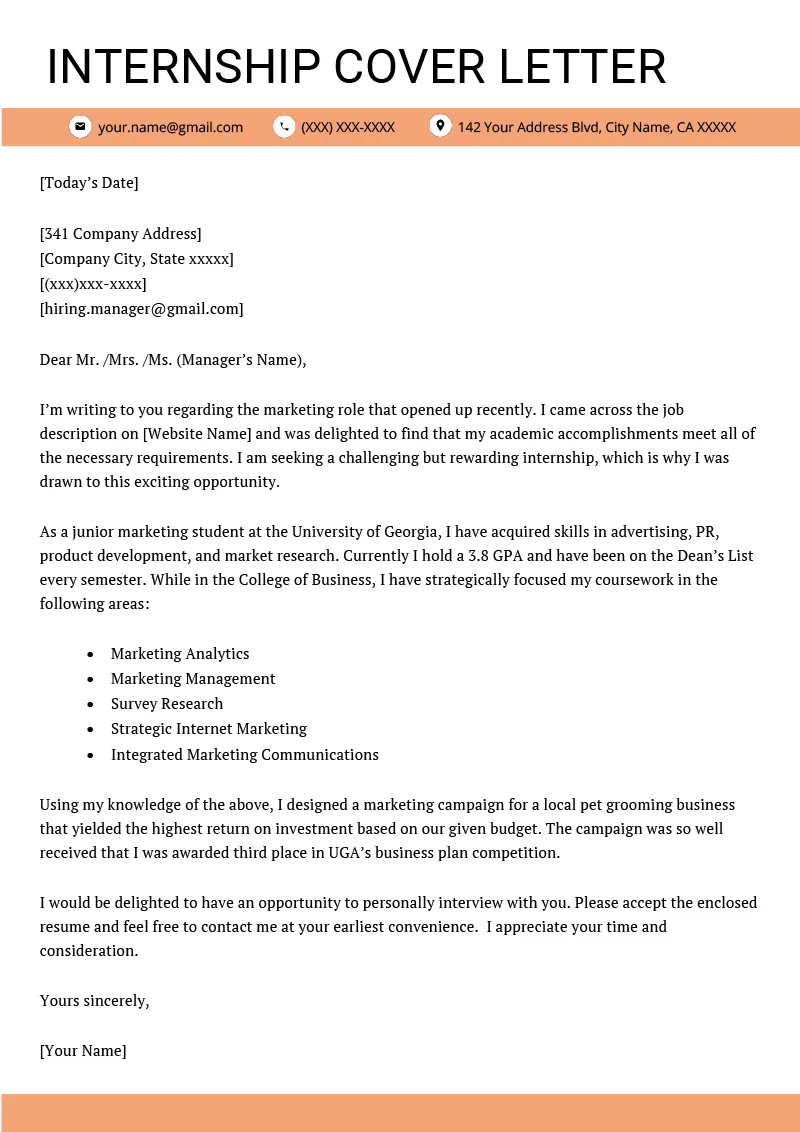
Crafting a Compelling Internship Cover Letter
A well-written cover letter is your first opportunity to impress potential employers and secure an internship. It’s a crucial document that complements your resume and provides a narrative showcasing your qualifications, enthusiasm, and suitability for the role. The goal isn’t just to list your skills but to tell a story that captures the hiring manager’s attention and makes them want to learn more about you. By taking the time to craft a compelling cover letter, you significantly increase your chances of landing an interview and ultimately, the internship of your dreams.
Understanding the Purpose of a Cover Letter
The primary purpose of a cover letter is to introduce you to the hiring manager and express your interest in a specific internship opportunity. It’s a chance to go beyond the basic information provided in your resume and demonstrate your personality, communication skills, and genuine enthusiasm for the company and the role. Think of it as your personal sales pitch, designed to convince the reader that you’re the perfect fit for the internship. A strong cover letter helps you stand out from the crowd of applicants.
Why a Cover Letter Matters for Internships

Even in today’s digital age, a cover letter remains a vital part of any internship application. It gives you the opportunity to address specific requirements, explain any gaps in your experience, and elaborate on your relevant skills and experiences in a way your resume cannot. For internships, where competition is often fierce, a well-crafted cover letter can make all the difference. It allows you to demonstrate your understanding of the role, showcase your initiative, and convey your genuine interest in the company. Many employers use cover letters to assess your writing skills, attention to detail, and overall professionalism.
Essential Components of an Internship Cover Letter
Contact Information and Header
Begin your cover letter with a professional header that includes your full name, contact information (phone number and email address), and the date. If you know the hiring manager’s name, include their name and title, along with the company’s address. Ensure your contact information is accurate and up-to-date, as this is how the company will reach you if they’re interested in your application. Use a professional email address.
The Introductory Paragraph

The introductory paragraph sets the tone for your cover letter. Start by clearly stating the position you are applying for, where you saw the advertisement (e.g., company website, university career portal), and a brief statement of your interest. Briefly mention why you’re excited about the opportunity and what sparked your interest in the company. This is your first chance to capture the reader’s attention, so make it compelling and concise. Show enthusiasm and a genuine interest in the internship.
Highlighting Relevant Skills and Experiences
This is where you demonstrate how your skills and experiences align with the internship requirements. Review the job description carefully and identify the key skills and qualifications the company is seeking. Then, provide specific examples from your coursework, projects, volunteer work, or previous internships to illustrate how you’ve developed and applied those skills. Quantify your achievements whenever possible to showcase the impact of your work. Tailor this section to each internship application, highlighting the most relevant experiences.
Showcasing Your Enthusiasm and Interest
Express your genuine interest in the company and the specific internship. Research the company’s mission, values, and recent projects to demonstrate your knowledge and understanding of their work. Explain why you’re particularly drawn to the company and the internship role. Highlight what excites you about the opportunity and how it aligns with your career goals. This shows the hiring manager that you’re not just looking for any internship but are genuinely interested in contributing to their organization. Personalize your letter; generic cover letters are easily spotted.
Closing Paragraph and Call to Action

In the closing paragraph, reiterate your interest in the internship and thank the hiring manager for their time and consideration. Express your eagerness to hear from them soon and mention your availability for an interview. End with a professional closing, such as “Sincerely” or “Best regards”, followed by your full name. A clear call to action ensures that the hiring manager knows what you want and what the next steps are.
Formatting and Presentation Tips
Font and Readability
Choose a professional and easy-to-read font, such as Times New Roman, Arial, or Calibri, with a font size between 11 and 12 points. Ensure your text is well-spaced with consistent margins (typically 1 inch on all sides) to create a clean and organized appearance. Avoid using overly stylized or decorative fonts, as they can distract from the content of your letter. Use bolding and italics sparingly, and only to emphasize key points.
Length and Structure

Keep your cover letter concise and focused, ideally within one page. Use a clear and logical structure, with well-defined paragraphs and headings to guide the reader. Each paragraph should focus on a specific point, and the language should be clear, concise, and easy to understand. Avoid long, rambling sentences or paragraphs; aim for brevity and directness. Ensure your writing flows smoothly from one point to the next.
Proofreading and Editing
Proofread your cover letter meticulously for any grammatical errors, spelling mistakes, or typos. These errors can create a negative impression and suggest a lack of attention to detail. Read the letter aloud to catch any awkward phrasing or sentence structures. Ask a friend, family member, or career advisor to review your cover letter for feedback before submitting it. Ensure consistency in formatting, such as font styles, spacing, and punctuation, throughout the document.
Tailoring Your Cover Letter
Researching the Company and Role

Before writing your cover letter, thoroughly research the company and the specific internship position. Visit the company’s website, read news articles about them, and explore their social media profiles to gain insights into their culture, values, and recent projects. Understand the responsibilities and requirements of the role to tailor your letter accordingly. This will enable you to highlight the skills and experiences most relevant to the position and demonstrate your genuine interest in the company.
Using Keywords Effectively
Carefully review the job description and identify the key skills and keywords used by the company. Integrate these keywords naturally throughout your cover letter to demonstrate your understanding of the role and how your qualifications align with the requirements. However, avoid keyword stuffing. Instead, weave the keywords seamlessly into your sentences, focusing on how you’ve demonstrated those skills in your previous experiences and projects. This ensures your letter resonates with the hiring manager.
Examples of Strong Internship Cover Letters
Cover Letter Example 1

Dear [Hiring Manager Name], I am writing to express my enthusiastic interest in the Marketing Intern position at [Company Name], as advertised on [Platform]. With a strong foundation in marketing principles and a passion for [Industry/Field], I am confident in my ability to contribute to your team’s success. During my studies at [University Name], I developed expertise in [Skill 1], [Skill 2], and [Skill 3], successfully leading [Project/Initiative] which resulted in [Quantifiable Achievement]. I am particularly drawn to [Company Name]’s commitment to [Company Value] and believe my skills and enthusiasm align perfectly with your company’s mission. Thank you for your time and consideration. I look forward to the opportunity to discuss my qualifications further. Sincerely, [Your Name]
Cover Letter Example 2
Dear [Hiring Manager Name], I am writing to express my interest in the Software Engineering Internship at [Company Name], as I saw advertised on [Platform]. As a highly motivated [Year]-year student pursuing a degree in Computer Science at [University Name], I am eager to apply my technical skills and contribute to your innovative projects. I have a strong background in [Programming Language 1], [Programming Language 2], and [Technology], where I was able to build [Project/Initiative] resulting in [Quantifiable Achievement]. I am excited about the chance to contribute to the groundbreaking work being done at [Company Name] in [Specific area]. Thank you for your time and consideration. I can be reached at [Your Phone Number] or [Your Email Address]. Sincerely, [Your Name]
Common Mistakes to Avoid
Avoid generic cover letters. Tailor your letter to each specific internship opportunity and company. Do not simply repeat information from your resume; use the cover letter to provide additional context and showcase your personality. Don’t use jargon or overly complex language. Keep it concise and to the point, avoiding lengthy paragraphs. Never include lies or exaggerations; always be truthful about your skills and experiences. Avoid typos, grammatical errors, and unprofessional formatting. Always proofread and edit your cover letter thoroughly before submitting it. Do not forget to include a call to action.