Why a Cover Letter Matters
In today’s competitive job market, a compelling cover letter can be the key that unlocks your dream job. Far from being a mere formality, a well-crafted cover letter provides you with an invaluable opportunity to introduce yourself to a potential employer, showcase your unique skills and experiences, and demonstrate your genuine interest in the specific role. It’s your chance to go beyond the often-stark details of your resume and inject your personality and passion into your application, making you stand out from the sea of other applicants. By taking the time to write a personalized cover letter, you signal to the hiring manager that you’re not just sending out generic applications, but that you’ve carefully considered the position and are genuinely excited about the prospect of joining their team. In essence, it’s your first impression and a crucial step toward securing an interview.
Your Cover Letter’s Purpose
The primary purpose of a cover letter is to persuade the hiring manager to read your resume and consider you for an interview. It serves as your personalized marketing document, allowing you to highlight the aspects of your experience and skills most relevant to the job description. The letter should articulate your understanding of the company’s needs and how your qualifications align with those needs. It also offers you a platform to explain any gaps in your resume, such as career transitions or periods of unemployment, ensuring that the employer has a complete picture of your professional journey. By clearly articulating your value proposition, you increase your chances of being selected for the next stage of the hiring process.
Showcase Your Value

Your cover letter is a prime opportunity to showcase your unique value proposition. Instead of simply restating your resume, focus on how your skills and experiences directly benefit the company and the specific role. Start by identifying the key requirements and responsibilities outlined in the job description. Then, select the accomplishments, projects, and experiences that best demonstrate your ability to meet those requirements. Whenever possible, quantify your achievements with data and metrics to provide tangible evidence of your impact. For instance, instead of saying “Improved customer satisfaction,” state “Increased customer satisfaction by 15% through implementing a new feedback system.” This approach allows the hiring manager to quickly understand your potential contributions and how you can add value to their team.
7 Secrets to a Successful Cover Letter
Highlight Your Skills
While your resume details your skills, the cover letter is where you bring them to life. Don’t just list your skills; provide examples of how you’ve used them successfully. If the job description emphasizes communication skills, describe a situation where you effectively communicated with a team, a client, or a stakeholder to achieve a specific goal. Similarly, if the role requires problem-solving abilities, share a challenging situation you faced, the steps you took to solve it, and the positive outcome. By providing concrete examples, you demonstrate your practical skills and provide the employer with a clearer understanding of your capabilities.
Tailor It to the Job

Generic cover letters are easily spotted and often disregarded. To create a winning cover letter, customize it for each job you apply for. Review the job description carefully and identify the keywords, skills, and experiences the employer is seeking. Then, tailor your letter to address these specific requirements. Highlight the experiences and accomplishments that directly align with the job’s needs. Research the company to show your understanding of its mission, values, and culture. Referencing the company and the specific job demonstrates your genuine interest and helps you stand out from applicants who are using a one-size-fits-all approach.
Quantify Your Achievements
Whenever possible, use numbers and data to quantify your achievements. Instead of vague statements like “Improved sales,” provide specific metrics such as “Increased sales by 20% in one quarter.” Quantifying your accomplishments adds credibility to your claims and allows the hiring manager to understand the tangible impact you’ve made in past roles. Use percentages, dollar amounts, timeframes, and other relevant metrics to paint a clear picture of your successes. This approach not only strengthens your cover letter but also makes you appear more results-oriented and data-driven, which are highly valued qualities in most professional settings.
Use Keywords
Many companies use Applicant Tracking Systems (ATS) to scan resumes and cover letters for relevant keywords. To ensure your application gets noticed, incorporate keywords from the job description into your cover letter. Review the job posting and identify the key skills, qualifications, and requirements. Then, naturally weave these keywords into your writing. Don’t stuff your cover letter with keywords; instead, use them strategically within the context of your accomplishments and experiences. This will help your application pass the ATS screening and increase the likelihood that a human will review your application.
Proofread Meticulously

Typos and grammatical errors can immediately undermine your credibility. Before submitting your cover letter, proofread it carefully multiple times. Check for spelling mistakes, grammatical errors, punctuation errors, and inconsistencies in formatting. Consider using a grammar checker tool, but always review the results yourself. It’s also beneficial to have a trusted friend or colleague review your cover letter for any errors you might have missed. A polished, error-free cover letter demonstrates your attention to detail and professionalism, leaving a positive impression on the hiring manager.
Follow Formatting Guidelines
Adhere to standard cover letter formatting guidelines to make your letter easy to read and visually appealing. Use a professional font, such as Arial or Times New Roman, in a readable size (11 or 12 points). Maintain consistent formatting throughout your letter, including spacing, margins, and paragraph alignment. Keep your letter concise, ideally no more than one page. Use clear headings and bullet points to break up large blocks of text. Proper formatting shows that you are organized and pays attention to detail, which are valuable qualities in the workplace.
End With a Strong Call to Action
Conclude your cover letter with a strong call to action. Clearly state your interest in the position and your desire to move forward in the hiring process. Express your enthusiasm for the opportunity and reiterate your relevant skills and experiences. Include a polite but firm request for an interview, such as, “I am eager to learn more about this opportunity and discuss how my skills and experience align with your needs. I am available for an interview at your earliest convenience.” Make sure to thank the hiring manager for their time and consideration, and include your contact information.
Cover Letter Structure

Header
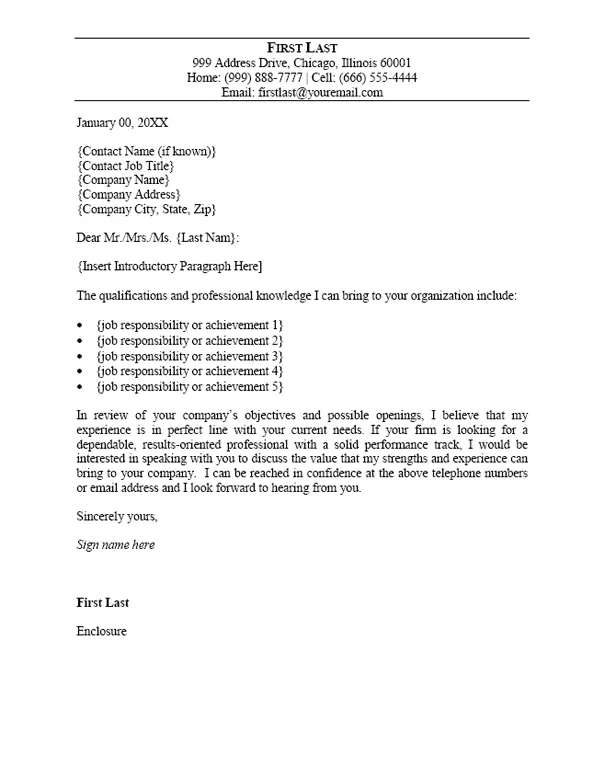
The header of your cover letter should include your full name, contact information (phone number, email address, and optionally, your LinkedIn profile URL). It should also include the date and the hiring manager’s name and title (if known), along with the company’s address. Ensure your contact information is accurate and up-to-date.
Greeting
Address the hiring manager by name, if possible. Research the company’s website or LinkedIn to find the hiring manager’s name. If you can’t find a specific name, use a professional salutation such as “Dear Hiring Manager” or “Dear [Department Name] Team.” Avoid generic greetings like “To Whom It May Concern” as they can appear impersonal.
Body Paragraphs

The body of your cover letter is where you highlight your relevant skills, experiences, and accomplishments. Start with an engaging opening paragraph that states your interest in the position and mentions where you found the job posting. Use the subsequent paragraphs to showcase your qualifications and explain why you are the best fit for the role. Focus on the company’s needs and illustrate how your skills can address those needs. Keep the tone professional and enthusiastic, and use clear, concise language.
Closing
Conclude your cover letter with a strong closing paragraph. Restate your interest in the position and express your desire for an interview. Include a call to action, such as, “I am available for an interview at your earliest convenience.” Thank the hiring manager for their time and consideration, and end with a professional closing, such as “Sincerely” or “Best regards.”
Cover Letter Final Tips
Format for Success

Choose a professional and easy-to-read font (e.g., Arial, Calibri, or Times New Roman). Keep the font size between 10 and 12 points. Maintain consistent formatting throughout your cover letter, including margins (typically 1 inch on all sides), spacing (single-spaced within paragraphs and double-spaced between paragraphs), and alignment (left-aligned is standard). Use a clear, concise writing style, and avoid overly complex sentences or jargon. Ensure your cover letter is well-organized, with clear headings and paragraphs, to make it easy for the hiring manager to scan and read. Use bullet points for lists to highlight key accomplishments and skills.
Proofreading Best Practices
Thoroughly proofread your cover letter before submitting it. Check for spelling errors, grammatical mistakes, punctuation errors, and typos. Read your letter aloud to catch any awkward phrasing or inconsistencies. Ask a friend, family member, or career advisor to review your cover letter for clarity and accuracy. Consider using online grammar and spell-checking tools, but always review the results carefully. Pay attention to the tone of your cover letter, making sure it is professional and appropriate for the target audience.