Why a Great Cover Letter Matters for Manager Jobs
In the competitive landscape of managerial positions, a well-crafted cover letter serves as your first impression, often determining whether your application even gets a second look. Unlike resumes, which provide a factual overview, a cover letter allows you to inject personality, passion, and a clear demonstration of how your skills align with the specific requirements of the role. For manager jobs, where leadership, strategic thinking, and communication are paramount, the cover letter becomes even more critical. It provides the space to articulate your management philosophy, showcase your leadership style, and demonstrate how your experience uniquely positions you to succeed. A strong cover letter immediately sets you apart from other applicants by highlighting your understanding of the company’s needs and your commitment to contributing to its success. This document is your opportunity to persuade the hiring manager that you are not just qualified but the ideal candidate.
Key Components of a Compelling Cover Letter
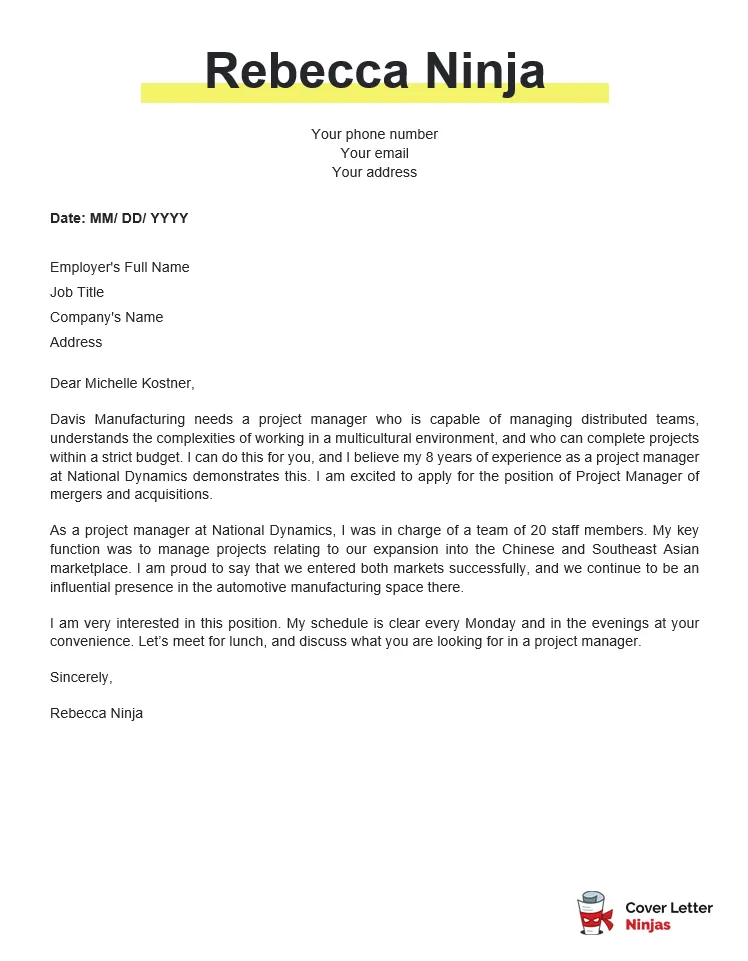
A compelling cover letter for a manager job should go beyond simply restating your resume. It must be a persuasive narrative that captures the hiring manager’s attention from the very first sentence. Begin with a strong opening that immediately grabs the reader’s interest, perhaps by referencing a specific achievement, a company value, or a recent company initiative. Next, clearly articulate the position you are applying for and why you are excited about the opportunity. The body of the letter should highlight key skills and experiences relevant to the manager role. These include leadership, team management, problem-solving, and strategic planning. Provide concrete examples of your accomplishments, quantifying your achievements whenever possible. Always tailor your letter to the specific job description and company culture. The closing should reaffirm your interest, reiterate your key qualifications, and include a clear call to action, such as expressing your eagerness for an interview. Proper formatting is essential, ensuring the letter is easy to read and visually appealing.
Highlighting Your Management Skills

When highlighting your management skills in a cover letter for a manager job, it is crucial to go beyond simply listing your abilities. Provide concrete examples and specific instances where you have successfully utilized these skills to achieve positive outcomes. For example, instead of stating ‘Managed a team,’ elaborate on the size of the team, the projects you oversaw, and the results you achieved. Emphasize skills such as delegation, conflict resolution, performance management, and the ability to motivate and inspire a team. Showcase your ability to create a positive and productive work environment, foster collaboration, and drive employee engagement. Use action verbs to describe your accomplishments, such as ’led,’ ‘managed,’ ‘oversaw,’ ‘implemented,’ and ‘achieved.’ Furthermore, demonstrate your understanding of the company’s management style and explain how your skills align with its values and goals. By providing detailed examples, you will effectively communicate the value you bring to the role.
Showcasing Leadership Experience
Leadership experience is at the heart of any manager role, and your cover letter should strongly emphasize this aspect. Provide specific examples of times you have taken initiative, made critical decisions, and guided a team toward a common goal. Describe situations where you had to navigate challenges, make tough choices, and take ownership of outcomes. Highlight your ability to inspire and motivate others, build consensus, and create a shared vision. Showcase any leadership training or certifications you have received, such as project management or leadership development programs. If you have experience in mentoring or coaching employees, be sure to include these details, as they demonstrate your commitment to developing talent within an organization. Use phrases like ‘spearheaded,’ ‘championed,’ or ‘drove’ to illustrate your leadership impact. Also, mention any instances where you successfully implemented new strategies or initiatives that significantly improved team performance or organizational results. Your goal is to show that you are not just a manager, but a leader capable of guiding a team to success.
Quantifying Achievements for Impact
One of the most effective ways to make your cover letter stand out is by quantifying your achievements. Instead of simply stating that you improved efficiency, provide specific metrics such as ‘increased efficiency by 15%,’ or ‘reduced operational costs by $50,000’. Use numbers to illustrate the impact of your contributions and make your accomplishments more tangible. For example, if you led a team to exceed sales targets, specify the percentage by which sales increased or the total revenue generated. If you implemented a new process that improved customer satisfaction, quantify the improvement using customer feedback scores or reduced complaint rates. By providing concrete data, you demonstrate your ability to deliver measurable results and prove the value you would bring to the company. This approach is particularly important in manager roles, where performance and results are critical. Quantifying your achievements will make your cover letter more compelling and show the hiring manager that you are a results-oriented leader.
Tailoring Your Cover Letter to the Job Description

A generic cover letter will not suffice for a manager job. Each cover letter should be meticulously tailored to the specific requirements and expectations outlined in the job description. Begin by carefully reviewing the job posting, highlighting key skills, experiences, and qualifications that the employer is seeking. Then, structure your cover letter to directly address these points. Use keywords from the job description throughout your letter to show that you understand the role’s demands. For example, if the job description emphasizes strategic planning, ensure your cover letter showcases your strategic thinking skills with relevant examples. If the posting requires experience with a particular software or methodology, explicitly mention your proficiency and provide instances where you have successfully used it. Tailoring your cover letter demonstrates your attention to detail and your commitment to the position. It tells the hiring manager that you have taken the time to understand their needs and are confident in your ability to meet them. Never submit a generic letter; always customize each application to maximize your chances of success.
Researching the Company Culture
Before writing your cover letter for a manager job, thorough research into the company’s culture is essential. This research will enable you to tailor your letter to align with the organization’s values, mission, and work environment. Visit the company website, read its ‘About Us’ section, and explore its social media profiles to understand its brand and culture. Look for details about its values, its leadership style, its commitment to employees, and any recent news or initiatives. If possible, research the hiring manager or other key people in the organization through LinkedIn or other professional platforms. Identify any common threads in the company’s communications, and use these insights to inform your tone, style, and content. Mentioning specific company values or initiatives in your cover letter will show that you are genuinely interested in the company and have taken the initiative to learn about its culture. This customized approach demonstrates your suitability for the role and your potential to thrive within the organization.
Demonstrating Your Value Proposition
Your cover letter should clearly and persuasively articulate your unique value proposition. This involves explaining what you can offer the company that other candidates cannot. Start by identifying your core strengths and the skills and experiences most relevant to the manager job you are applying for. Then, articulate how these strengths align with the specific needs and challenges of the role and the company. Highlight what sets you apart from other candidates, whether it’s your specific expertise, your innovative approach to problem-solving, or your proven ability to drive results. Provide concrete examples that demonstrate your capacity to contribute to the company’s success. For instance, if the company is focused on growth, explain how your experience in scaling teams or implementing new strategies can help them achieve their goals. If the company values innovation, share examples of creative solutions you have developed. Your value proposition should be clear, concise, and directly related to the employer’s needs. It is your opportunity to convince the hiring manager that you are the best candidate.
Formatting and Structure Best Practices

The formatting and structure of your cover letter are just as important as its content. A well-formatted letter is easy to read and visually appealing, while a poorly formatted one can quickly turn off a hiring manager. Begin with a professional heading that includes your contact information and the date. Address the hiring manager by name if possible, and if not, use a professional salutation such as ‘Dear Hiring Manager’. Use a clear and concise font, such as Arial or Times New Roman, in a readable size (11 or 12 points). Use standard margins (1 inch on all sides) and single-space the body of the letter. Break up large blocks of text into shorter paragraphs to improve readability. Use bullet points sparingly to highlight key accomplishments or skills. Ensure that the letter is well-organized, with a logical flow of information from the introduction to the conclusion. Proofread carefully for any errors in grammar or spelling. A clean, well-formatted cover letter shows attention to detail and professionalism, both of which are essential for a manager role. The structure should include an introduction, body paragraphs highlighting skills and experience, and a strong conclusion.
Choosing the Right Tone and Style
The tone and style of your cover letter should be professional yet engaging. The tone you adopt should be appropriate for the company culture and the manager role you are applying for. If the company culture is formal, maintain a more professional and reserved tone. If the company is known for its creativity or innovation, you may be able to adopt a slightly more informal and creative style, but always maintain a level of professionalism. Avoid slang, jargon, or overly casual language. Use strong action verbs to describe your accomplishments, such as ’led,’ ‘managed,’ ‘achieved,’ and ‘implemented’. Aim for a concise and direct style, avoiding overly lengthy sentences and paragraphs. Be enthusiastic about the opportunity, but avoid sounding overly desperate or boastful. The goal is to strike a balance between professionalism and personality, showing your enthusiasm for the role while demonstrating your skills and experience. Remember, your cover letter is a reflection of your communication skills, so ensure that it is clear, concise, and tailored to the specific opportunity.
Avoiding Common Cover Letter Mistakes
Avoiding common cover letter mistakes is crucial to ensure that your application stands out for the right reasons. One of the most frequent errors is submitting a generic cover letter that is not tailored to the specific job or company. Another mistake is making grammatical errors or typos, which can immediately undermine your credibility. Ensure that you have proofread your cover letter thoroughly. Including irrelevant information or overly long paragraphs can also detract from your message; keep your letter focused on the skills and experiences most relevant to the role. Failing to quantify your achievements is a common mistake; always try to provide specific metrics and data to support your claims. Avoid using clichés or overly generic phrases. Don’t make the cover letter about you alone, instead, also express how you can meet the needs of the company. Finally, neglecting a clear call to action or failing to include the hiring manager’s name can make your cover letter less effective. By avoiding these common mistakes, you significantly increase your chances of making a positive impression and securing an interview.
Proofreading and Editing Your Cover Letter

Proofreading and editing your cover letter is a critical step in the application process. Errors in grammar, spelling, or punctuation can create a negative impression and undermine your credibility, especially for a manager job where attention to detail is essential. After writing your cover letter, set it aside for a few hours or even a day, then review it with fresh eyes. Use a spell-checker and grammar-checker, but don’t rely on them entirely; they often miss subtle errors. Read your letter aloud to catch any awkward phrasing or sentence structure. Ask a trusted friend, colleague, or career advisor to review your cover letter as well. They can provide a fresh perspective and catch errors you might have missed. Pay close attention to the letter’s flow, ensuring it is logical and easy to understand. Verify that your contact information is correct and that the letter is formatted consistently. A polished, error-free cover letter demonstrates professionalism and shows the hiring manager that you take your application seriously. Thorough proofreading and editing significantly enhance your chances of success.
Call to Action in Your Cover Letter
A strong call to action is essential for closing your cover letter effectively. It should clearly state what you want the hiring manager to do next. Instead of simply ending your letter with a generic phrase like ‘Thank you for your time,’ express your enthusiasm for the opportunity and your interest in moving forward. For example, you could write ‘I am eager to discuss how my skills and experience can benefit your team and would welcome the opportunity to schedule an interview.’ Reiterate your key qualifications and express your confidence in your ability to meet the company’s needs. Make it easy for the hiring manager to contact you. Include your phone number and email address, and consider adding a link to your LinkedIn profile or online portfolio. A well-crafted call to action ensures that the hiring manager knows you are genuinely interested in the position and encourages them to take the next step in the hiring process. This is your last opportunity to leave a lasting positive impression.
Contact Information and Professional Presentation
Your contact information and professional presentation are fundamental elements of an effective cover letter. Include your full name, professional email address, and phone number at the top of the letter. Make sure your email address is professional; avoid using nicknames or informal addresses. Consider including a link to your LinkedIn profile or an online portfolio if it is relevant to the job. Choose a clean, easy-to-read font, such as Arial or Times New Roman, and use a font size between 11 and 12 points. Ensure consistent formatting throughout the letter, including margins, spacing, and paragraph alignment. Use a professional-looking letterhead, if appropriate. Proofread your contact information meticulously to ensure it is accurate and up-to-date. The overall presentation of your cover letter speaks volumes about your attention to detail and your professionalism. A well-formatted and neatly presented cover letter makes a positive impression and enhances the likelihood of your application being considered favorably. This is your final opportunity to showcase your professionalism before the hiring manager even reviews your qualifications.