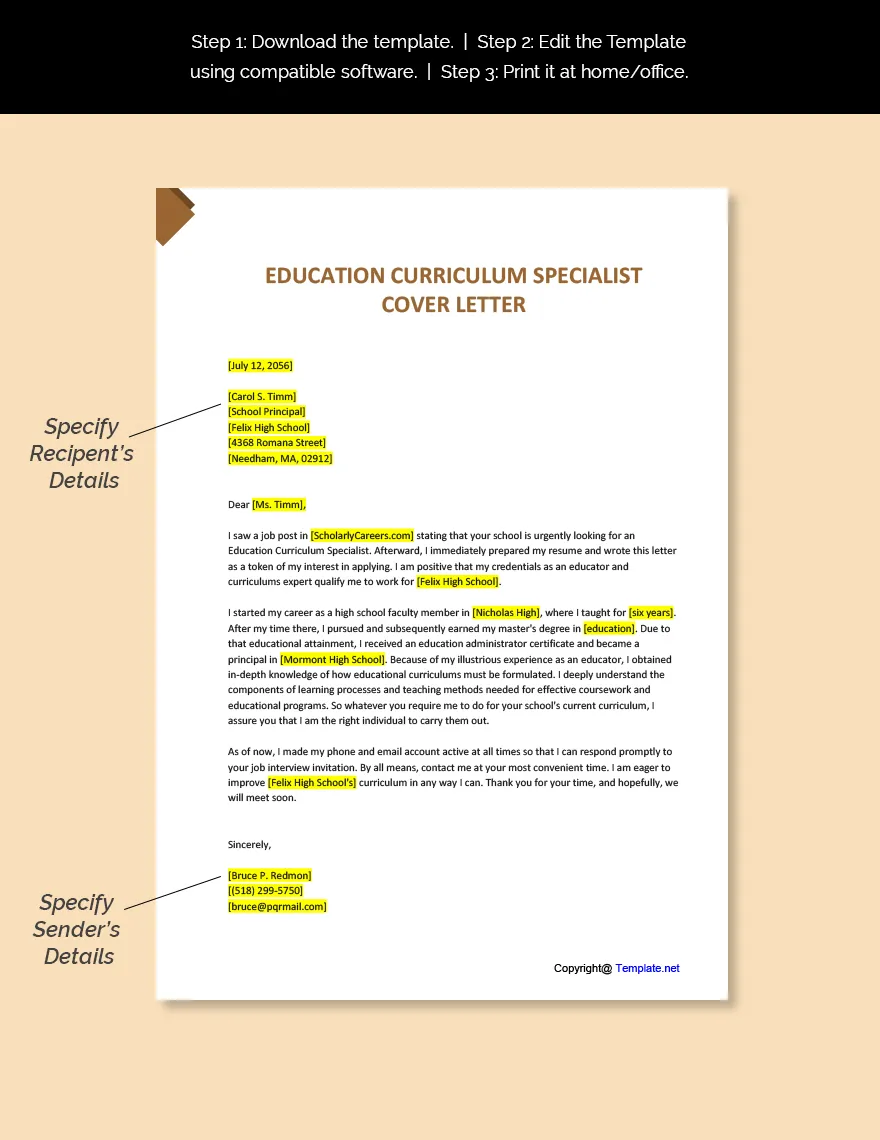
Crafting a Curriculum Specialist Cover Letter
A well-crafted cover letter is essential for any curriculum specialist seeking a new role. It provides an opportunity to showcase your skills, experience, and passion for education beyond what is captured in a resume. This guide will walk you through the essential steps to create a compelling cover letter that grabs the attention of hiring managers and increases your chances of landing an interview. Creating a cover letter is not just about listing qualifications, it is about telling your story and demonstrating how your skills align with the specific needs of the position and the school or district.
Understanding the Purpose of a Cover Letter
The primary purpose of a cover letter is to introduce yourself and express your interest in a specific job. It serves as a formal introduction and allows you to highlight the most relevant aspects of your background. Furthermore, it allows you to demonstrate your communication skills, writing ability, and enthusiasm for the role. A strong cover letter complements your resume, providing context and depth to your qualifications. It is a chance to connect with the hiring manager on a personal level and demonstrate how your skills and experiences align with the job description and the school’s mission.
Key Components of a Curriculum Specialist Cover Letter

A successful cover letter typically includes several key components that work together to create a persuasive and professional document. These elements guide the reader through your qualifications and make a positive impression. Every element is crucial to ensure your application receives the consideration it deserves. It is essential to understand the role of each element to craft an effective cover letter that effectively presents your qualifications.
Contact Information and Date
Begin your cover letter with your contact information, including your name, address, phone number, and email address. Place this information at the top left of the page. Then, on the right side, include the date you are submitting the application. This establishes a professional format and provides easy access to your contact details. Make sure the information is up-to-date and accurate, as this is the primary way a hiring manager can reach you for an interview.
Hiring Manager’s Information
If possible, address your cover letter to a specific person, such as the hiring manager or principal. Research the school or district to find out the correct name and title. If you cannot find a specific name, use a professional title like “Dear Hiring Committee.” Addressing the letter to a specific person demonstrates that you have taken the time to research the organization and shows a level of interest in the role. Using the correct name adds a personal touch that sets your letter apart.
Greeting the Hiring Manager

Start your cover letter with a professional greeting. Use “Dear Mr./Ms./Mx. [Last Name],” if you know the hiring manager’s name. If you don’t know the name, use a general greeting like “Dear Hiring Manager” or “To Whom It May Concern.” This sets the tone for the rest of your letter and shows respect. Always maintain a professional tone throughout your cover letter to show your respect for the position and the school district.
Writing a Compelling Opening Paragraph
Your opening paragraph should immediately capture the reader’s attention. State the position you are applying for and how you learned about it. Briefly mention your key qualifications or a compelling reason for your interest in the role or the school district. Clearly state your intent and enthusiasm, setting the stage for the rest of your letter. The goal is to make a strong first impression and encourage the reader to continue reading. The opening paragraph is vital for setting the tone and piquing the reader’s interest.
Highlighting Relevant Skills and Experience
The body of your cover letter is where you showcase your skills and experience. Review the job description and identify the key requirements. Then, provide specific examples from your previous roles that demonstrate how you have successfully used those skills. Use action verbs and quantifiable achievements to show your impact. Focus on experiences that align with the specific needs of the position and the organization. Tailor your examples to address the key requirements mentioned in the job description.
Showcasing Curriculum Development Expertise

As a curriculum specialist, your expertise in curriculum development is crucial. Highlight your experience in designing, implementing, and evaluating curriculum materials. Include examples of successful projects you have led or contributed to, emphasizing your ability to align curriculum with educational standards and student learning outcomes. Discuss your knowledge of instructional strategies, assessment methods, and any relevant technologies used in curriculum development. Focus on how your work has improved student achievement and enhanced the learning environment. Emphasize the successful development and implementation of curriculum materials.
Demonstrating Knowledge of Educational Standards
Demonstrate your understanding of educational standards, such as Common Core State Standards or other relevant frameworks. Explain how you have integrated these standards into curriculum development and instructional practices. Show your ability to analyze and interpret standards and translate them into effective learning experiences. Discuss your experience in aligning curriculum with these standards and ensuring that students are meeting or exceeding the expectations. It is important to showcase your knowledge to show your familiarity with current educational practices and policies.
Emphasizing Communication and Collaboration Skills
Highlight your communication and collaboration skills, which are essential for a curriculum specialist. Describe your experience working with teachers, administrators, and other stakeholders to implement curriculum changes and support student success. Provide examples of how you have facilitated professional development, led workshops, or communicated effectively with parents and the community. Demonstrate your ability to build strong relationships, foster teamwork, and communicate complex ideas clearly. It is important to demonstrate your ability to work collaboratively and build consensus.
Quantifying Achievements and Impact

Whenever possible, quantify your achievements. Use data and statistics to show the impact of your work. For example, mention how you improved student test scores, increased teacher engagement, or streamlined a curriculum development process. Provide specific numbers and percentages to demonstrate the results of your efforts. Quantifying your achievements provides concrete evidence of your value and demonstrates your ability to make a tangible difference. Always use metrics to make your claims more credible.
Structuring the Body of Your Cover Letter
Organize the body of your cover letter into well-defined paragraphs. Each paragraph should focus on a specific skill, experience, or achievement. Use clear topic sentences and concise language to convey your message effectively. Maintain a logical flow throughout the letter, connecting your ideas and creating a cohesive narrative. Consider using bullet points or short lists to highlight key accomplishments or skills. This enhances readability and makes it easier for the hiring manager to scan your qualifications. Ensure that the organization helps the reader understand your qualifications and capabilities easily.
Providing Specific Examples
Support your claims with specific examples. Instead of just stating that you are a good communicator, describe a time when you successfully facilitated a difficult conversation or resolved a conflict. Provide details about the situation, your actions, and the results. The more specific your examples, the more credible your claims. Your examples should be relevant to the job requirements and demonstrate your ability to apply your skills in real-world situations. Use the STAR method (Situation, Task, Action, Result) to structure your examples, to make them more impactful.
Tailoring Your Letter to the Job

Customize your cover letter for each job application. Do not send a generic letter. Review the job description carefully and identify the key skills, experiences, and qualifications the employer is seeking. Then, tailor your letter to highlight those specific areas. Use the same keywords and phrases from the job description. Demonstrating how your qualifications match the job requirements is essential for showing your interest in the position and your suitability for the role. Making sure your letter reflects what the employer needs will increase your chances of success.
Addressing the Job Requirements
Directly address each of the job requirements in your cover letter. Explain how your skills and experience align with each requirement, providing specific examples. Demonstrate that you have the necessary qualifications for the position. This shows the hiring manager that you have carefully considered the job and are a good fit. Be clear and concise in demonstrating how you meet the requirements. Make sure you cover all the critical requirements, from the list of job responsibilities to the required skills, in your letter.
Expressing Enthusiasm and Interest
Convey your enthusiasm and interest in the position and the organization. Show that you are excited about the opportunity and eager to contribute to the school’s or district’s mission. Demonstrate your knowledge of the organization and its values. Explain why you are interested in working there and how you believe you can make a positive impact. Your enthusiasm can make your letter more memorable and show the hiring manager that you are a good fit for the school’s culture. Genuine enthusiasm can set you apart from other candidates.
Writing a Strong Closing Paragraph

Your closing paragraph should reiterate your interest in the position and thank the hiring manager for their time and consideration. Express your eagerness to learn more about the opportunity and discuss your qualifications in an interview. Provide clear contact information and indicate your availability for an interview. End with a professional closing, such as “Sincerely” or “Best regards.” The closing paragraph leaves a lasting impression, so make it concise, professional, and impactful. Thanking the hiring manager leaves a positive impression.
Reiterating Your Interest
In your closing paragraph, restate your interest in the position and the organization. Remind the hiring manager why you are a good fit and what you can bring to the role. Show that you are enthusiastic about the opportunity and that you are eager to contribute to the school or district’s mission. Reinforce your key qualifications and make a final strong impression. This will help the hiring manager remember you and consider your application favorably.
Thanking the Hiring Manager
Express your gratitude to the hiring manager for their time and consideration. Thank them for reviewing your application and taking the time to learn about your qualifications. Show your appreciation for the opportunity to be considered for the role. This demonstrates professionalism and respect. A simple thank you can leave a positive impression, making you a more memorable candidate.
Providing Contact Information

In your closing paragraph, provide your contact information, including your phone number and email address. Ensure that your contact information is accurate and up-to-date. Indicate your availability for an interview and show that you are easily reachable. Making it easy for the hiring manager to contact you increases your chances of getting an interview. Including your contact information ensures that you are accessible for any further communication.
Proofreading and Editing Your Cover Letter
Proofread and edit your cover letter carefully before submitting it. Check for any grammatical errors, spelling mistakes, and typos. Ensure that your writing is clear, concise, and professional. Have a friend, colleague, or career advisor review your letter for feedback. Mistakes can undermine your credibility and make a negative impression. Always thoroughly review your cover letter before sending it. A well-edited letter reflects your attention to detail and professionalism.
Ensuring Clarity and Professionalism
Write in clear, concise language. Avoid jargon or overly complex sentences. Use a professional tone throughout your cover letter. Ensure that your writing is easy to read and understand. Clarity and professionalism demonstrate your communication skills and make a positive impression on the hiring manager. Your cover letter is an opportunity to showcase your writing ability. Keep your language clear, simple, and direct.
Formatting for Readability
Use a professional format for your cover letter. Choose a standard font, such as Times New Roman, Arial, or Calibri, in a readable size (11 or 12 points). Use appropriate spacing and margins to ensure your letter is visually appealing. Avoid using excessive colors, fonts, or formatting that could distract the reader. A well-formatted cover letter is easy to read and enhances the overall presentation of your qualifications. Your letter should be organized and visually appealing.
Final Review Checklist
Before submitting your cover letter, use a checklist to ensure that you have included all the necessary elements and that your letter is error-free:
- Contact information and date are correct.
- The hiring manager’s information is accurate.
- The greeting is professional.
- The opening paragraph captures attention and states your purpose.
- Key skills and experiences are highlighted with specific examples.
- Curriculum development expertise is showcased.
- Knowledge of educational standards is demonstrated.
- Communication and collaboration skills are emphasized.
- Achievements and impact are quantified.
- The body of the letter is well-structured.
- Specific examples are provided to support claims.
- The letter is tailored to the specific job requirements.
- The job requirements are directly addressed.
- Enthusiasm and interest in the position are conveyed.
- The closing paragraph reiterates interest and offers contact information.
- The letter has been proofread and edited for errors.
- The tone is professional and the language is clear and concise.
- The format is professional and readable.