Understanding the Importance of a Designer Cover Letter
In the competitive world of design, a compelling cover letter is your first opportunity to make a lasting impression. It serves as more than just an introduction it’s a crucial tool for showcasing your skills, experience, and passion for design. A well-crafted cover letter can set you apart from other applicants, providing a personal touch that a resume alone cannot achieve. Think of it as your personal brand statement, a chance to tell your unique story and demonstrate why you’re the perfect fit for the role. It allows you to expand on your resume, highlighting relevant projects and experiences that align with the specific job requirements.
Why a Cover Letter is Crucial for Designers
For designers, a cover letter is particularly vital. It’s where you can demonstrate your communication skills, which are essential for conveying design concepts and collaborating with clients and colleagues. It’s also an opportunity to showcase your personality and design aesthetic. Design is a visual field, and your cover letter allows you to demonstrate this even before the hiring manager sees your portfolio. Use your cover letter to reflect your design style, whether minimalist, bold, or something in between. This shows you understand how to present yourself professionally while staying true to your creative identity. Many recruiters and hiring managers value cover letters because they provide a deeper understanding of the applicant than a resume alone can offer.
The Role of a Cover Letter in Showcasing Skills

A cover letter gives you the space to elaborate on your skills and explain how they align with the job requirements. Instead of just listing skills, you can provide examples of how you’ve used those skills to achieve specific results. This is your chance to tell a story. Instead of saying you’re proficient in Adobe Photoshop, you can describe a project where you used Photoshop to create a stunning visual campaign that boosted client engagement by a certain percentage. Use action verbs to describe your contributions and achievements. This approach makes your cover letter more engaging and memorable, clearly demonstrating the value you bring to the table. Think about what makes you unique as a designer and highlight those aspects in your cover letter, emphasizing your problem-solving abilities, creative vision, and technical proficiency.
Key Elements of a Compelling Designer Cover Letter
Formatting Your Designer Cover Letter
The format of your designer cover letter is as important as its content. It reflects your attention to detail and professionalism. Use a clean, easy-to-read font, such as Arial, Helvetica, or Calibri, and maintain a consistent font size (11 or 12 points). Use adequate spacing between paragraphs and sections to ensure readability. A well-formatted cover letter is easier to scan and digest, which can significantly influence the hiring manager’s first impression. Consider using bullet points to highlight key skills or achievements, but ensure they are used sparingly and relevant to the job description. Ensure the layout is visually appealing and uncluttered. Avoid distracting elements and stick to a simple, elegant design that complements your overall design aesthetic. This demonstrates that you understand the principles of effective design, even in a non-visual format. See Image: designer-cover-letter-format
Choosing the Right Tone and Style

Your tone and style should align with your personal brand and the job you’re applying for. If you’re applying for a creative role in a modern company, you can afford to be more expressive and show your personality. For more conservative industries, a professional and formal tone is more suitable. Research the company’s culture to understand their communication style. Is it playful or serious? Do they value innovation or tradition? Tailoring your tone ensures your cover letter resonates with the hiring manager. Always maintain a respectful and professional tone. Avoid slang, jargon, or overly casual language. The style of your cover letter should also reflect your design aesthetic. If you’re a minimalist designer, your cover letter can be clean and concise. If you’re a more flamboyant designer, you can incorporate more creative elements, but always in a controlled and professional manner.
Header and Contact Information
Your header should include your name, address, phone number, email address, and a link to your online portfolio or website. Make sure all contact information is accurate and up-to-date. Ensure your email address is professional. Avoid using nicknames or unprofessional usernames. Present your contact information in a clear, easy-to-read format at the top of the page. This allows the hiring manager to easily find your details. See Image: designer-cover-letter-header
Addressing the Hiring Manager
Always address the hiring manager by name if possible. This shows you’ve taken the time to research the company and are genuinely interested in the role. If you can’t find the name, use a general greeting like “Dear Hiring Manager.” Avoid generic greetings like “To Whom It May Concern,” which can make your application feel impersonal. Finding the hiring manager’s name often involves a quick LinkedIn search or checking the company’s website. Personalizing your greeting immediately makes your cover letter more engaging. It sets the tone for a professional and personable communication, and it shows that you are proactive and invested in the opportunity.
Crafting the Perfect Opening Paragraph

Your opening paragraph is crucial for grabbing the hiring manager’s attention. State the position you’re applying for and where you found the job posting. Briefly mention something that excites you about the role or the company. Highlight a key skill or experience that aligns with the job requirements. You want to immediately capture the reader’s interest. Be concise and to the point, avoiding generic introductions. Tailor the opening to the specific job and company. Demonstrate that you’ve done your research and understand their needs. This will immediately capture their attention and compel them to continue reading. Consider a strong statement or anecdote that showcases your passion for design and how you can contribute to the company’s goals.
Highlighting Your Skills and Experience
The body of your cover letter is where you highlight your skills and experience in detail. Focus on the most relevant aspects, tailoring your information to align with the job description. Use specific examples to illustrate your skills. Instead of just saying you have experience with UI design, describe a UI project where you improved user engagement by a specific percentage. Quantify your achievements whenever possible. Use numbers and data to show the impact of your work. For example, say “Increased website conversion rates by 15%.” This provides tangible evidence of your capabilities. Link your skills to the company’s needs. Explain how your skills align with the company’s objectives and how you can contribute to their success. See Image: graphic-designer-cover-letter
Showcasing Relevant Projects
Select projects that are most relevant to the job you are applying for. Briefly describe the project, your role, and the results you achieved. Use the STAR method (Situation, Task, Action, Result) to structure your project descriptions. For example, describe the situation, explain your task, detail the actions you took, and highlight the positive results. Include a link to your online portfolio where the hiring manager can see the project in more detail. If you’re applying for a web design role, showcase your best web design projects. If you’re applying for a UX/UI role, highlight projects that demonstrate your understanding of user-centered design principles. Providing concrete examples of your work will give the hiring manager a clear idea of your capabilities.
Quantifying Your Achievements

Whenever possible, quantify your achievements with numbers and data. Instead of saying you improved user experience, say you increased user satisfaction scores by 20%. Quantifiable achievements make your cover letter more impactful and show the tangible results you can bring to the company. Use metrics like conversion rates, user engagement, and project completion times to demonstrate your value. This is more convincing than simply listing your skills. Consider using percentages, numbers, and specific data points to show the impact of your work. This provides concrete evidence of your capabilities and helps the hiring manager understand the value you bring. For example, mention how you reduced project costs by a certain percentage, optimized a design for a specific performance improvement, or delivered a project on time and within budget.
Demonstrating Your Understanding of the Role
Show that you understand the role and the company’s needs. Research the company and the specific job requirements thoroughly. Tailor your cover letter to address those needs directly. Describe how your skills and experience align with the job description. Explain how you can contribute to the company’s goals. Demonstrate your understanding of the industry, the company’s products or services, and their target audience. This shows that you’re not just sending out a generic application but that you’re genuinely interested in this specific opportunity. Highlight your knowledge of the company’s competitors and the latest design trends. This demonstrates your commitment to the field and your ability to adapt and innovate.
Expressing Enthusiasm and Interest
Express your genuine enthusiasm for the role and the company. Show that you’re excited about the opportunity and the possibility of contributing to their success. Mention specific aspects of the job or the company that interest you. This makes your cover letter more engaging and shows that you’re genuinely interested in the position. Avoid generic statements and instead personalize your message. Share why you’re interested in the role, the company’s mission, or their design style. This will show the hiring manager that you’ve done your research and are genuinely enthusiastic about the opportunity. Express your excitement about the prospect of applying your skills and experience to the role and contribute to the team’s success.
Writing a Strong Closing Paragraph

Your closing paragraph should summarize your key qualifications and reiterate your interest in the role. Thank the hiring manager for their time and consideration. Express your eagerness to discuss your application further and your availability for an interview. End with a professional closing, such as “Sincerely” or “Best regards,” followed by your name. Make sure you maintain a positive and confident tone. Avoid any negative or overly formal language. Your closing paragraph should leave a lasting positive impression and encourage the hiring manager to contact you for an interview.
Call to Action
Include a clear call to action in your closing paragraph. State that you’re available for an interview and provide your contact information. Make it easy for the hiring manager to take the next step. For example, write “I am eager to discuss how my skills and experience can contribute to your team, and I am available for an interview at your earliest convenience. You can reach me at [phone number] or [email address].” A call to action encourages the hiring manager to take the next step and schedule an interview. This directness can increase your chances of being contacted and moving forward in the hiring process. Avoid vague statements. Instead, be clear and specific about your willingness to discuss your application further.
Proofreading and Editing
Before submitting your cover letter, proofread it carefully for any errors in grammar, spelling, and punctuation. A cover letter riddled with mistakes can make you appear careless and unprofessional, which damages your chances of landing the job. Check for clarity and conciseness. Ensure your writing is easy to understand. Ask a friend or colleague to review your cover letter for a second opinion. Fresh eyes can often catch errors you might have missed. Ensure that your formatting is consistent throughout the document. Use spell-check and grammar-check tools, but don’t rely on them entirely. Manually review your cover letter to ensure it reads well and accurately reflects your skills and experience.
Common Mistakes to Avoid in Your Designer Cover Letter

Generic Cover Letters
Avoid using a generic cover letter that you send to every job application. Tailor your cover letter to each specific job and company. Generic cover letters show a lack of effort and a lack of genuine interest in the position. Customize your cover letter to the company’s culture, the job requirements, and your specific skills and experience. Show you have researched the company. Address the hiring manager by name. Tailoring your letter demonstrates that you’re genuinely interested in the role and have taken the time to understand their needs. Be specific about why you are interested in this particular role and company. Avoid generic statements that could apply to any job.
Typos and Grammatical Errors
Typos and grammatical errors can immediately undermine your credibility and professionalism. Proofread your cover letter carefully before submitting it. Use grammar-checking tools, but always read it over yourself. Ensure your writing is polished and error-free. A cover letter with errors suggests a lack of attention to detail, which is critical in the design field. Pay close attention to your word choices. Ensure your writing flows smoothly and that your sentences are clear and concise. This will help you make a strong impression on the hiring manager and show them you’re a professional who values attention to detail. Errors, even minor ones, can give the impression that you are careless and unprofessional. See Image: designer-cover-letter-mistakes
Lack of Personalization

A cover letter must be personalized. Show that you’ve researched the company and understand their needs. Address the hiring manager by name. Customize the content to align with the job requirements. A lack of personalization makes your application feel generic and impersonal. It’s important to demonstrate your interest in the specific job and company. Highlight your experience and skills relevant to their requirements, and tailor your tone to reflect their culture and values. Without personalization, you risk giving the impression that you’re sending out a mass application. This decreases your chances of making a positive impression and securing an interview.
Ignoring the Job Requirements
Carefully read the job description and address all the requirements in your cover letter. Tailor your cover letter to match the job requirements. Highlight your relevant skills and experience. Ignoring the job requirements suggests that you haven’t read the job description. It could also indicate that you’re not a good fit for the role. Aligning your skills and experience with the requirements of the job will show the hiring manager that you’re a good fit for the role. Emphasize the experiences and qualifications that directly match the job description. Failing to do so could significantly diminish your chances of landing an interview. Make sure your cover letter demonstrates that you understand the job requirements and have the skills to meet them.
Cover Letter Examples for Different Design Roles
Graphic Designer Cover Letter
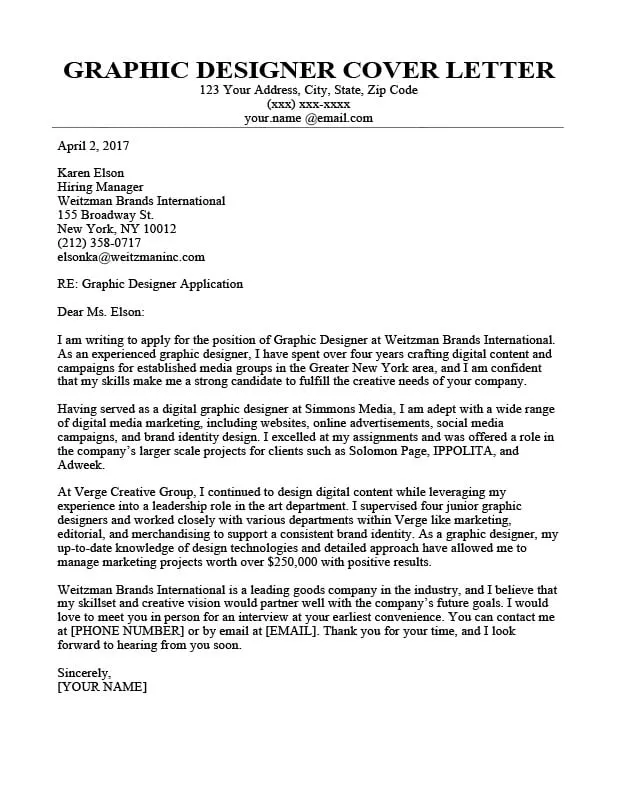
In a graphic designer cover letter, emphasize your visual communication skills, your proficiency with design software, and your ability to create impactful visual assets. Highlight projects where you’ve designed logos, marketing materials, or branding campaigns. Use your cover letter to showcase your design style. Ensure that your cover letter is visually appealing, reflecting your design aesthetic. Mention any awards or recognition you’ve received. If applying for a specific graphic design position, tailor your letter to address the requirements of the job. Show you have relevant experience and skills. See Image: graphic-designer-cover-letter
Web Designer Cover Letter
For a web designer cover letter, focus on your expertise in web design principles, user experience (UX), user interface (UI) design, and front-end development. Mention your experience with responsive design, accessibility, and SEO. Showcase projects where you’ve designed and developed websites, landing pages, or web applications. Include a link to your online portfolio. Mention any experience with coding languages like HTML, CSS, and JavaScript. Emphasize your ability to create user-friendly and visually appealing websites. See Image: web-designer-cover-letter
UX/UI Designer Cover Letter
A UX/UI designer cover letter should highlight your understanding of user-centered design principles, user research, and usability testing. Showcase projects where you’ve conducted user research, created wireframes, and designed user interfaces. Emphasize your ability to create intuitive and engaging user experiences. Mention your experience with design tools like Figma, Sketch, or Adobe XD. Describe how you’ve improved user satisfaction and engagement through your designs. Detail your experience in designing user flows, information architecture, and interactive prototypes. See Image: ux-ui-designer-cover-letter
Interior Designer Cover Letter
In an interior designer cover letter, focus on your knowledge of interior design principles, space planning, and material selection. Showcase projects where you’ve designed residential or commercial spaces. Highlight your ability to create functional, aesthetically pleasing, and safe environments. Mention your experience with design software like AutoCAD or Revit. Include examples of projects where you’ve created innovative and practical designs. If you have experience working with clients or managing projects, emphasize these skills. Demonstrate your design process and your ability to bring projects from concept to completion. See Image: interior-designer-cover-letter
Cover Letter Best Practices for Designers
Tailoring Your Cover Letter to Each Job
Avoid using a generic cover letter. Customize each cover letter to the specific job and company. Show you have researched the company and the job requirements. This demonstrates that you’re genuinely interested in the role. Highlighting your relevant skills and experience will show the hiring manager that you understand their needs. Tailoring your letter is a significant advantage. It increases your chances of getting noticed and landing an interview. Ensure your application reflects the specific job and company.
Using Keywords from the Job Description
Carefully review the job description and use keywords from it in your cover letter. This helps your application pass through applicant tracking systems (ATS). It also shows the hiring manager that you understand the job requirements. Make sure your keywords are relevant and used naturally within your cover letter. Avoid keyword stuffing, which can make your writing sound unnatural. Incorporate the relevant keywords to increase your chances of getting your cover letter noticed by both ATS and the hiring manager. Focus on integrating keywords related to skills, software proficiency, and project types.
Maintaining a Professional Tone
Maintain a professional tone throughout your cover letter. Use clear, concise language and avoid slang or overly casual language. A professional tone will show the hiring manager that you’re serious about the opportunity and that you’re a professional. Always be respectful, polite, and enthusiastic. Ensure your cover letter reflects your brand and the job you are applying for. Even if you’re applying to a more creative position, a professional tone remains important.
Including a Portfolio Link
Always include a link to your online portfolio or website in your cover letter. Your portfolio is essential for showcasing your design work. It provides the hiring manager with a visual representation of your skills and experience. Ensure your portfolio is up-to-date, well-organized, and reflects your best work. Include a clear call to action to visit your portfolio. Make it easy for the hiring manager to view your work. A well-curated portfolio can significantly increase your chances of landing an interview. Make sure your portfolio is easy to navigate and provides a good representation of your design abilities. See Image: portfolio-link