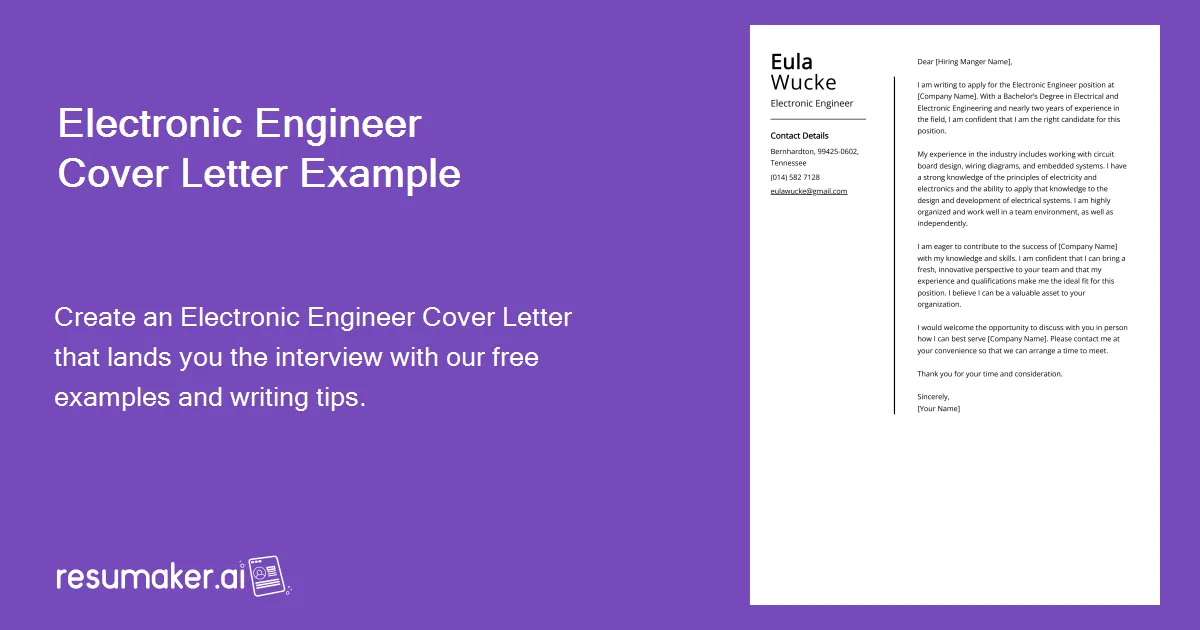
Crafting an Electronics Engineer Cover Letter
A well-crafted cover letter is your first opportunity to make a strong impression on a potential employer. For an electronics engineer, the cover letter serves as more than just an introduction it’s a showcase of your technical prowess, problem-solving abilities, and professional demeanor. It complements your resume by providing context to your experiences and highlighting the specific ways you can contribute to the company’s goals. The cover letter should be concise, well-structured, and tailored to the specific job you’re applying for. Avoid generic templates and instead, focus on demonstrating your understanding of the role and your enthusiasm for the opportunity. Remember, the goal is to capture the hiring manager’s attention and prompt them to read your resume with genuine interest. Your cover letter is the appetizer, and your resume is the main course; both need to be equally compelling to secure an interview. Make sure to proofread for grammatical errors and typos, which can undermine your credibility.
Highlighting Your Skills and Experience
Your cover letter should prominently feature the skills and experience that align with the job requirements. Begin by identifying the key skills and qualifications mentioned in the job description. Then, provide specific examples from your past experiences where you’ve utilized those skills. For instance, if the job requires proficiency in circuit design, describe a project where you successfully designed and implemented a complex circuit. If the role emphasizes teamwork and communication, share an instance where you collaborated effectively with a team to solve an engineering challenge. Quantify your achievements whenever possible, such as by mentioning the percentage improvement in efficiency or the cost savings achieved through your contributions. This not only validates your claims but also provides concrete evidence of your abilities and the value you can bring to the company. By connecting your skills directly to the job requirements, you demonstrate that you’re a well-suited candidate.
Technical Skills and Expertise

Electronics engineering is a highly technical field, so your cover letter should clearly articulate your technical skills. Highlight your proficiency in relevant areas such as circuit design, PCB layout, embedded systems, signal processing, and analog or digital electronics. Mention specific software and tools you’re familiar with, including CAD software like Altium Designer or Cadence, simulation tools like SPICE, and programming languages like C or Python. If you have specialized knowledge in areas like RF engineering, power electronics, or control systems, be sure to emphasize these as well. Showcase your understanding of industry standards and best practices. Remember, the more specific you are about your technical expertise, the better. This section should leave no doubt about your technical competence and readiness to contribute to the engineering tasks at hand. Tailor these technical skills to the job requirements to demonstrate you meet the needed qualifications.
Project Experience and Accomplishments
Your project experience is a critical element of your cover letter, serving as a tangible demonstration of your abilities. Instead of merely listing projects, provide detailed descriptions of your involvement, the challenges you faced, and the solutions you implemented. Explain your role within each project and the specific tasks you were responsible for. Mention any innovative approaches you took or any technical breakthroughs you achieved. For example, if you worked on a project involving the development of a new product, describe your contributions to the design, prototyping, and testing phases. If you have led any projects, emphasize your leadership skills and the outcomes achieved under your guidance. This section should paint a clear picture of your practical experience and the impact you’ve had on previous projects. Use action verbs to highlight your responsibilities and achievements. Ensure you align your project descriptions with the requirements outlined in the job description.
Quantifiable Achievements
Quantifiable achievements are a powerful way to demonstrate the impact of your work. Instead of simply stating what you did, provide concrete data and metrics to showcase your successes. For instance, instead of saying “Improved system performance,” say “Improved system performance by 15% by optimizing the signal processing algorithm.” If you contributed to cost savings, specify the amount or percentage saved. If you designed a more efficient circuit, mention the reduction in power consumption. Use numbers and data to back up your claims and provide tangible evidence of your abilities. When possible, include results in terms of time, money, or efficiency. This type of detail demonstrates that you are results-oriented and capable of delivering tangible value to an employer. These facts and figures make your cover letter more compelling and make it easier for the hiring manager to understand your contributions.
Emphasizing Relevant Projects

Not all projects are equally relevant to every job application. Focus on highlighting the projects that best align with the specific requirements and responsibilities of the role. Review the job description carefully and identify the key skills and experience the employer is seeking. Then, select the projects from your portfolio that best demonstrate those skills. Provide detailed descriptions of these projects, emphasizing your contributions and the outcomes achieved. While it’s acceptable to briefly mention other projects, prioritize the ones that are most relevant. This targeted approach shows that you understand the job requirements and have the experience to excel in the role. If you have a portfolio website, be sure to include a link in your cover letter. The more precisely you tailor your project descriptions to the job, the more compelling your application will be. This tailoring demonstrates your focus and understanding of the role.
Tailoring Your Cover Letter to the Job
One of the most crucial tips is to tailor your cover letter to each specific job application. A generic cover letter will rarely impress a hiring manager. Instead, thoroughly research the company and the role to understand their specific needs and requirements. Analyze the job description carefully, paying attention to the keywords and phrases used. Use these keywords throughout your cover letter to demonstrate that you possess the necessary skills and experience. Customize your cover letter by highlighting the projects and experiences that are most relevant to the job. Demonstrate that you understand the company’s mission and values, and explain how your skills and experience align with their goals. This level of customization shows that you have taken the time to understand the opportunity and are genuinely interested in the position. This personalized approach significantly increases your chances of getting noticed.
Researching the Company
Before you start writing your cover letter, invest time in researching the company. Visit their website, read their mission statement, and learn about their products or services. Explore their social media profiles, such as LinkedIn, to understand their culture and values. Identify any recent projects or initiatives the company has undertaken, and consider how your skills and experience could contribute to their success. This research will provide you with valuable insights that you can incorporate into your cover letter. For example, you can mention a specific product or project you admire or explain how your skills could help them achieve their goals. Showing that you have taken the time to understand the company demonstrates your genuine interest and enhances your credibility as a candidate. Furthermore, if you know someone who works at the company, consider reaching out to them for insights.
Matching Skills to Requirements

Carefully review the job description and identify the skills and qualifications the employer is seeking. Then, match your skills and experience to those requirements. Use the same keywords and phrases that are used in the job description, and provide specific examples of how you have demonstrated those skills in your previous roles. For instance, if the job requires experience with a specific software tool, mention your proficiency with that tool and provide details on how you have used it in past projects. If the role emphasizes teamwork and communication, share examples of how you’ve collaborated effectively with others to achieve common goals. Be as specific as possible, and provide concrete evidence to support your claims. The goal is to demonstrate that you are a perfect fit for the position and that you possess the skills and experience necessary to succeed. Remember to tailor this section to each individual job application.
Demonstrating Enthusiasm and Fit
Your cover letter should convey your enthusiasm for the opportunity and your genuine interest in the company. Avoid generic statements and instead, express your excitement for the specific role and the company’s mission. Explain why you are particularly drawn to this opportunity, and highlight the aspects of the job that excite you most. Mention any specific projects or initiatives the company is involved in that resonate with your interests. Demonstrate that you have researched the company and understand its values, culture, and goals. Showing that you are passionate about the position will significantly increase your chances of capturing the hiring manager’s attention. Make sure your enthusiasm is genuine and comes across naturally. Your cover letter is the perfect place to make a personal connection and demonstrate your fit within the company’s culture. Express your confidence in your ability to succeed.
Showcasing Your Professionalism
Your cover letter is a reflection of your professionalism, so it’s essential to present yourself in a polished and professional manner. Use a professional tone throughout the letter, avoiding slang or overly casual language. Maintain a formal business format, with a clear and concise structure. Proofread your cover letter carefully for any grammatical errors, spelling mistakes, or typos. Pay attention to your writing style, and ensure that your sentences are clear, concise, and easy to understand. Be respectful and courteous in your communication, and avoid making any negative comments about your previous employers or colleagues. Your cover letter should demonstrate your ability to communicate effectively and professionally. Your cover letter should convey the impression that you are a reliable, detail-oriented, and professional candidate.
Formatting and Presentation

The formatting and presentation of your cover letter are just as important as its content. Use a professional font, such as Times New Roman, Arial, or Calibri, and maintain a consistent font size throughout the document. Use standard margins and line spacing to ensure readability. Keep your cover letter to one page, as hiring managers often have limited time. Use clear headings and subheadings to organize your content and make it easy to scan. Break up long paragraphs into shorter, more manageable sections. Ensure your cover letter is visually appealing and easy to read. Consider using bullet points to highlight key skills and accomplishments. Save your cover letter as a PDF file to preserve its formatting and ensure that it displays correctly on any device. The overall look and feel should be clean and professional, demonstrating your attention to detail.
Proofreading and Editing
Proofreading and editing are critical steps in ensuring your cover letter is free of errors. Before submitting your cover letter, carefully review it for any grammatical errors, spelling mistakes, typos, or formatting inconsistencies. It’s easy to overlook errors when you’ve been working on a document for an extended period, so consider asking a friend, family member, or career advisor to review your cover letter as well. A fresh pair of eyes can often catch errors that you might miss. Pay close attention to the tone and clarity of your writing. Ensure that your sentences are clear, concise, and easy to understand. Make sure your cover letter flows logically and presents your information in a compelling manner. Take your time and revise your cover letter as many times as needed until you are confident that it is perfect. This is one of the most important steps to a successful job application. A polished cover letter will significantly increase your chances of getting noticed.
Call to Action
Conclude your cover letter with a strong call to action. Clearly state your interest in the position and express your desire to learn more about the opportunity. Reiterate your enthusiasm for the company and the role. Include a statement indicating your availability for an interview and provide your contact information, including your phone number and email address. Thank the hiring manager for their time and consideration. Make sure to sign off professionally, such as “Sincerely” or “Respectfully.” Ensure the call to action is clear and leaves the hiring manager with a positive impression. The goal is to encourage the hiring manager to take the next step and invite you for an interview. Make it easy for them to reach out to you.