Crafting Your HR Assistant Cover Letter
A well-crafted HR assistant cover letter is your first impression on a potential employer, and it can significantly influence whether you get an interview. It’s a crucial document that complements your resume by providing context and highlighting your key skills and experiences in a way that a resume alone cannot. This guide will provide a detailed approach to writing a cover letter that stands out, showcasing your suitability for the role and increasing your chances of landing an interview. By focusing on clarity, relevance, and a professional tone, you can create a compelling narrative that positions you as the ideal candidate. Remember, this letter is your opportunity to demonstrate your understanding of the HR field and your enthusiasm for the specific position.
Understanding the Purpose of a Cover Letter
The primary purpose of a cover letter is to introduce yourself, express your interest in the position, and persuade the hiring manager that you are a strong fit. It’s not merely a repetition of your resume; instead, it’s an opportunity to provide a narrative about your qualifications and demonstrate how your skills align with the company’s needs and the specific requirements of the HR assistant role. This document is also your chance to exhibit your writing and communication skills, which are essential for an HR professional. A well-written cover letter demonstrates attention to detail, professionalism, and a genuine interest in the company and the position.
Highlighting Relevant Skills and Experience

When writing your cover letter, focus on skills and experiences that are directly relevant to the HR assistant position. These typically include strong organizational skills, attention to detail, excellent communication and interpersonal skills, proficiency in relevant software (like Microsoft Office or HRIS systems), and experience in tasks like data entry, record keeping, and handling confidential information. Quantify your achievements whenever possible; for example, you could mention the number of employees you supported or the efficiency improvements you contributed to in a previous role. Tailor your examples to match the job description, highlighting the skills and experiences that the employer specifically mentions as essential for the role.
Formatting Your Cover Letter for Maximum Impact
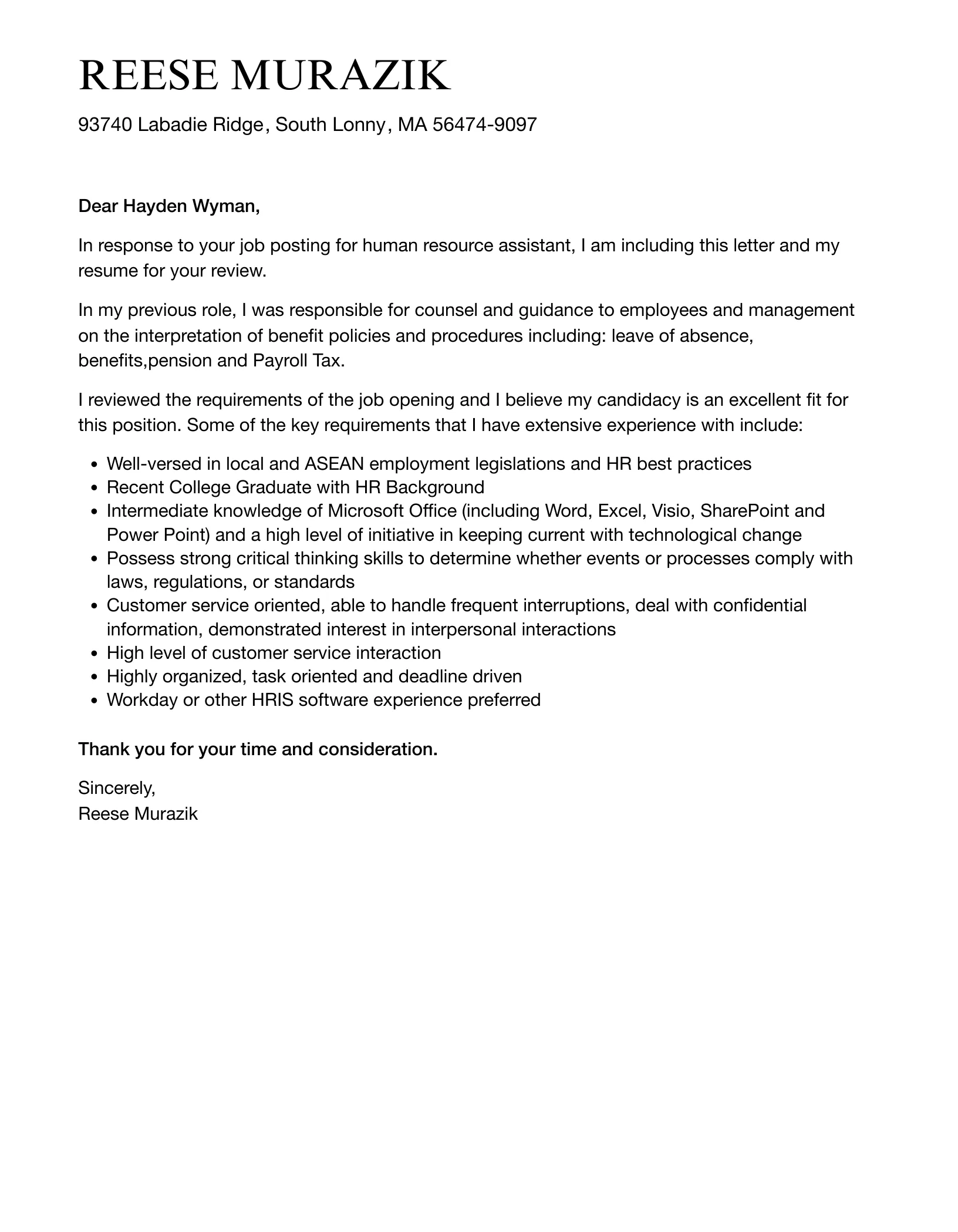
The format of your cover letter is essential for making a positive first impression. Use a professional font such as Times New Roman, Arial, or Calibri, with a font size between 10 and 12 points. Maintain consistent formatting throughout the document, including margins, spacing, and bullet points. A standard business letter format, with your contact information at the top, the date, the recipient’s information, and a clear subject line, is recommended. Keep the letter concise, ideally within one page, with a clear and easy-to-read layout. Proper formatting shows that you pay attention to detail and respect the hiring manager’s time.
Key Sections to Include in Your Cover Letter
A strong cover letter generally includes several key sections that work together to create a compelling narrative. Start with your contact information, the date, and the recipient’s details. The opening paragraph should express your interest in the position and explain where you saw the job posting. The body of the letter should highlight your relevant skills and experiences, providing specific examples to support your claims. The closing paragraph should reiterate your interest, thank the hiring manager for their time, and include a call to action, such as inviting them to contact you for an interview. Each section should flow logically into the next, creating a cohesive and persuasive document.
Contact Information and Salutation

At the top of your cover letter, include your full name, address, phone number, and email address. This allows the hiring manager to easily contact you. Always use a professional email address. Following this, include the date and the recipient’s information, which should include the hiring manager’s name (if known), their title, the company name, and the company’s address. The salutation should be formal, such as “Dear Mr./Ms. [Last Name]” or “Dear Hiring Manager,” if you don’t know the name. Avoid generic greetings like “To Whom It May Concern”.
The Opening Paragraph A Strong Start
The opening paragraph sets the tone for your cover letter and immediately grabs the reader’s attention. Start by stating the position you are applying for and where you saw the job posting. Briefly mention why you are interested in the role and the company. Your opening should be concise, enthusiastic, and demonstrate your understanding of the company’s mission or values. Clearly indicate that you possess the skills and experiences necessary to fulfill the responsibilities of the HR assistant position. This initial paragraph should be compelling enough to encourage the hiring manager to read the rest of your letter.
Showcasing Your Skills and Qualifications
The body of your cover letter is where you showcase your skills and qualifications. Focus on the skills and experiences that align with the job description, providing specific examples to demonstrate your abilities. For example, if the job description requires strong organizational skills, describe a time when you successfully managed multiple tasks or projects simultaneously. Use action verbs to describe your accomplishments, such as “managed,” “coordinated,” “implemented,” or “resolved.” Quantify your achievements whenever possible to provide tangible evidence of your contributions. This section should be well-organized and easy to read, with clear paragraphs and concise sentences.
Mentioning Relevant Experience

When mentioning your experience, focus on the roles and responsibilities most relevant to the HR assistant position. Highlight the tasks you performed, the skills you utilized, and the results you achieved. If you have experience with tasks such as onboarding, employee record management, or benefits administration, make sure to mention them. Be specific and provide concrete examples. For instance, instead of simply stating that you “handled employee inquiries,” you could write, “Responded to over 50 employee inquiries per week regarding benefits and payroll, ensuring prompt and accurate resolutions.” Tailor your descriptions to match the requirements outlined in the job posting.
Demonstrating Your Enthusiasm and Fit
In addition to highlighting your skills and experience, your cover letter should demonstrate your enthusiasm for the role and the company. Research the company and mention something specific that appeals to you, whether it’s their mission, values, or recent achievements. Explain why you are interested in the HR assistant position and how it aligns with your career goals. Express your understanding of the HR field and your desire to contribute to the company’s success. Your enthusiasm will make you stand out from other candidates who may simply list their qualifications without showing any genuine interest.
The Closing Paragraph and Call to Action
The closing paragraph should reiterate your interest in the position and express your gratitude for the hiring manager’s time and consideration. Restate your excitement about the opportunity and emphasize your qualifications once more. Include a clear call to action, such as inviting the hiring manager to contact you for an interview. Provide your contact information one last time, and thank them for their time. Conclude with a professional closing, such as “Sincerely” or “Best regards,” followed by your full name. This final paragraph leaves a lasting positive impression.
Proofreading and Editing Your Cover Letter

Before submitting your cover letter, proofread it carefully for any grammatical errors, spelling mistakes, or typos. A well-written cover letter demonstrates your attention to detail and professionalism. Read the letter aloud to catch any awkward phrasing or sentence structures. Consider having a friend, family member, or career counselor review your cover letter for feedback. Ensure that the content is clear, concise, and free of errors. Proofreading is a critical step, as even minor mistakes can detract from your overall impression.
Examples of HR Assistant Cover Letter Samples
Reviewing examples of HR assistant cover letters can provide valuable insights into format, content, and tone. Many online resources offer cover letter templates and samples that you can adapt to your specific needs and experiences. While using these samples, remember to personalize your letter to reflect your unique qualifications and the specific requirements of the job. Pay attention to how others highlight their skills, quantify their achievements, and express their enthusiasm. Use these examples as a guide to help you create a compelling cover letter that effectively showcases your strengths and increases your chances of landing an interview.