Navigating the U.S. immigration system can be complex, but understanding the processes involved can significantly streamline your journey. One such process, the concurrent filing of Forms I-130 and I-485, offers a strategic advantage for certain individuals. This guide provides a comprehensive overview of the concurrent filing process, offering step-by-step instructions and essential insights to help you successfully file your application. Whether you’re seeking to adjust your status or help a family member immigrate, understanding the intricacies of concurrent filing is crucial for a smooth and efficient experience. We’ll break down everything you need to know, from eligibility requirements to the documents you’ll need, ensuring you’re well-prepared every step of the way.
What Is Concurrent Filing of I-130/I-485?
Concurrent filing refers to submitting Form I-130, Petition for Alien Relative, and Form I-485, Application to Register Permanent Residence or Adjust Status, simultaneously to the United States Citizenship and Immigration Services (USCIS). This option is available to individuals who are eligible to adjust their status to that of a lawful permanent resident (Green Card holder) while residing in the United States. By filing both forms at the same time, applicants aim to expedite the immigration process, as USCIS can review both petitions concurrently. This can lead to a quicker overall processing time compared to filing the I-130 first and waiting for its approval before filing the I-485.
Eligibility Requirements for Concurrent Filing
Not everyone is eligible to file Form I-130 and Form I-485 concurrently. Eligibility depends on several factors, including the applicant’s current immigration status, the availability of an immigrant visa, and whether they are admissible to the United States. Generally, to be eligible, the applicant must be physically present in the United States and meet the criteria for adjusting status. Certain visa categories allow concurrent filing, while others require the I-130 to be approved first. Understanding these requirements is crucial. Additionally, applicants should not have any criminal history or other factors that would make them inadmissible to the U.S. Careful consideration of these prerequisites is vital to avoid delays or denials.
Who Can File Concurrently

Individuals who have an approved or concurrently filed I-130 petition and are eligible to adjust status in the U.S. can file concurrently. This includes immediate relatives of U.S. citizens (spouses, parents, and unmarried children under 21) if a visa is immediately available. Also, certain employment-based visa applicants and those with derivative status may also be eligible. It’s important to confirm visa availability using the Visa Bulletin to ensure that a visa number is available for the applicant’s category. Those who are in valid non-immigrant status, such as F-1 student status, and have not violated their status, are generally eligible to apply. Always verify your eligibility to prevent any potential issues.
Necessary Forms for Concurrent Filing
The concurrent filing process requires several forms, each serving a specific purpose in the application. Accurate completion and submission of these forms are critical for a successful application. Providing all the necessary information and supporting documents is essential to demonstrate eligibility and support your case. The main forms include the I-130 petition, the I-485 application, and the I-864 affidavit of support (if applicable). It’s essential to download the latest versions of the forms from the USCIS website to ensure that you are using the correct forms, as versions are frequently updated, reflecting changes in regulations or instructions. Make sure to follow all instructions carefully.
Form I-130
Form I-130, Petition for Alien Relative, is filed by the U.S. citizen or lawful permanent resident petitioner to establish the qualifying relationship with the foreign-born beneficiary. The petitioner must provide detailed information about the relationship, such as the marriage certificate if the beneficiary is a spouse or the birth certificate if the beneficiary is a child. This form essentially confirms the familial relationship, which is a fundamental requirement for immigration based on family ties. The petition must include evidence that the relationship is bona fide, meaning it is genuine and not entered into for the sole purpose of obtaining immigration benefits. This often involves providing documentation such as photographs, shared financial records, and other forms of correspondence to show the authenticity of the relationship.
Form I-485

Form I-485, Application to Register Permanent Residence or Adjust Status, is filed by the foreign-born beneficiary to apply for a Green Card. This form requires extensive information about the beneficiary, including their immigration history, employment history, and any criminal record. The applicant needs to provide personal details and answer questions concerning their eligibility for adjustment of status. Supporting documents, such as a copy of the beneficiary’s passport, birth certificate, and medical examination, must be included. Careful attention to detail when completing this form will prevent delays. In addition, the applicant needs to undergo a medical examination conducted by a USCIS-approved physician. The physician will fill out Form I-693, Report of Medical Examination and Vaccination Record, which must be submitted with the I-485 form.
Form I-864 (Affidavit of Support)
The Form I-864, Affidavit of Support, is required if the petitioner is a U.S. citizen or lawful permanent resident. This form demonstrates that the petitioner has sufficient financial resources to support the beneficiary and ensure that the beneficiary is not likely to become a public charge. The petitioner must meet the income requirements specified by USCIS, based on the size of their household. If the petitioner’s income is insufficient, they may use a joint sponsor to meet the financial requirements. Supporting documentation, such as tax returns, W-2 forms, and employment verification letters, must be submitted to prove the petitioner’s financial ability to support the beneficiary. The government wants to ensure that immigrants can sustain themselves without relying on public assistance, so this affidavit is an essential part of the application.
Supporting Documentation
Supporting documentation is crucial to substantiate your application and establish your eligibility for concurrent filing. The required documents vary depending on the specific circumstances of the case, but some common documents are consistently necessary. Preparing and organizing these documents correctly can significantly facilitate the application process and help in avoiding any potential issues. Make sure to make copies of all documents and retain the originals for your records. If any documents are not in English, certified translations must be provided.
Birth Certificates

Birth certificates serve as primary evidence of the beneficiary’s identity and relationship to the petitioner. Both the beneficiary and, in some cases, the petitioner will need to provide their birth certificates. These documents are crucial to verify their age and country of birth. Ensure that the birth certificates are official copies issued by the relevant government authority. If the original birth certificate is unavailable, alternative documentation like baptismal records, school records, or affidavits may be considered, but only if a birth certificate cannot be obtained. A certified translation is needed if the birth certificate is not in English.
Marriage Certificate (If Applicable)
If the petition is based on a spousal relationship, a marriage certificate is essential. This certificate confirms the legal marriage between the U.S. citizen/lawful permanent resident and the beneficiary. Ensure that the marriage certificate is valid and legally recognized in the jurisdiction where the marriage took place. You may need to provide additional documentation, such as proof of previous marriages (divorce decrees) if either party has been previously married. The marriage must be legally valid and not entered into for immigration purposes. This is a key piece of evidence, and it is important to submit a certified copy, along with any required translations if the original isn’t in English.
Passport Photos
Passport-style photographs are required for both Form I-130 and Form I-485. The photos must meet the specific requirements outlined by USCIS. These photos are used for identification purposes and are essential for processing the application. Make sure to follow the guidelines carefully regarding the size, background, and pose. The photos should be recent, clear, and represent the applicant’s current appearance. Typically, two passport-style photos are required for each form. It’s crucial to follow all the specifications provided by USCIS to avoid the rejection of the application due to non-compliant photos.
Medical Examination Report

A medical examination is a compulsory part of the I-485 application. The beneficiary must undergo a medical examination conducted by a USCIS-approved civil surgeon. The examination includes a review of the applicant’s vaccination records and screening for certain medical conditions. The civil surgeon will complete Form I-693, Report of Medical Examination and Vaccination Record. The completed form must be submitted with the I-485 application and must be valid at the time of filing. Be prepared to provide your vaccination records and information about any past medical conditions. The medical examination is essential to ensure that the applicant does not have any conditions that would make them inadmissible to the United States.
How to Prepare Your I-130/I-485 Package
Preparing the I-130/I-485 package correctly is critical for a successful application. It involves gathering all the necessary forms and supporting documents, organizing them systematically, and ensuring all information provided is accurate. Attention to detail and careful preparation can significantly increase the chances of a smooth process and decrease the risk of denials or requests for evidence. It is vital to review the instructions for each form, as well as all the required documents, well in advance. Consider using a checklist to ensure you have everything needed. Proper preparation can save time and prevent complications.
Organizing Your Documents
Organizing your documents logically is essential for efficient processing by USCIS. A well-organized application package is much easier to review. Consider using tabs or dividers to separate the different forms and supporting documents. You can create a checklist to keep track of all documents included in your package. Organize your documents in the order suggested by the USCIS instructions. Make copies of all documents before submission, and keep the originals for your records. Proper organization minimizes the chances of missing documents or information, and facilitates the review process, leading to a faster and more efficient application review.
Writing a Strong Cover Letter

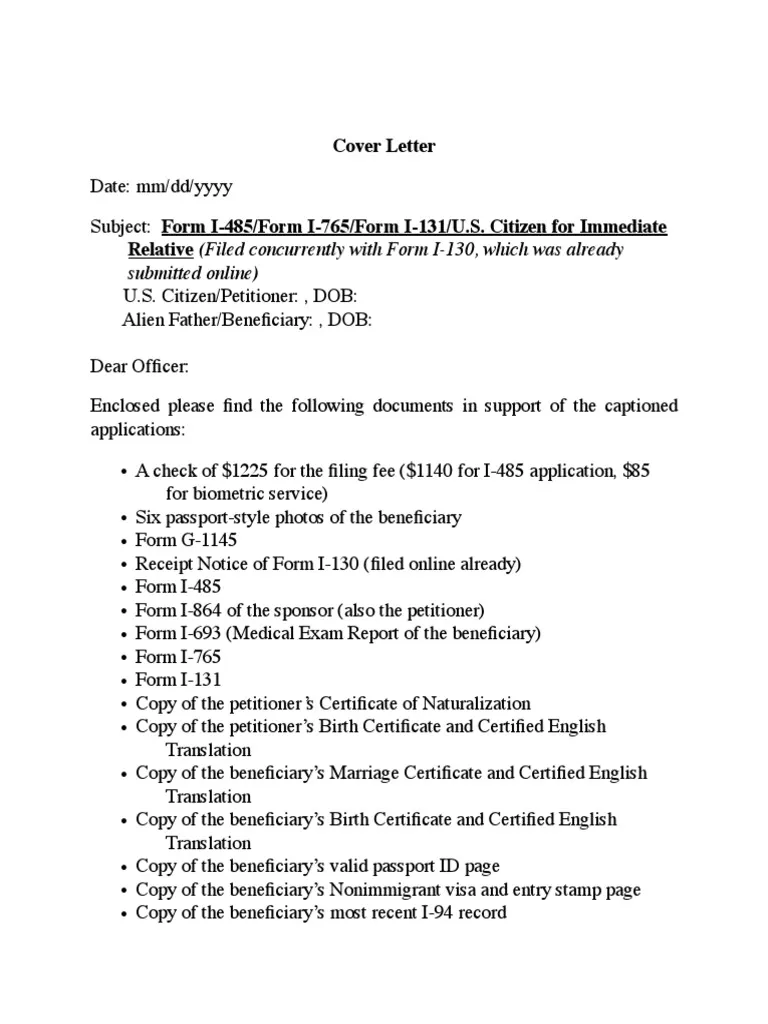
A well-written cover letter can be an invaluable component of your application package. It provides an overview of your application, highlights key information, and ensures all forms and supporting documents are included. A cover letter serves as a roadmap for the USCIS officer, making it easier for them to understand your case. The cover letter provides the opportunity to briefly explain the purpose of your submission, list all included forms and documents, and emphasize the key elements of your application. Use a professional and respectful tone. A thoughtfully crafted cover letter can make a significant difference in how your application is received. It demonstrates your attention to detail and helps USCIS understand the context of your filing.
Detailed Cover Letter Guide
A detailed cover letter should include the following key elements. Start with a clear statement that you are filing Form I-130 and Form I-485 concurrently. Provide the applicant’s full name, date of birth, and Alien Registration Number (if available). The petitioner should include their full name, date of birth, and address. List each form and supporting document included in your package, referencing specific documents, such as birth certificates or marriage certificates. Briefly explain the basis for eligibility (e.g., spousal relationship or family ties). It is also helpful to mention any specific circumstances or factors that support your application. End your letter with a statement of intent to cooperate with USCIS and a thank you. Ensure the cover letter is signed and dated.
Address to Use
The correct filing address is crucial. The address you use for filing your application depends on your location and the forms you are submitting. The filing address information is provided on the USCIS website and is often updated, so it’s essential to check the latest instructions. Incorrectly filed applications will likely be rejected or returned. Use the USCIS website’s filing address tool to find the correct address for your specific application. Make sure to verify the address to the specific forms you are filing and your location. Always double-check the address just before sending your application to ensure it is the most current information.
Key Elements to Include

Include all required forms, such as Form I-130, Form I-485, and Form I-864, if applicable. Provide all necessary supporting documentation, including birth certificates, marriage certificates, passport photos, and the medical examination report. Ensure that all forms are signed and dated. Pay the correct filing fees for each form. The fee amounts are listed on the USCIS website. Include a detailed cover letter that lists each form and supporting document, along with a brief explanation of your case. Double-check everything before sending your application to avoid delays or rejections. Failing to include any of these elements can significantly delay your application process.
Filing Fees and Payment Methods
Accurately calculating and submitting the correct filing fees is a critical step in the concurrent filing process. Failure to pay the correct fees will result in the rejection of your application. Make sure to review the USCIS website to determine the current filing fees for each form you are submitting. These fees are subject to change, so always check the latest information. Payment can typically be made by check, money order, or credit card. When paying by check or money order, make it payable to the U.S. Department of Homeland Security. If paying by credit card, you must use Form G-1450, Authorization for Credit Card Transactions. Ensure that you include the correct payment with your application package.
Where to File Your Application
The filing location for your application depends on where you live and the forms you are submitting. The USCIS website provides detailed instructions on where to send your application package. Filing in the correct location ensures that your application is processed promptly. The filing addresses are regularly updated, so it’s essential to confirm the current address shortly before sending your application. Always consult the latest USCIS instructions. Incorrectly sending your application to the wrong address will cause delays. It’s best to verify the filing address on the USCIS website or by using the USCIS online tools to ensure your application is correctly submitted.
USCIS Processing Times and Updates

USCIS processing times can vary significantly, and it’s crucial to manage your expectations. Processing times depend on the volume of applications received, the complexity of the case, and other factors. You can check the current processing times on the USCIS website. This will give you a general idea of how long it might take to process your application. USCIS provides online case status updates. You can track your case by entering your receipt number on the USCIS website. Delays can happen. Understanding that processing times are not guaranteed can help you manage expectations. Keep an eye on your case status online and be ready to respond to any requests for evidence from USCIS.
What to Expect After Filing
After submitting your application, you will receive a receipt notice from USCIS. This notice confirms that your application has been received and provides your case receipt number. This number is essential for tracking your case status online. You may be scheduled for a biometrics appointment. This appointment is for taking fingerprints, photos, and a signature. You may also be scheduled for an interview. USCIS may request additional evidence to support your application. Responding promptly and completely to any requests for evidence is crucial. It’s essential to keep all your contact information up-to-date with USCIS to receive all communications. Prepare yourself for potential delays and be patient throughout the process.
Biometrics Appointment
The biometrics appointment is a mandatory step in the application process. During this appointment, USCIS will collect your fingerprints, photograph, and signature. You will receive a notice with the date, time, and location of your appointment. It’s important to attend the appointment as scheduled. Ensure you bring a valid form of identification, such as your passport or driver’s license. Failure to attend the biometrics appointment can lead to the denial of your application. USCIS uses the information collected to conduct background checks. Keep your appointment notice and arrive on time to avoid any delays. Understand that this is a routine procedure, and the information is used to verify your identity and conduct security checks.
Interview
Some applicants may be required to attend an interview with a USCIS officer. The purpose of the interview is to verify the information provided in the application and to determine the applicant’s eligibility for adjustment of status. You will receive a notice with the date, time, and location of your interview. During the interview, the officer will ask questions about your application and your relationship with the petitioner. Be prepared to answer these questions honestly and accurately. Bring all original documents, including your passport, birth certificate, and marriage certificate (if applicable). It’s important to arrive on time. Answer each question clearly and concisely. Failure to attend the interview or providing inconsistent information could negatively impact your application.
Potential Delays and How to Address Them
Delays in the immigration process are unfortunately common. They can occur for various reasons, including high application volumes, security checks, and requests for additional evidence. There are steps you can take to address potential delays. You can monitor your case status online using your receipt number. Respond promptly to any requests for evidence from USCIS, and provide all requested information completely and accurately. If your case is taking longer than the posted processing times, you can contact USCIS to inquire about the status. Keep all of your contact information current. In some cases, you may want to seek assistance from an experienced immigration attorney to understand the cause of the delay and what options are available.
Common Mistakes to Avoid
There are common mistakes that applicants often make during the concurrent filing process. Avoiding these errors can help you prevent delays or denials. Make sure to use the most current forms and instructions available from USCIS. Carefully review all the instructions to ensure you understand the requirements. Failure to provide all required documentation and accurately complete the forms can cause significant delays. Always verify your eligibility to file concurrently, and ensure you meet all the requirements. Ensure that you pay the correct filing fees. Consider using a checklist. Proofread your application before submitting it, and ensure all information is accurate and consistent. Common mistakes include not providing enough evidence, incorrect completion of the forms, and not following instructions, all of which can easily be avoided by paying close attention to detail.
Seeking Legal Advice
Immigration law can be complex, and seeking legal advice from an experienced immigration attorney can be beneficial. An attorney can review your case, help you understand your options, and guide you through the process. They can help you gather the necessary documents, complete the forms accurately, and prepare for your interview. An attorney can identify potential issues and help you address them before they cause delays or denials. They can also represent you before USCIS. Consulting with an attorney can give you peace of mind. They can also help you to understand the specific requirements of your case. The cost of an attorney varies depending on the complexity of the case and the services provided, but for many, the investment is worthwhile.
In conclusion, the concurrent filing of Forms I-130 and I-485 provides a viable path to obtaining a Green Card, but it requires meticulous preparation, understanding of the eligibility criteria, and strict adherence to USCIS guidelines. By following this comprehensive guide and seeking professional legal advice when needed, you can increase your chances of a successful application and navigate the complex immigration process with greater confidence. Remember, the key to success is thoroughness and accuracy. Good luck!