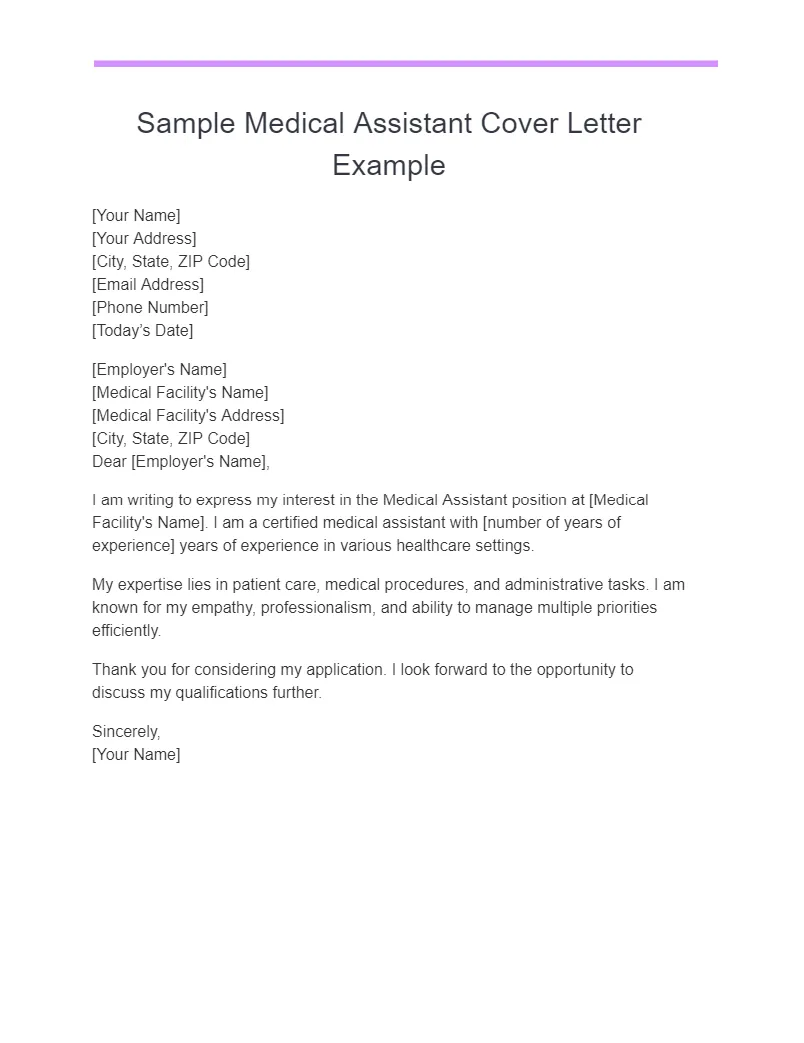
Why a Medical Assistant Cover Letter Matters
In the competitive field of healthcare, a well-crafted Medical Assistant cover letter is your first chance to make a positive impression. It serves as your introduction, showcasing your personality, skills, and enthusiasm for the position. Unlike a resume, which is a factual overview of your experience, the cover letter allows you to connect with the hiring manager on a personal level. It’s an opportunity to demonstrate why you are the ideal candidate for the role, highlighting your passion for patient care and your understanding of the healthcare environment. A compelling cover letter not only grabs the reader’s attention but also significantly increases your chances of securing an interview. It is the key to getting hired as a medical assistant.
Key Components of a Winning Medical Assistant Cover Letter
A successful Medical Assistant cover letter includes several key components that work together to present you as a qualified and enthusiastic candidate. Each section plays a crucial role in conveying your suitability for the role and your eagerness to contribute to the healthcare team. From the header to the closing, every element should be carefully crafted to ensure that the hiring manager is left with a positive impression. Remember to keep the tone professional and engaging.
Header Information

The header sets the stage for professionalism. Begin by including your full name, address, phone number, and email address. This ensures the hiring manager can easily contact you. Place this information at the top of your cover letter, usually aligned left. The header should be clear, concise, and easy to read. It is the first thing the hiring manager sees, so make sure it is presented well. An organized header demonstrates attention to detail, a valuable quality in a medical assistant.
Applicant’s Contact Information
Your contact information should include your full name, address, phone number, and email address. Ensure the email address is professional-sounding (e.g., john.doe@email.com), not something casual. Double-check that the phone number is correct and that you have a professional voicemail setup. This section needs to be present in the header, enabling the hiring manager to know how to contact you.
Date of the Letter
The date on your cover letter is important. It indicates when you are applying for the position. Place the date just below your contact information, and before the employer’s details. Using the current date shows that your application is current and that you are actively seeking a position. This simple detail shows your attention to detail and demonstrates that you understand the formalities of the job application.
Employer’s Contact Information

Include the hiring manager’s name (if known), their title, the clinic or hospital’s name, and the address. If you can’t find the hiring manager’s name, use ‘Hiring Manager.’ Addressing the letter to a specific person shows you’ve done your research and are genuinely interested in the position. Always double-check the accuracy of the information to show your attention to detail.
Professional Salutation
A professional salutation sets the tone for your cover letter. Use ‘Dear Mr./Ms./Dr. [Last Name]’ if you know the hiring manager’s name. If the name is unknown, use ‘Dear Hiring Manager.’ Avoid casual greetings like ‘Hello’ or ‘Hi.’ The salutation should be formal and respectful. This initial greeting is a small but important step in presenting yourself professionally.
Body Paragraph 1 Crafting a Compelling Introduction
Your introduction is your first opportunity to capture the hiring manager’s attention. Start with a strong opening statement that immediately indicates the position you are applying for. Briefly state where you saw the job posting and express your interest in the role. Mention a key skill or achievement that aligns with the job requirements to make a strong first impression. Keep the introduction concise and engaging, demonstrating your enthusiasm and understanding of the medical assistant role. This is your chance to hook the reader and make them want to know more.
Highlighting Your Skills and Qualifications

In the first paragraph, highlight key skills and qualifications that align with the job description. This is your chance to showcase what makes you the ideal candidate. Tailor your letter to the specific requirements outlined in the job posting. Focus on relevant skills such as patient care, medical terminology, administrative tasks, and any specific software proficiencies. Provide brief examples of how you’ve used these skills successfully in previous roles or during your training. Make sure you’re showcasing your strengths and how they are applicable to the specific job requirements.
Tailoring Your Letter to the Job Description
Tailor your cover letter to match the job description. Review the job posting carefully and identify the key requirements and responsibilities. Adjust your letter to emphasize the skills and experiences that align with these requirements. This shows the hiring manager that you’ve taken the time to understand the role and that you’re a good fit. Use keywords from the job description to demonstrate your understanding of the role and your ability to perform its duties. This personalization increases your chances of getting noticed and advancing to the interview stage.
Body Paragraph 2 Demonstrating Relevant Experience
The second paragraph should detail your relevant experience. Provide specific examples from your past experiences to demonstrate how you’ve utilized your skills and achieved positive results. Use the STAR method (Situation, Task, Action, Result) to structure your examples. Briefly describe the situation, the task you were given, the actions you took, and the positive results you achieved. This approach provides a clear and concise overview of your capabilities and accomplishments, making your experience easily understandable for the hiring manager.
Quantifying Accomplishments

Whenever possible, quantify your accomplishments. Use numbers and data to showcase your impact. Instead of saying ‘Improved patient satisfaction,’ say ‘Increased patient satisfaction scores by 15%.’ Quantifying your achievements provides tangible evidence of your abilities and demonstrates the value you can bring to the role. Highlighting specific accomplishments provides a concrete understanding of your capabilities.
Focusing on Patient Care Skills
Focus on patient care skills, which are essential in a medical assistant role. Describe your experience with taking patient histories, vital signs, and assisting with examinations. Highlight your ability to communicate effectively with patients and provide a supportive environment. Detail your skills in explaining medical procedures, providing comfort, and ensuring patient well-being. Emphasize your empathy and commitment to providing high-quality patient care. Be sure to mention any specific patient care skills you have such as phlebotomy and injections.
Body Paragraph 3 Expressing Enthusiasm and Interest
In your third paragraph, express your genuine enthusiasm and interest in the specific opportunity. Show that you’ve researched the clinic or hospital and understand their mission or values. Explain why you are particularly interested in working there and what you admire about their work. Tailor your letter to the organization and demonstrate that you are not just applying for a job, but that you are excited about joining their team.
Mentioning the Clinic or Hospital

Mention the clinic or hospital by name and explain why you are interested in working there. Demonstrate that you’ve researched their services, values, or mission. This shows that you are genuinely interested in the position and that you have taken the initiative to learn about the organization. Reference a specific aspect of their work or reputation that appeals to you. This will demonstrate your understanding of the organization and your commitment to them.
Demonstrating Your Understanding of Healthcare
Demonstrate your understanding of the healthcare environment. Discuss current trends, challenges, or developments in healthcare. Show that you are knowledgeable about the industry and that you are committed to staying informed. You can mention any relevant certifications, training, or professional development activities. This conveys your interest in continuous learning and improvement in the healthcare field. This knowledge will make you stand out from other candidates.
Body Paragraph 4 Call to Action
Your final paragraph should include a clear call to action. Express your interest in an interview and indicate your availability. Make it easy for the hiring manager to contact you. Reiterate your enthusiasm for the position and thank the reader for considering your application. This concluding paragraph ensures that the hiring manager knows that you are available for the next steps.
Requesting an Interview

Clearly state your desire for an interview in the final paragraph. Express your eagerness to discuss your qualifications further and learn more about the opportunity. This is a proactive step that shows your interest and commitment to the position. Include your availability for an interview, whether by phone or in person, making it easy for the hiring manager to move forward. This proactive stance increases your chances of getting an interview.
Thanking the Reader
Always thank the hiring manager for their time and consideration. Express your gratitude for the opportunity to apply and express your anticipation for a positive response. This shows respect for their time and effort and leaves a positive final impression. A simple thank you can make a big difference in showing gratitude.
Closing and Signature
Use a professional closing, such as ‘Sincerely’ or ‘Respectfully,’ followed by your typed name. If you are submitting a hard copy, sign your name above your typed name. This final step adds a personal touch and confirms that the letter is complete. Make sure your name is clearly legible and easy to read.
Common Mistakes to Avoid
Avoid these common mistakes to ensure your cover letter makes a positive impression. Careful attention to detail will enhance your application and increase your chances of getting an interview. Make sure you proofread and edit your work before submitting it.
Generic Cover Letters
Avoid sending a generic cover letter. Tailor each letter to the specific job and organization. Generic letters often lack impact because they don’t address the specific requirements of the role or the values of the organization. Customize your letter to show that you understand the job and are genuinely interested in it. This is very important to stand out.
Typos and Grammatical Errors
Always proofread your cover letter for typos and grammatical errors. These errors can undermine your credibility and create a negative impression. Before submitting your letter, check for spelling, grammar, punctuation, and sentence structure. Use a grammar checker tool and have someone else proofread your letter as well. A well-written cover letter will demonstrate your attention to detail and professionalism.
Exceeding the Ideal Length
Keep your cover letter concise and to the point. Aim for a one-page letter, or at most, one page and a few lines. Hiring managers are busy and often skim cover letters. Make sure your key points are clear and easy to find. Edit out any unnecessary information. A concise cover letter allows the hiring manager to get the information they need quickly.
Formatting Issues
Ensure that your cover letter is well-formatted. Use a standard font, such as Times New Roman or Arial, with a font size between 10 and 12 points. Use consistent spacing, margins, and paragraph alignment. Proper formatting makes your letter easy to read and enhances its professional appearance. A well-formatted letter shows that you pay attention to details.
Finalizing Your Cover Letter
Before submitting your cover letter, take the time to finalize it. Proofread, edit, and customize your letter for each application. This will increase your chances of getting an interview and landing the job.
Proofreading and Editing
Proofread and edit your cover letter carefully. Check for any errors in spelling, grammar, and punctuation. Read your letter aloud to catch awkward phrasing. Ask someone else to review your letter for clarity and accuracy. A polished cover letter demonstrates your attention to detail and professionalism.
Customizing for Each Application
Customize your cover letter for each job application. Tailor your letter to the specific requirements and responsibilities of the role. Research the clinic or hospital and address your letter to the hiring manager if possible. Demonstrating that you have taken the time to understand the job will significantly improve your chances of getting hired. Customize your letter to highlight the most relevant skills and experiences for the position.