Understanding the Importance of a Cover Letter for New Teachers
For new teachers, a cover letter isn’t just a formality; it’s your first impression on paper. It serves as a crucial tool in showcasing your passion for education, highlighting your skills, and demonstrating why you’re the perfect fit for a teaching position. Unlike your resume, which provides a snapshot of your experience and qualifications, your cover letter allows you to tell your story. It provides the opportunity to articulate your teaching philosophy, express your enthusiasm, and connect with the hiring manager on a more personal level. Without a well-crafted cover letter, your application may be overlooked, regardless of how impressive your resume might be. It’s your chance to shine and stand out from the numerous other applicants vying for the same role. A compelling cover letter demonstrates professionalism, attention to detail, and a genuine interest in the specific school and position.
Key Components of a New Teacher Cover Letter
A successful cover letter for a new teacher includes several key components, each playing a vital role in effectively communicating your qualifications and suitability for the role. From the header to the closing paragraph, every section should be carefully crafted to create a cohesive and compelling narrative. Focusing on these sections will ensure your cover letter effectively showcases your strengths. Make sure to tailor your letter to the specific requirements of the job and the school. The overall goal is to demonstrate your unique value as an educator and your enthusiasm for the opportunity. By paying close attention to each of these elements, you’ll craft a cover letter that grabs the hiring manager’s attention and increases your chances of securing an interview.
Header of the Cover Letter

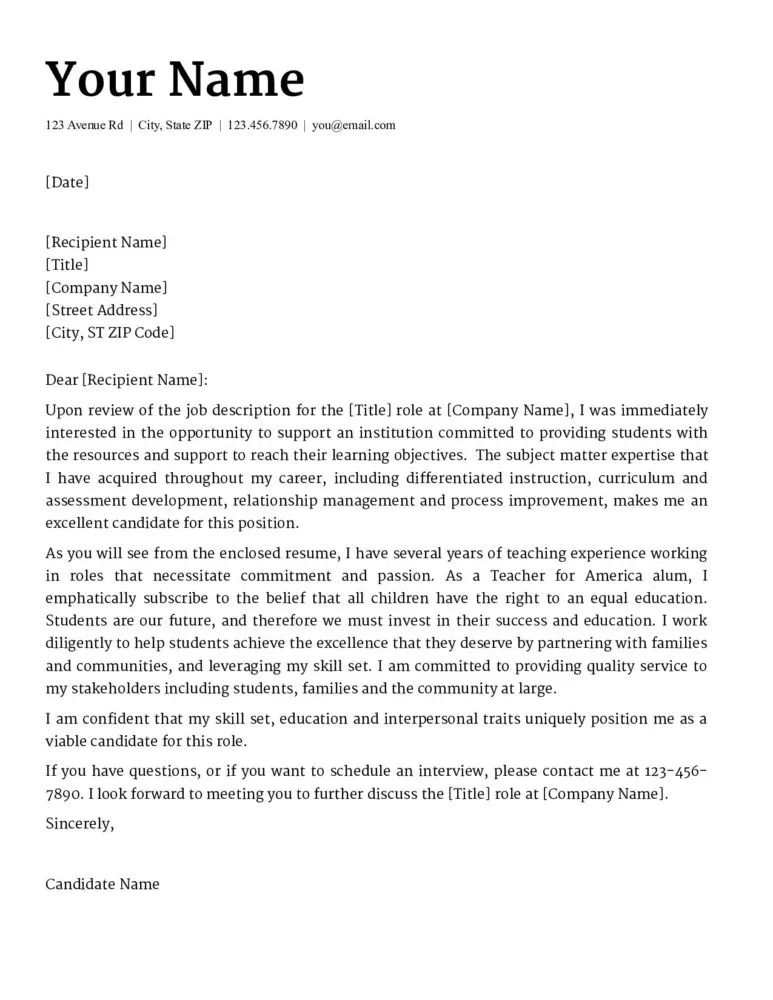
The header of your cover letter is the first thing a hiring manager will see, so it’s critical to make a professional and organized impression. Begin with your contact information, including your full name, phone number, email address, and if applicable, your LinkedIn profile URL. This information should be clearly presented and easy to find. Following your contact details, include the date, and then the recipient’s information, starting with their name, title, the school’s name, and the school’s address. This ensures that you are addressing the letter correctly and demonstrates your attention to detail. Using a clean and professional font, such as Times New Roman or Arial, also helps create a polished appearance.
Your Contact Information
Start with your full name, clearly displayed at the top. Below your name, include your phone number, ensuring it is current and professional. Your email address should also be included; choose a professional-sounding email address. Consider adding a link to your LinkedIn profile to offer more information about your professional background. This allows the hiring manager to quickly find and review your online presence. Accuracy and presentation in this section are critical, as it ensures the recruiter can easily reach you.
Date and Recipient’s Information
Following your contact details, add the current date. Directly below the date, address the recipient with their name, title, the school’s name, and the school’s address. If you know the hiring manager’s name, use it. Addressing the letter to a specific person demonstrates that you have done your research and shows attention to detail. Use the correct title to show professionalism. This meticulous attention to detail sets a positive tone from the start.
Salutation

The salutation sets the tone for the entire letter. If you know the hiring manager’s name, use ‘Dear Mr./Ms./Mx. [Last Name]’. It adds a personal touch. If you don’t know the name, use ‘Dear Hiring Committee’ or ‘Dear [School Name] Hiring Team’. Avoid generic greetings like ‘To Whom It May Concern’, which can make the letter feel impersonal. Always maintain a professional tone, reflecting respect and enthusiasm for the opportunity. The salutation creates the first point of contact and can immediately impact how the reader perceives the rest of your letter.
The Opening Paragraph
The opening paragraph is your chance to grab the reader’s attention and establish your interest in the position. Start by clearly stating the specific position you are applying for and how you learned about the opportunity. Express your enthusiasm for the role and the school. Briefly mention your key qualifications and experiences that align with the job requirements. Avoid generic statements and instead showcase your personality and teaching philosophy. Make your opening concise, engaging, and tailored to the specific school and position. Your goal is to make the reader want to continue reading. A strong opening can significantly influence the reader’s interest.
Expressing Enthusiasm and Identifying the Position
Begin by clearly stating the position you are applying for, being specific (e.g., ‘Elementary School Teacher for Grade 3’). Following that, express your genuine enthusiasm for the role and the school. Mentioning something specific that attracted you to the school helps demonstrate your interest. Highlight why you are excited about the opportunity to teach at their school. You could say, ‘I am writing to express my enthusiastic interest in the Grade 3 Elementary School Teacher position advertised on [Platform]. I am particularly drawn to [School Name]’s commitment to [School Value].’ This direct approach ensures the reader understands immediately why you are writing and what motivates your interest.
Highlighting Relevant Skills and Experiences

The body of your cover letter should highlight your relevant skills and experiences that align with the job requirements. Provide concrete examples to demonstrate your abilities, focusing on your accomplishments and how you have positively impacted students in the past. This is your opportunity to show, not just tell, what you can do. Use action verbs to describe your experiences and quantify your achievements whenever possible. This section should clearly connect your qualifications with the school’s needs. Showcase your relevant teaching skills such as lesson planning, classroom management, and curriculum development. Keep your focus on how your skills and experiences align with the specific needs of the school and position.
Showcasing Education and Certifications
Include details about your education, highlighting degrees, certifications, and any specialized training relevant to the position. Mention your teaching credentials and any licenses or certifications that are required or preferred for the role. If you have earned any honors or awards, be sure to mention them. Also include the name of the institution and the date of your graduation. Be specific, such as mentioning your specialization, and how these certifications align with the school’s needs and values. This demonstrates that you have the necessary foundation and ongoing commitment to professional development.
Demonstrating Classroom Management Skills
Highlight your classroom management skills, as this is a crucial aspect of teaching. Describe your approach to creating a positive and productive learning environment. Provide specific examples of how you have successfully managed student behavior, resolved conflicts, and fostered a collaborative classroom culture. Mention any specific strategies or techniques you use, such as positive reinforcement, clear expectations, or restorative justice practices. Show how you create a supportive and engaging environment where students feel safe and motivated to learn. Demonstrate your ability to handle diverse student needs.
Highlighting Achievements and Accomplishments
Provide specific examples of your achievements and accomplishments in previous teaching roles. Use the STAR method (Situation, Task, Action, Result) to structure your examples. Briefly describe the situation or context. Explain the task you were assigned. Detail the actions you took to address the challenge or achieve the goal. Most importantly, describe the results of your actions, quantifying them whenever possible. For example, ‘Implemented a new reading program that increased student reading comprehension scores by 15% within the first year.’ This showcases your ability to drive positive outcomes and demonstrates your value as an educator.
Quantifying Your Successes
Whenever possible, quantify your achievements with data and numbers. Instead of saying ‘Improved student engagement’, state ‘Increased student engagement by 20% using interactive learning activities.’ Quantifying your successes adds credibility and demonstrates the impact of your work. Use metrics such as test scores, attendance rates, or participation levels to showcase your effectiveness. For example, ‘Improved student test scores in mathematics by 10% through differentiated instruction.’ This demonstrates your ability to analyze data and achieve tangible results.
Providing Examples of Teaching Philosophies
Share your teaching philosophy, emphasizing your beliefs about education and how you create a positive learning environment. Briefly describe your approach to instruction, classroom management, and student assessment. Explain how you differentiate instruction to meet the needs of diverse learners. Mention any specific educational philosophies or approaches that guide your teaching practice, such as project-based learning, inquiry-based learning, or a student-centered approach. Make sure your philosophy aligns with the school’s values and mission. Demonstrate that you have a clear understanding of what constitutes effective teaching and how you contribute to student success.
Tailoring the Cover Letter to the School

One of the most critical aspects of a successful cover letter is tailoring it to the specific school and position. Generic cover letters are easily identified and often discarded. Demonstrate that you have researched the school and understand its values, mission, and needs. Your cover letter should reflect your genuine interest in the school and your ability to contribute to its specific goals. Tailoring your cover letter will show the hiring manager that you are genuinely interested in their specific role. Take the time to research the school, the position, and the school’s needs.
Researching the School’s Values and Mission
Before writing your cover letter, thoroughly research the school’s mission, values, and any recent initiatives. Visit the school’s website to understand their vision, educational approach, and any specific programs or goals. Identify the school’s culture, core values, and any special programs that resonate with your teaching philosophy. You can also read testimonials from current teachers, review parent feedback, or check the school’s social media. This research provides the information you need to tailor your letter to the specific school. Understanding their values will help you highlight how your skills and experiences align with their mission.
Incorporating School-Specific Keywords
Incorporate keywords from the job description and the school’s website into your cover letter. This shows that you have carefully read the job posting and understand what the school is looking for. Using the same language as the job description helps demonstrate that you meet the requirements. If the job posting emphasizes a specific teaching method or technology, mention your experience with it. Be sure to use these keywords naturally and strategically throughout the letter, ensuring that your language reflects the school’s culture and priorities. This targeted approach helps the hiring manager see you as a relevant candidate.
The Closing Paragraph

Your closing paragraph should reiterate your interest in the position, offer contact information, and thank the reader for their time and consideration. Reiterate your enthusiasm for the opportunity and express your eagerness to discuss your qualifications further. Provide your contact information again, including your phone number and email address, to make it easy for the hiring manager to reach you. Always thank the reader for their time and consideration. Conclude with a professional closing, such as ‘Sincerely’ or ‘Respectfully’. This final paragraph provides a concise, professional, and memorable conclusion.
Reiterating Interest and Offering Contact Information
Restate your interest in the position and express your enthusiasm to the hiring manager. Offer to provide more information, answer any questions they may have, and reiterate your availability for an interview. Provide your contact information, including your phone number and email address, again to make it easy for them to contact you. Ensure your contact information is accurate and professional. This final touch reinforces your interest and makes it simple for the hiring manager to reach you.
Thanking the Reader
Conclude your cover letter by thanking the reader for their time and consideration. Express your appreciation for their review of your application and acknowledge the effort they put into reviewing each application. Use a formal and respectful closing, such as ‘Sincerely’ or ‘Respectfully,’ followed by your full name. This courteous gesture shows respect and leaves a positive impression, demonstrating your professionalism and gratitude. Your closing words reflect courtesy and professionalism.
Formatting and Proofreading Your Cover Letter

Proper formatting and meticulous proofreading are essential for creating a professional cover letter that impresses hiring managers. Pay attention to the visual presentation of your document, ensuring it is neat, easy to read, and free of errors. Take the time to format your cover letter correctly and proofread it for errors before you submit it. This section ensures your cover letter is easy to read and free of errors. A well-formatted and error-free cover letter demonstrates attention to detail and professionalism. Errors can undermine your credibility.
Choosing a Professional Font and Layout
Select a professional, easy-to-read font such as Times New Roman, Arial, or Calibri. Maintain a consistent font size (11 or 12 points) and use standard margins (1 inch on all sides) to create a clean, uncluttered appearance. Use single spacing within paragraphs and double spacing between paragraphs. Avoid excessive use of bolding, italics, or underlining. Ensure your formatting is consistent throughout the document. These simple measures enhance readability and contribute to a professional appearance.
Proofreading for Grammar and Spelling Errors
Carefully proofread your cover letter for any grammatical errors, spelling mistakes, and punctuation errors. Use a grammar checker, but don’t rely on it entirely. Read your letter aloud to catch any awkward phrasing or sentence structure issues. Ask a friend, mentor, or career advisor to review your letter for errors. A polished, error-free cover letter demonstrates your attention to detail and professionalism. Attention to detail is one of the most important aspects for a new teacher.
Common Mistakes to Avoid
To ensure your cover letter is effective, avoid common mistakes that can undermine your application. Avoid errors by carefully reviewing your letter. Poorly crafted letters can result in your application being rejected. Common mistakes that often lead to rejection can make your application be ignored.
Using Generic Language
Avoid using generic, vague, or overly general language. Tailor your cover letter to the specific job and school, using specific examples and demonstrating your unique skills. Phrases like ‘hardworking,’ ’team player,’ and ’excellent communicator’ are overused and don’t provide any real value. Instead, show these qualities through specific examples. For example, rather than saying ‘I am a good communicator,’ write, ‘During my student teaching, I successfully communicated with parents, administrators, and students to ensure a collaborative learning environment.’
Focusing Solely on Yourself
While it’s important to highlight your skills and experiences, avoid making your cover letter all about you. Focus on the school’s needs and how you can contribute to their goals. Connect your skills to the school’s needs and the requirements of the position. Demonstrate your understanding of the school’s mission and values and how your experience aligns with their needs. Emphasize the benefits that you would bring to the school. Use ‘you-focused’ language to show your commitment to the role.
Failing to Tailor the Letter
Do not submit a generic cover letter. Customize each cover letter to the specific job and school. Research the school’s mission, values, and any specific requirements for the position. Use keywords from the job description and highlight the experiences and skills that align with the school’s needs. Failing to tailor your cover letter is a clear indication that you are not genuinely interested in the role. This is one of the most important aspects when writing a cover letter.
Examples of Cover Letter
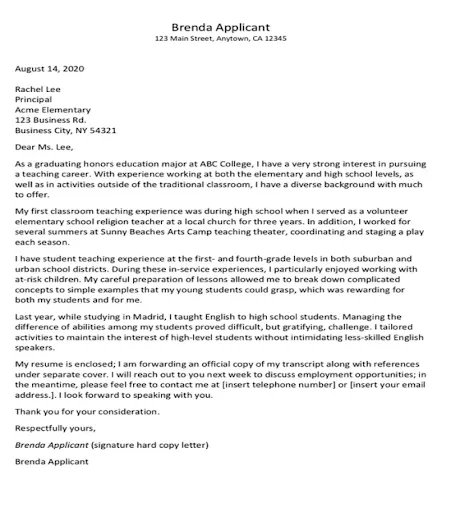
Include examples of successful cover letters. This includes general templates and examples for different levels of experience. Include examples of cover letters for different types of teaching positions, such as elementary, middle, and high school. Provide a template that new teachers can adapt. This can guide new teachers, and highlight key points for them.
Cover Letter Checklist for New Teachers
Use a checklist for a new teacher cover letter to help ensure that all essential elements are included. Review the cover letter, and make sure to do a final proofread. The checklist will make sure the cover letter is complete. The checklist can also prevent common mistakes. Consider the following items: Contact information, recipient’s information, salutation, an opening paragraph, skills and experience highlights, details about education and certification, classroom management skills, achievement and accomplishment examples, tailoring your cover letter to the school, closing paragraph, formatting, and proofreading.