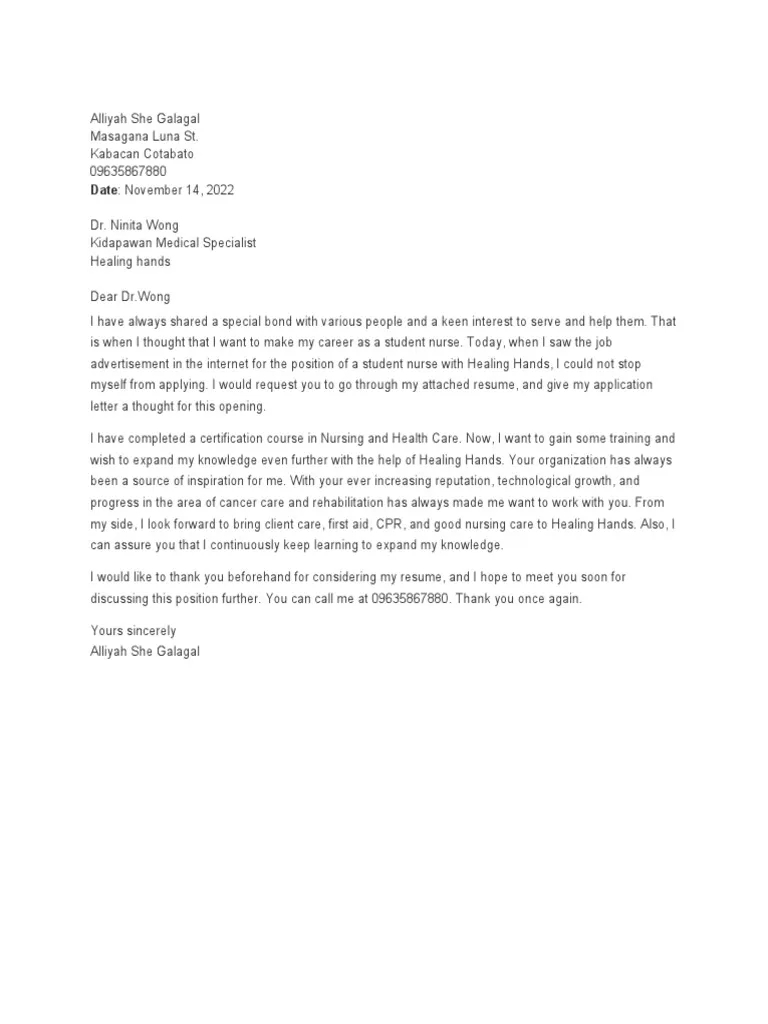
Crafting a Winning Nursing Student Cover Letter
A well-crafted cover letter is your first opportunity to make a positive impression on potential employers. For nursing students, the cover letter serves as a crucial tool to highlight your skills, experience, and enthusiasm for the field. It’s more than just a formality; it’s your chance to demonstrate why you’re the ideal candidate for the position and stand out from the crowd. In this guide, we’ll delve into the essential components of a nursing student cover letter, providing you with the knowledge and tools to create a compelling document that secures you an interview and ultimately, your dream job.
Understanding the Purpose of a Cover Letter
The primary purpose of a cover letter is to introduce yourself, express your interest in the position, and showcase how your qualifications align with the employer’s needs. It provides a space to elaborate on your resume, highlighting specific skills and experiences that make you a strong fit for the role. Think of it as a narrative that complements your resume, offering a deeper insight into your personality, work ethic, and career aspirations. It should demonstrate your understanding of the healthcare environment and your commitment to providing excellent patient care.
Highlighting Your Skills and Experience

As a nursing student, your experience may be limited, but that doesn’t mean you have nothing to offer. Focus on the skills you’ve gained through clinical rotations, volunteer work, and academic projects. Emphasize any specialized training or certifications you’ve obtained, such as Basic Life Support (BLS) or Advanced Cardiac Life Support (ACLS). Quantify your achievements whenever possible. For example, you could mention the number of patients you assisted or any positive feedback you received from supervisors. This will give the employer a clear view of your abilities. Also, showcase your soft skills, such as communication, teamwork, and problem-solving abilities.
Addressing the Employer’s Needs
Research the healthcare facility or organization you’re applying to. Understand their mission, values, and the specific requirements of the job. Tailor your cover letter to address these needs. Highlight how your skills and experiences align with their expectations and how you can contribute to their team. Demonstrate your knowledge of the healthcare landscape and your commitment to patient care. Show them that you’ve done your homework and are genuinely interested in working for them. This personalized approach shows that you care about the role, and the institution.
Essential Components of a Nursing Student Cover Letter
Contact Information

Start with your full name, address, phone number, and email address. Ensure your email address is professional. Include the date and the hiring manager’s name and title, if available. If you don’t know the hiring manager’s name, use a general salutation, such as ‘Dear Hiring Manager.’
The Greeting
Address the hiring manager directly, if possible. A personalized greeting shows that you’ve taken the time to research the organization. Avoid generic greetings like ‘To Whom It May Concern.’ Instead, use ‘Dear Mr./Ms./Mx. [Last Name].’ If you don’t know the hiring manager’s name, use a general greeting like ‘Dear Hiring Manager’ or ‘Dear Nursing Recruitment Team.’
Body Paragraphs
The body paragraphs are the heart of your cover letter. Here, you’ll expand on your skills, experiences, and qualifications, using the following structure to provide context. It is where you convince the employer that you are the best candidate for the job.
Expressing Your Interest and Enthusiasm

In the first paragraph, state the position you’re applying for and where you found the job posting. Express your genuine interest in the role and the organization. Briefly mention what attracted you to the position and why you’re excited about the opportunity. Show your passion for nursing and your commitment to patient care. Let the employer know that you are excited for the opportunity.
Showcasing Relevant Skills and Experiences
In the subsequent paragraphs, highlight your relevant skills and experiences. Use specific examples from your clinical rotations, volunteer work, or academic projects. Quantify your achievements whenever possible. For instance, you can mention that you assisted with the care of a certain number of patients or that you successfully implemented a new procedure. Relate your skills back to the job description. If the job requires strong communication skills, provide examples of times you successfully communicated with patients, families, or other healthcare professionals. Focus on the skills, experiences, and qualifications that make you a strong candidate for the position.
Tailoring Your Letter to the Job
Tailor your cover letter to each job you apply for. Review the job description carefully and highlight the skills and experiences that align with the requirements. Use the same keywords and phrases from the job description. Show that you understand the organization’s mission and values and how you can contribute to their success. Customize each letter to reflect your genuine interest in that specific role and organization, showing that you’ve put in the effort to understand their needs and goals.
The Closing

In the closing paragraph, reiterate your interest in the position and thank the hiring manager for their time and consideration. Express your availability for an interview and how you can be reached. Use a professional closing, such as ‘Sincerely,’ ‘Best regards,’ or ‘Thank you.’ Proofread the entire letter again before sending it.
Formatting and Proofreading
Font and Style Guidelines
Choose a professional and easy-to-read font, such as Times New Roman, Arial, or Calibri. Use a font size between 10 and 12 points. Maintain consistent formatting throughout the letter, including line spacing and margins. Use a standard business letter format with single spacing within paragraphs and double spacing between paragraphs. Ensure your letter is visually appealing and easy to navigate, making it easy for the hiring manager to read.
Proofreading Checklist

Before submitting your cover letter, carefully proofread it for any errors. Check for typos, grammatical errors, and spelling mistakes. Ensure your contact information is accurate. Ask a friend, family member, or career advisor to review your letter for clarity and accuracy. A well-proofread cover letter demonstrates professionalism and attention to detail. Double check everything, from capitalization to the correct job title, before submitting. Ensure the tone is suitable and that you have addressed the right person.
Examples of Effective Nursing Student Cover Letters
Reviewing examples can help you understand how to structure your cover letter and highlight your qualifications effectively. The following examples showcase different approaches to highlight skills and experiences. Use these examples as a guide, but remember to tailor your cover letter to reflect your unique experiences and the specific job requirements.
Example 1 Focus on Clinical Skills
In this example, the student highlights clinical skills gained during their rotations, such as patient assessment, medication administration, and wound care. They emphasize their ability to work in a fast-paced environment and their commitment to providing excellent patient care. This is a great way to showcase your experience in the field and provide employers with confidence in your work abilities. Here is an example of what a paragraph would look like: ‘During my clinical rotation at [Hospital Name], I administered medications to over 50 patients, ensuring accurate dosages and timely delivery. I have honed my ability to assess patient conditions, prioritize tasks, and communicate effectively with both patients and healthcare professionals.’
Example 2 Highlight Leadership Qualities

This example focuses on leadership skills demonstrated through volunteer work or academic projects. The student emphasizes their ability to lead teams, manage projects, and motivate others. They show how they’ve taken initiative and gone above and beyond in their roles. Consider an example: ‘As a team lead in the Nursing Students Association, I organized and led a fundraising event that raised over $5,000 for community health initiatives. I have experience coordinating and leading teams, and my organizational and communication skills have led to many successful projects.’
Example 3 Emphasize Volunteer Experience
Here, the student focuses on volunteer experience to showcase their dedication to patient care and community involvement. They highlight their empathy, compassion, and ability to work with diverse populations. Consider the example: ‘During my time at [Volunteer Organization], I provided emotional support and assistance to patients and families facing difficult circumstances. I am able to work with diverse populations, and am known for my empathy and compassion.’ They emphasize their ability to work with diverse populations and their genuine desire to make a difference.
Final Thoughts
Writing a nursing student cover letter that lands you a job is a crucial part of the job-search process. By following the guidelines above, you can create a cover letter that highlights your skills and experience, addresses the employer’s needs, and sets you apart from the competition. Remember to tailor your letter to each job, proofread carefully, and showcase your passion for nursing. By following these tips, you will be well on your way to securing your dream job in the healthcare field. Your attention to detail and commitment to excellence will make a difference.