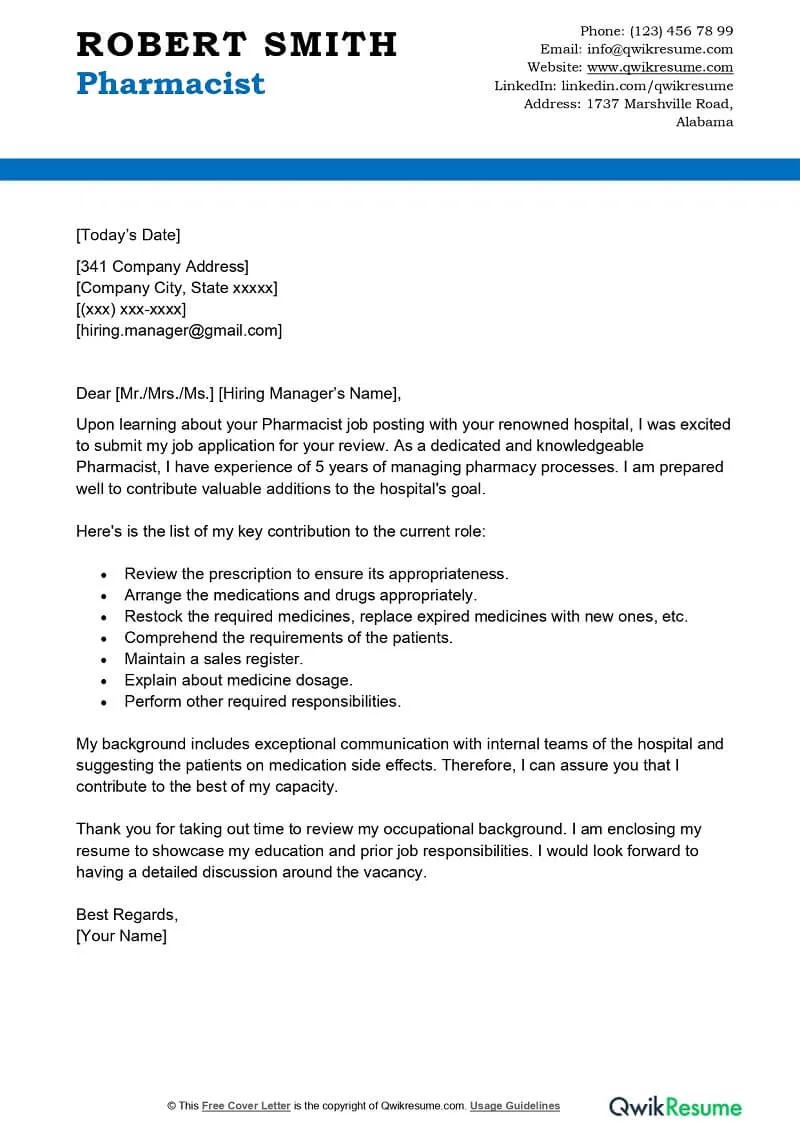
Crafting a Winning Pharmacist Cover Letter
A well-crafted pharmacist cover letter is a crucial tool in your job search arsenal, serving as your initial introduction to potential employers. It’s not merely a formality; it’s your opportunity to showcase your personality, passion for pharmacy, and unique qualifications. This guide will provide you with step-by-step instructions, helpful tips, and actionable advice to create a compelling cover letter that will significantly increase your chances of landing an interview and ultimately, your dream job. From understanding its purpose to avoiding common pitfalls, we’ll cover everything you need to know to make a lasting impression.
Understanding the Purpose of a Cover Letter
The primary purpose of a pharmacist cover letter is to introduce yourself and express your interest in a specific position, as well as to highlight your relevant skills and qualifications. Think of it as a personal narrative that complements your resume. While your resume provides a concise overview of your experience and education, your cover letter allows you to elaborate on your achievements, explain why you’re a perfect fit for the role, and demonstrate your enthusiasm for the opportunity. This is your chance to connect with the hiring manager on a more personal level.
Highlighting Key Skills and Qualifications

Your cover letter should prominently feature the key skills and qualifications that align with the job description. Review the job posting carefully and identify the most important requirements. Then, tailor your cover letter to showcase how your experience and skills match those requirements. This could include your proficiency in medication dispensing, patient counseling, clinical knowledge, experience with pharmacy software, or leadership abilities. Make sure to provide specific examples to illustrate your skills and accomplishments. For example, instead of simply stating “Proficient in patient counseling,” you could write, “Successfully counseled over 100 patients per week, resulting in a 15% increase in medication adherence.” This detail will help you stand out.
Essential Components of a Pharmacist Cover Letter
Contact Information and Salutation
Begin your cover letter with your contact information, including your name, phone number, email address, and professional online profiles like LinkedIn. Always address the hiring manager by name. If you’re unsure of the hiring manager’s name, research the company’s website or LinkedIn to find it. Addressing the letter to a specific person shows you’ve taken the time to personalize your application. If you can’t find a name, use a professional salutation like “Dear Hiring Manager.”
Opening Paragraph and Hook

Your opening paragraph should immediately grab the reader’s attention. Clearly state the position you’re applying for and how you learned about the opportunity. Briefly mention your most relevant qualification or accomplishment to pique their interest. This is your chance to make a strong first impression. Example: “I am writing to express my keen interest in the Pharmacist position at [Company Name], as advertised on [Platform]. With five years of experience in retail pharmacy and a proven track record of improving patient outcomes, I am confident I possess the skills and dedication to excel in this role.”
Body Paragraphs Detailing Experience and Skills
The body paragraphs are where you elaborate on your experience and skills, linking them to the requirements outlined in the job description. Provide specific examples of how you’ve demonstrated those skills in previous roles. Use the STAR method (Situation, Task, Action, Result) to structure your examples: Describe the situation, the task you were assigned, the actions you took, and the positive results you achieved. Quantify your achievements whenever possible to demonstrate your impact. This section should highlight your most relevant skills and accomplishments.
Quantifying Achievements and Contributions
Whenever possible, quantify your achievements to demonstrate your impact. Use numbers and data to highlight your accomplishments. For example, instead of saying “Improved patient adherence,” say “Improved patient adherence by 20% through implementing a new medication counseling program.” Quantifiable results make your cover letter more impactful and show the hiring manager the tangible benefits you can bring to their organization. Other examples include the number of prescriptions you filled per day, the reduction in medication errors, or the positive feedback you received from patients.
Closing Paragraph and Call to Action

In your closing paragraph, reiterate your interest in the position and express your enthusiasm for the opportunity. Thank the hiring manager for their time and consideration. Include a clear call to action, such as, “I am eager to learn more about this opportunity and discuss how my skills and experience align with your needs. I am available for an interview at your earliest convenience.” Providing a call to action makes it easier for the hiring manager to move forward and consider your application for the next step.
Formatting and Design Best Practices
Choosing the Right Font and Font Size
Use a professional and easy-to-read font, such as Times New Roman, Arial, or Calibri. The font size should be between 10 and 12 points for readability. Ensure consistent formatting throughout your cover letter, including consistent spacing, alignment, and use of bullet points if necessary. A well-formatted cover letter is easier to read and demonstrates your attention to detail. Avoid using overly decorative fonts or excessive formatting, as this can distract from the content.
Maintaining Professionalism and Clarity

Maintain a professional tone throughout your cover letter. Use formal language and avoid slang or jargon. Ensure your writing is clear, concise, and easy to understand. Use strong action verbs to describe your accomplishments and skills. Proofread carefully for any grammatical errors or typos. Your cover letter should reflect your professionalism and attention to detail, as this is your first impression on the potential employer. Make sure your contact information is accurate and easily accessible.
Proofreading and Editing for Perfection
Proofreading is critical. Before submitting your cover letter, carefully proofread it for any spelling, grammar, and punctuation errors. Ask a friend, family member, or career advisor to review your cover letter as well. Fresh eyes can often catch mistakes that you might have missed. A polished and error-free cover letter demonstrates your professionalism and attention to detail, which are important qualities in a pharmacist.
Tailoring Your Cover Letter to Specific Jobs
Researching the Employer and Job Requirements

Before you start writing, research the employer and the specific job requirements. Visit the company’s website to learn more about their mission, values, and culture. Carefully review the job description and identify the key skills and qualifications the employer is seeking. Tailor your cover letter to directly address those requirements and demonstrate how your experience and skills align with the company’s needs. This shows the employer that you’ve taken the time to understand their organization and are genuinely interested in the position.
Customizing Your Letter for Each Application
Avoid using a generic cover letter for every job application. Instead, customize your cover letter for each position you apply for. Highlight the skills and experiences that are most relevant to the specific job requirements. Modify your opening paragraph to reflect your genuine interest in the company and the role. Personalizing your cover letter shows the employer that you’ve taken the time to understand their needs and are serious about the opportunity. Generic cover letters often get overlooked.
Addressing Common Mistakes in Pharmacist Cover Letters
Generic vs. Specific Cover Letters

One of the most common mistakes is using a generic cover letter that could apply to any job. Recruiters can easily spot a generic cover letter. Instead, customize your letter to each specific job. Research the employer and the role to show how your skills and experience match their needs and interests. This level of personalization shows you are serious about the opportunity and have taken the time to understand the role and the company.
Overlooking the Importance of Keywords
Failing to include relevant keywords from the job description is another common mistake. Many companies use applicant tracking systems (ATS) to scan resumes and cover letters for specific keywords. If your cover letter doesn’t contain the right keywords, it may be rejected even if you’re qualified. Carefully review the job description and incorporate the key skills and qualifications throughout your cover letter, ensuring you’re using the same language the employer has used.
Failing to Showcase Personality and Enthusiasm
A cover letter is an opportunity to showcase your personality and enthusiasm. A bland and impersonal letter will not leave a lasting impression. Use a professional tone, but also let your passion for pharmacy shine through. Share your genuine interest in the role, company, and the pharmacy field. Tell the reader why you are interested in working for the company. Your enthusiasm can make you more memorable.
Resources and Templates for Pharmacist Cover Letters
Numerous resources and templates are available online to assist you in crafting a compelling pharmacist cover letter. Utilize these resources as a starting point, but always customize your letter to reflect your unique skills, experience, and the specific requirements of the job. Consider using online cover letter builders, searching for examples from your university’s career services, or consulting with a career advisor for personalized guidance. These resources can provide you with structure, inspiration, and valuable insights to help you create a cover letter that stands out from the competition.