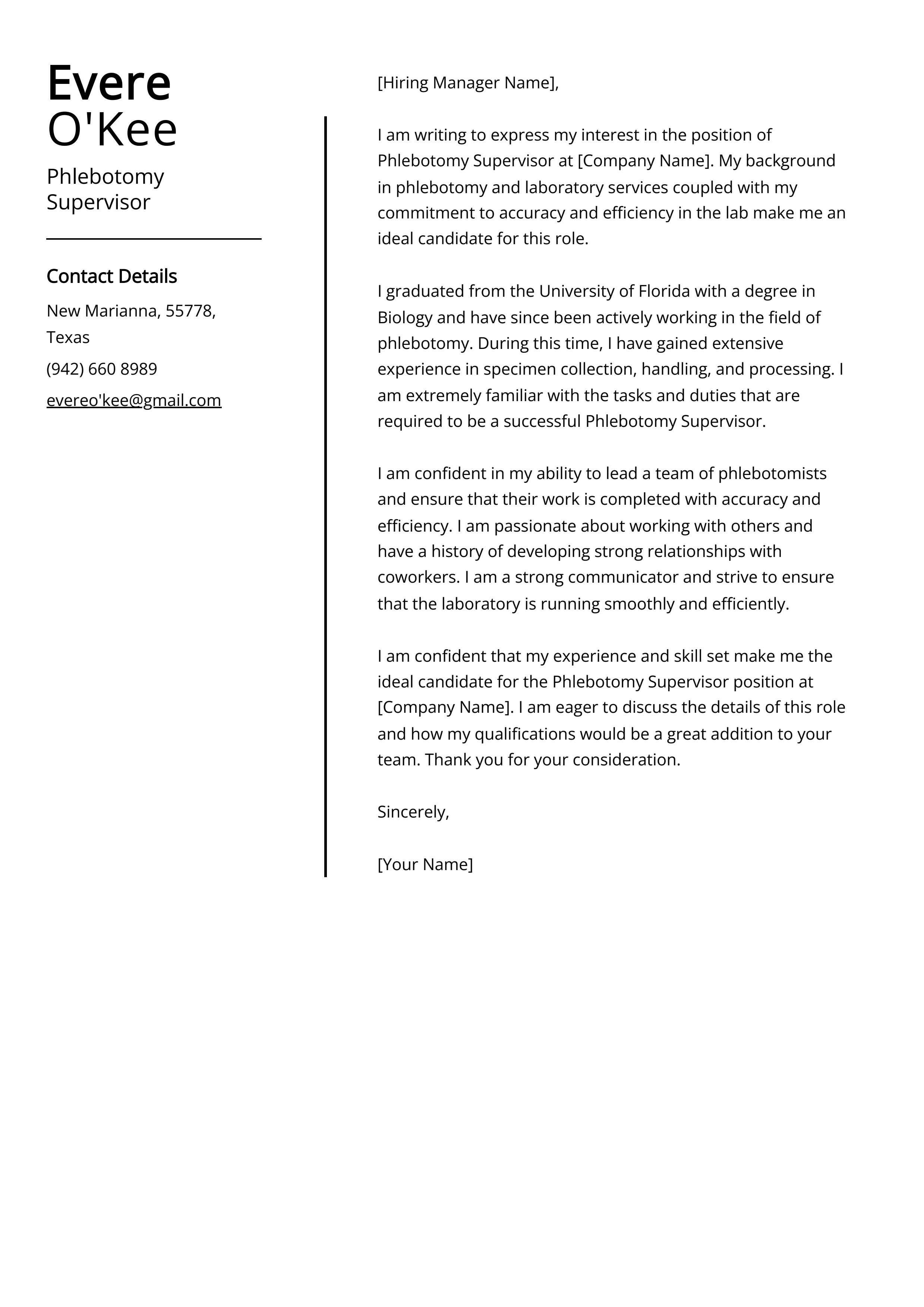
What is a Phlebotomy Cover Letter
A phlebotomy cover letter is your first chance to make a great impression on a potential employer. It’s a formal document submitted with your resume when you’re applying for a phlebotomy position, offering an opportunity to highlight your skills and experiences. More than just a summary of your qualifications, a cover letter allows you to showcase how you match the specific job requirements and the company’s needs. A well-written cover letter can significantly increase your chances of securing an interview and landing your dream job. It’s a great way to show why you are the ideal candidate and gives you a leg up on the competition.
Purpose of a Phlebotomy Cover Letter
The primary goal of a phlebotomy cover letter is to convince the hiring manager that you are the best fit for the job. This goes far beyond listing your credentials, allowing you to connect your skills directly to the job description. By showing a clear understanding of the role and matching your experience to the employer’s needs, you can have a powerful impact on your application. It allows you to expand on your experiences, discuss any gaps in your resume, and highlight your sincere interest in the position and the organization. This is a key way to show your personality, communication skills, and dedication to the field of phlebotomy.
Key Components of a Phlebotomy Cover Letter

Header and Contact Information
Begin your cover letter with a professional header that includes your full name, address, phone number, and a professional-looking email address. Place the date and the hiring manager’s name and title (if known) and the company’s address just below your contact information. Proper formatting sets a professional tone and makes it easy for the hiring manager to contact you. Having a clean header shows attention to detail, a crucial skill in phlebotomy, and makes it easy for the hiring manager to reach out. This is the first thing the reader sees, so make sure it’s polished and easy to read. See image (phlebotomy-cover-letter-header).
Greeting
Always address the hiring manager by name if possible. Use a professional greeting like ‘Dear Mr./Ms./Mx. [Last Name]’. If the name of the hiring manager is not available, ‘Dear Hiring Manager’ is acceptable. Making sure you know the name of the hiring manager shows you have done your homework and shows initiative and attention to detail. It also grabs the reader’s attention and makes the letter more engaging, increasing the chance they’ll read the whole thing. A specific greeting sets the tone for a personalized and attentive approach, making you stand out.
Body Paragraph 1 Introduce Yourself

Start by clearly stating the position you are applying for and how you discovered the opening. Give a brief mention of your most relevant qualifications or the key experience that makes you a strong candidate. This opening paragraph is important to grab the reader’s attention. It gives context for the rest of the letter and lets the hiring manager know why you’re applying for the job. Clearly stating your intention and highlighting a key skill from the beginning will set your cover letter off on the right foot.
Body Paragraph 2 Highlight Skills and Experience
This is where you showcase your skills and experience as a phlebotomist. Back up your claims with specific examples. For instance, mention your experience with venipuncture, patient care, and lab procedures. Whenever possible, quantify your achievements (e.g., ‘performed an average of 50 successful blood draws daily’). Match your skills to the requirements in the job description. This helps you highlight your competencies to prove you’re a great fit for the role. Use strong action verbs (such as ‘performed,’ ‘managed,’ or ‘assisted’) to describe your accomplishments. See image (phlebotomy-cover-letter-skills) for a good reference.
Body Paragraph 3 Express Enthusiasm and Interest
Express your genuine enthusiasm for the position and the company. Explain why you are interested in working there and what attracts you to their mission or values. Show that you’ve researched the company and understand their goals. Personalize your statement to match the employer’s specific needs and show that you wish to contribute to their success. Demonstrating your interest shows initiative and helps create a personal connection with the hiring manager. Expressing enthusiasm underscores your commitment to the role and the company and will help you to stand out from other candidates. See image (phlebotomy-cover-letter-enthusiasm).
Body Paragraph 4 Mention Job Specifics

If the job description includes any specific requirements, be sure to address them here. Provide information on any certifications, licenses, or specialized training you possess. Use this section to highlight any unique skills or experiences that make you stand out. Personalize your answer to directly match the needs of the employer, showing you are a thoughtful and prepared candidate. By mentioning your skills and experience and how they meet the specific requirements of the role, you add extra value to your application.
Closing and Call to Action
End with a strong call to action. Thank the hiring manager for their time and consideration. Indicate your availability for an interview and provide your contact information again, making it easy for them to reach you. Reiterate your interest in the position and express your confidence in your ability to contribute. A call to action shows professionalism and eagerness. It clearly indicates your next steps and makes it effortless for the hiring manager to contact you for an interview. Always sign off with a professional closing such as ‘Sincerely’ or ‘Best regards’.
Top 5 Tips for a Winning Phlebotomy Cover Letter
Tip 1 Tailor the Letter

Always customize your cover letter for each job you apply for. Don’t send a generic letter; instead, thoroughly research the company and review the job description. Identify the key skills and qualifications they are looking for and address them in your letter. Show how your experience matches the company’s specific needs and values. Customization shows that you’ve put in the effort to understand the role and the organization. Personalization significantly boosts your chances of getting noticed and selected for an interview. See image (phlebotomy-cover-letter-tailor) to guide your writing process.
Tip 2 Quantify Achievements
Use numbers and data to illustrate your accomplishments. Instead of saying you have ’experience with patient care,’ state you ‘provided care to an average of 30 patients daily.’ Quantifying your achievements makes your claims more credible and memorable. It provides tangible evidence of your skills and experience and allows the hiring manager to easily understand your value. Quantifying your achievements is a key way to strengthen your argument for your ability to excel in the phlebotomy role, making your achievements more impactful and memorable.
Tip 3 Proofread Carefully
Proofread your cover letter meticulously. Always check for grammatical errors, typos, and spelling mistakes. Have a friend or colleague review your letter, as a fresh pair of eyes can catch errors you might miss. Errors in your cover letter can create a negative impression and can undermine your professionalism. Proofreading ensures your letter is polished and error-free, which reflects positively on your attention to detail—a critical skill in phlebotomy. Demonstrating a commitment to accuracy shows that you take pride in your work. See image (phlebotomy-cover-letter-proofread) for proofreading tips.
Tip 4 Use Action Verbs

Incorporate strong action verbs to describe your skills and accomplishments. Use verbs like ‘performed,’ ‘managed,’ ‘assisted,’ ‘collected,’ ‘processed,’ and ‘maintained’ to actively show your abilities. Action verbs bring your cover letter to life and make your experiences more engaging. They demonstrate your proactive approach and ability to perform the duties of a phlebotomist. They make your descriptions more impactful and show your engagement. This will make your cover letter more dynamic and engaging for the reader. See image (phlebotomy-cover-letter-action-verbs) for inspiration.
Tip 5 Show Passion
Show your enthusiasm for phlebotomy and the company you’re applying to. Explain why you are passionate about healthcare and why you are drawn to this field. Demonstrate that you’ve researched the company and understand their values and mission. Including this personal touch will set you apart from other candidates. Showing a clear understanding of the company’s culture and goals helps you connect with the hiring manager on a deeper level. Your passion makes your cover letter more compelling.
Formatting and Design
Font and Layout

Choose a professional and easy-to-read font such as Times New Roman, Arial, or Calibri, with a font size between 10 and 12 points. Use a clean layout with clear headings, spacing, and paragraph breaks. Make sure your letter is well-organized and easy to scan. Proper formatting increases readability and gives your cover letter a professional look. It highlights your attention to detail and makes the document visually appealing. See image (phlebotomy-cover-letter-formatting).
Length of the Cover Letter
Keep your cover letter concise, preferably one page long. Focus on the most relevant information and avoid unnecessary details. Get straight to the point and make every word count. A concise cover letter respects the hiring manager’s time and helps them find the key information they need. If you’re struggling to keep your cover letter concise, focus on the most important qualifications and skills that make you a perfect fit for the role. Make sure it is concise and easy to read.
Common Mistakes to Avoid
Typos and Grammatical Errors

Carelessly written cover letters with typos and grammatical errors can immediately disqualify your application. Always proofread your letter carefully or have someone else review it to ensure accuracy. Errors reflect poorly on your attention to detail and professionalism. Proofreading and use of tools such as spell-check are crucial to make sure your letter has no errors, which will make or break your chances.
Generic Cover Letter
Avoid sending a generic cover letter. Tailor each letter to the specific job and company you’re applying to. Customize your letter to demonstrate that you’ve taken the time to understand the role. Generic letters show a lack of initiative and often get overlooked. Always customize your cover letter by researching the company and including information from the job description. A personalized letter will increase your chances of getting an interview.
Ignoring the Job Description
Carefully review the job description and address its requirements in your cover letter. Explain how your skills and experience match the employer’s needs. Ignoring the job description demonstrates a lack of attention to detail and an inability to follow instructions. Make sure you meet the requirements. If the job description asks for specific skills or qualifications, include them in your cover letter. This will show that you have read the job description thoroughly.
Conclusion
A well-written phlebotomy cover letter is a must to create a great impression and get you an interview. Use the tips in this guide to create a compelling cover letter that highlights your skills, experience, and passion for phlebotomy. Make sure you tailor each letter to the specific job, proofread carefully, and showcase your enthusiasm. By crafting a cover letter that follows these guidelines, you’ll significantly increase your chances of landing a phlebotomy position. Good luck with your job search!