Understanding the Importance of a Psychologist Cover Letter
A psychologist cover letter serves as your initial introduction to a potential employer, and it plays a crucial role in shaping their first impression of you. Unlike a resume, which is a factual summary of your qualifications, a cover letter allows you to showcase your personality, communication skills, and genuine interest in the specific position and organization. It’s your opportunity to elaborate on your experiences, highlight the skills that make you a strong candidate, and articulate why you are the perfect fit for the role. A well-crafted cover letter can significantly increase your chances of securing an interview, making it a vital part of any job application process in the field of psychology. This document is not just a formality; it is a strategic tool that allows you to distinguish yourself from other applicants and demonstrate your enthusiasm and suitability for the position.
Why a Cover Letter Matters
Cover letters matter because they provide context to your resume, which might not fully capture your motivations, passion, or how your skills align with the job requirements. They also offer a chance to address any potential gaps in your resume and explain your career goals. In a field like psychology, where interpersonal skills, empathy, and the ability to communicate effectively are paramount, a cover letter is a prime opportunity to exhibit these qualities. It shows your potential employer that you can write well, think critically, and understand the needs of the specific role and organization. Moreover, it demonstrates that you’ve taken the time to personalize your application, indicating your genuine interest and commitment to the opportunity, setting you apart from candidates who may have submitted generic applications.
Highlighting Your Skills and Experiences

In your cover letter, you should directly connect your skills and experiences to the job description’s requirements. Instead of merely listing your qualifications, explain how they have prepared you for the role. This can be done by providing specific examples of how you’ve applied your skills in previous roles or projects. For instance, if the job description emphasizes experience in cognitive behavioral therapy (CBT), you can share instances where you successfully implemented CBT techniques to help patients overcome challenges. Similarly, if the position requires strong assessment skills, describe how you’ve conducted assessments, analyzed data, and formulated treatment plans. This helps the hiring manager understand not just what you’ve done, but how well you’ve done it and the impact you’ve made.
Key Components of a Psychologist Cover Letter
Contact Information and Date
Begin your cover letter with your contact information, including your full name, phone number, email address, and optionally, your LinkedIn profile URL. This information should be clearly displayed at the top of the letter. Directly beneath your contact information, include the date of the letter. This provides essential details for the recipient and ensures that your application is easily traceable. Using a professional format for your contact information is key to a polished and professional presentation.
The Salutation

Always start with a professional salutation. If possible, address the hiring manager by name; this demonstrates that you’ve done your research and personalized your application. Use “Dear Dr. [Last Name]” or “Dear Mr./Ms./Mx. [Last Name]” if you know their name. If you are unsure of the hiring manager’s name, it is acceptable to use a more general greeting like “Dear Hiring Manager.” However, try to find out the name through the organization’s website, LinkedIn, or a phone call. A personalized salutation shows initiative and attention to detail.
Opening Paragraph
The opening paragraph should immediately capture the reader’s attention and state the purpose of your letter. Clearly mention the position you are applying for and where you saw the job posting. Briefly introduce yourself and explain why you are interested in the position and the organization. Show enthusiasm and mention something specific about the role or company that has piqued your interest. This sets the tone for the rest of the letter, letting the hiring manager know that you are a serious candidate who has done their homework.
Body Paragraphs
The body paragraphs are where you demonstrate your qualifications and experience. Focus on the skills and experiences most relevant to the job requirements, using specific examples to illustrate your abilities. This section is your opportunity to sell yourself, so highlight your key accomplishments and how you can contribute to the organization’s goals. Make sure the content is clear, concise, and easy to read, using a logical structure to help the hiring manager quickly understand your value proposition.
Highlighting Relevant Skills

Identify the key skills required for the position and provide evidence of your proficiency. Include both hard skills (e.g., specific therapeutic techniques, assessment tools, data analysis) and soft skills (e.g., communication, empathy, problem-solving, teamwork). For each skill, provide a brief description and an example of how you have utilized it in a professional context. Use action verbs (e.g., “developed,” “implemented,” “managed”) to describe your actions and achievements. Demonstrating the skills needed is essential to make your cover letter effective.
Showcasing Experience and Achievements
Provide detailed examples of your experience to highlight your accomplishments. Instead of simply listing your job duties, focus on what you achieved in each role. Quantify your accomplishments whenever possible; for example, you might state how many patients you treated, the improvement in client outcomes, or the percentage increase in patient satisfaction. Use the STAR method (Situation, Task, Action, Result) to structure your examples and make them more compelling. This approach helps you provide a clear and concise narrative that emphasizes your skills and the results you’ve achieved.
Quantifying Your Accomplishments
Whenever possible, use numbers and data to quantify your accomplishments and show the impact you’ve made. Instead of saying you “improved patient outcomes,” state that you “increased patient satisfaction by 20% through the implementation of a new therapeutic approach.” Instead of saying you “managed a large caseload,” specify the number of patients you worked with or how quickly you were able to manage and treat them. Quantifiable achievements demonstrate the tangible value you bring to an organization and provide concrete evidence of your skills and capabilities.
Closing Paragraph

In the closing paragraph, reiterate your interest in the position and the organization. Thank the hiring manager for their time and consideration. Express your enthusiasm for the opportunity to discuss your qualifications in more detail. This section should leave a lasting positive impression and re-emphasize why you are a strong candidate for the role. A strong closing paragraph is essential to keep you fresh in the hiring manager’s mind.
The Closing and Signature
Use a professional closing such as “Sincerely,” “Best regards,” or “Respectfully.” Leave space for your signature above your typed name if you are printing the letter. If submitting electronically, your typed name is sufficient. Ensure your signature is easy to read and aligns with the professional tone of your letter. This final step provides a formal conclusion to your cover letter and demonstrates your attention to detail.
Formatting Your Psychologist Cover Letter
Font and Formatting Guidelines

Choose a professional and easy-to-read font, such as Times New Roman, Arial, or Calibri. The font size should be between 10 and 12 points. Use single-spaced lines with a blank line between paragraphs. Align your text to the left and use standard 1-inch margins. A well-formatted letter is visually appealing and easy to read, which makes a positive impression on the hiring manager. Proper formatting also shows attention to detail and professionalism, reflecting positively on your overall application.
Proofreading and Editing
Carefully proofread your cover letter for any grammatical errors, typos, or inconsistencies. Spelling and grammatical errors can detract from your credibility and make you appear less professional. Read your letter aloud to catch any awkward phrasing or sentences that do not flow smoothly. Consider asking a friend, mentor, or career counselor to review your cover letter for feedback. Proofreading ensures that your cover letter is polished, professional, and effectively conveys your qualifications.
Tailoring Your Cover Letter for Each Application
Researching the Organization

Before writing your cover letter, thoroughly research the organization. Understand their mission, values, and the specific requirements of the position. Visit their website, read recent news articles, and check their social media profiles. Demonstrating that you understand the organization’s goals and culture will make your application more relevant and increase your chances of getting noticed. This shows initiative and a genuine interest in the opportunity.
Customizing Your Letter
Customize your cover letter to reflect the specific requirements and expectations of each job. Review the job description carefully and highlight the skills and experiences that align with the organization’s needs. Use keywords from the job description throughout your letter. Show how your qualifications meet the specific requirements of the position and explain why you are uniquely suited for the role. A customized cover letter demonstrates that you have carefully considered the opportunity and are a well-suited candidate.
Common Mistakes to Avoid
Generic Cover Letters
Avoid using generic cover letters that are not tailored to the specific job. Hiring managers can easily spot generic letters and will be less likely to consider your application. Always customize your cover letter to match the job description and the organization. Generic letters show a lack of interest and effort, which can reflect negatively on your candidacy.
Typos and Grammatical Errors
Carelessly written cover letters that are riddled with typos and grammatical errors are a major turn-off. Proofread your cover letter multiple times and have someone else review it. Errors damage your credibility and suggest a lack of attention to detail. Be meticulous with your grammar, spelling, and punctuation to ensure your cover letter presents you in the best possible light. Ensure that all sentences flow well and convey your message effectively.
Exceeding the Recommended Length
Keep your cover letter concise, aiming for one page. Hiring managers are busy and may not have time to read a lengthy cover letter. Focus on the most relevant information and avoid unnecessary details. Get straight to the point and clearly articulate why you are the best candidate for the job. A well-structured, concise cover letter demonstrates respect for the reader’s time and enhances your overall application.
Example of a Strong Psychologist Cover Letter
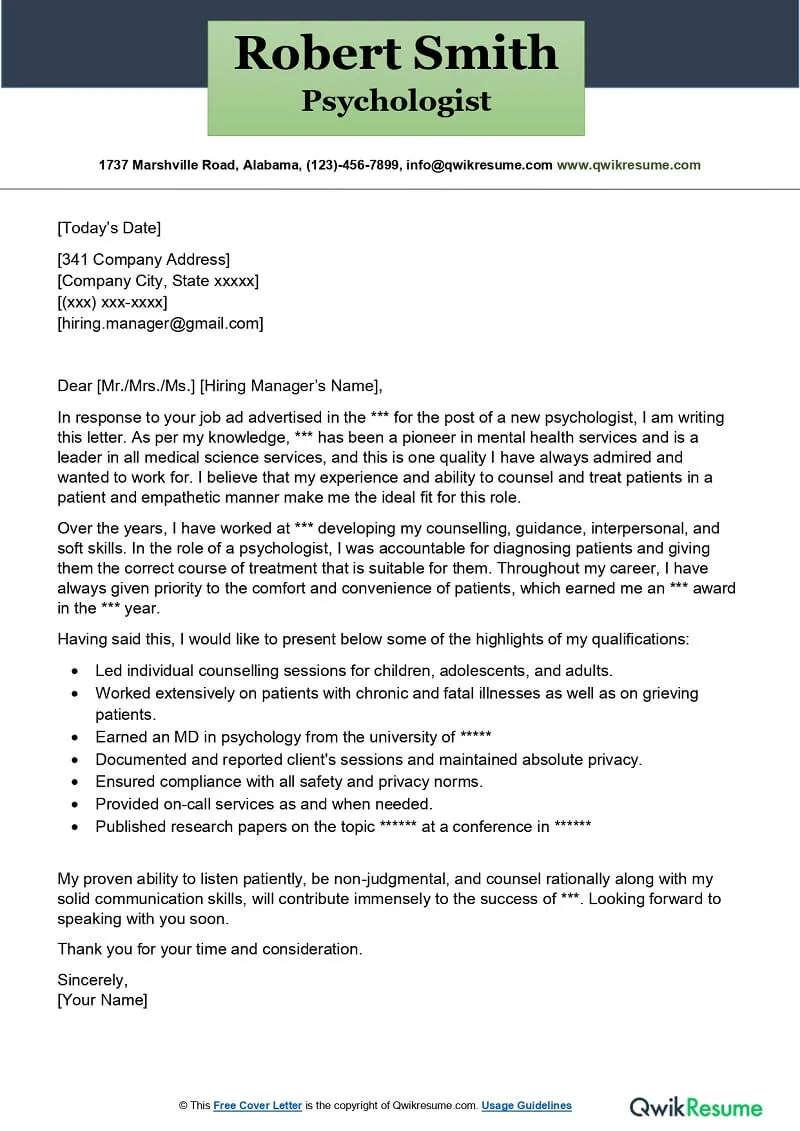
A strong psychologist cover letter balances professionalism with personality, demonstrates relevant skills, and highlights achievements. It showcases a clear understanding of the role and organization. Here’s a basic example to guide you, and it’s crucial to adapt the structure and content to reflect your individual experiences and the specific job you’re applying for. Remember to personalize it to stand out.
Reviewing the Example
Carefully study the example to understand how the different components of a psychologist cover letter come together. Note the tone, language, and structure. Pay attention to how skills and experiences are presented, and how achievements are quantified. Use the example as a guide, but customize it to accurately reflect your unique background, skills, and the specific job you’re applying for. Adapt this example, while ensuring your letter reflects your own style and perspective.