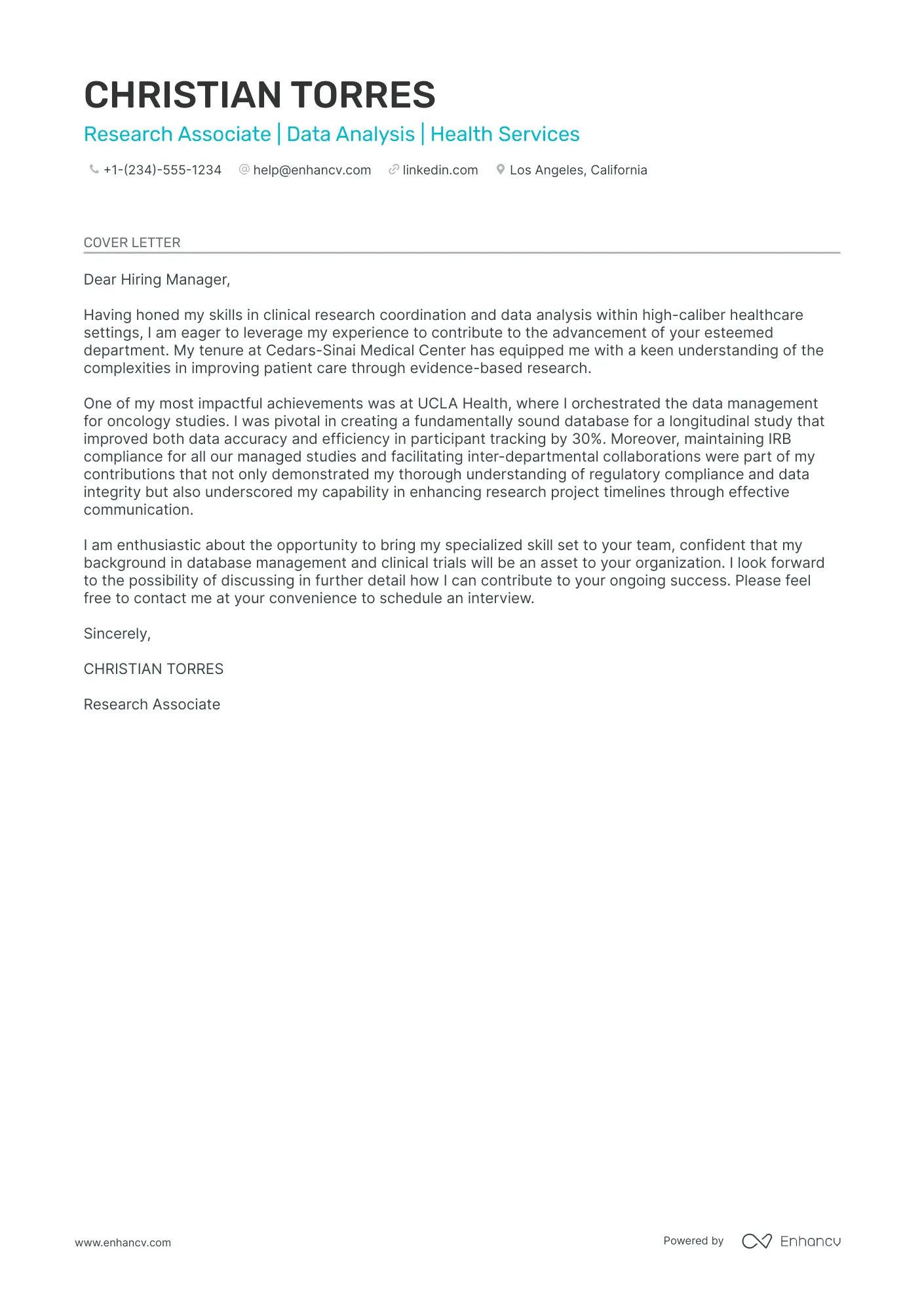
What is an RA Cover Letter?
An RA (Research Assistant) cover letter is a crucial document that accompanies your resume when applying for research assistant positions. Its primary purpose is to introduce you to the hiring manager, showcase your relevant skills and experiences, and express your interest in the specific role and institution. Unlike a resume, which provides a chronological overview of your work history, the cover letter allows you to elaborate on your qualifications and explain why you are a suitable candidate. It is your opportunity to make a compelling case for why you should be considered for the position and demonstrate your understanding of the research field and the specific research project. A well-crafted cover letter can significantly increase your chances of securing an interview.
Why is an RA Cover Letter Important?
The significance of an RA cover letter cannot be overstated, as it provides a personalized introduction beyond the scope of a resume. Firstly, it helps you stand out from other applicants by demonstrating your genuine interest in the specific position and the research being conducted. Secondly, it allows you to highlight your unique skills, experiences, and qualifications that align with the requirements of the job. It provides context to your resume entries, enabling you to explain how your past experiences have prepared you for the RA role. Furthermore, a cover letter showcases your communication skills and writing ability, which are essential for research assistants who often need to write reports, assist with publications, and communicate with colleagues and supervisors. Finally, a well-written cover letter can leave a lasting positive impression on the hiring manager and increase your chances of being selected for an interview.
Key Elements of a Strong RA Cover Letter

A compelling RA cover letter should include several key elements to effectively convey your qualifications and enthusiasm. Begin with a professional heading that includes your contact information, the date, and the recipient’s details. The opening paragraph should immediately capture the reader’s attention by clearly stating the position you are applying for and where you found the posting. The body of the letter should highlight relevant skills and experience, quantify accomplishments with specific examples, and demonstrate your understanding of the research project and the institution. Moreover, express your enthusiasm for the position, the research field, and the institution’s mission. Conclude with a strong closing paragraph that reiterates your interest, thanks the reader for their time, and includes a call to action, such as expressing your availability for an interview. Properly proofreading and formatting your cover letter is paramount to its effectiveness.
Your Contact Information
At the top of your cover letter, provide your full name, address, phone number, and professional email address. This information ensures that the hiring manager can easily contact you. Use a clear and professional font. Make sure your contact details are accurate and up-to-date. Avoid using an unprofessional email address; instead, opt for a combination of your first and last name.
The Date and Recipient’s Information
Following your contact information, include the current date. Below the date, provide the recipient’s details, including their name, title, and the department or institution where you are applying. If you know the hiring manager’s name, address your letter to them directly. If you don’t know the hiring manager’s name, you can use a general salutation such as “Dear Hiring Committee” or “Dear [Department Name] Hiring Manager”.
Greeting or Salutation

Choose a professional greeting. If you know the hiring manager’s name, use “Dear Mr./Ms./Mx. [Last Name]”. If you don’t know the name, use a more general greeting like “Dear Hiring Committee” or “Dear [Department Name] Hiring Manager”. Avoid overly casual greetings like “Hey” or “Hi”.
Crafting the Body of Your RA Cover Letter
The body of your RA cover letter is the heart of your application, where you articulate your qualifications and express your interest. Begin by clearly stating the position you are applying for and where you found the job posting. This allows the hiring manager to quickly understand your application’s purpose. Focus on highlighting your skills and experience, demonstrating a clear understanding of the role, quantifying your accomplishments, and expressing your enthusiasm for the research and institution. The length should be concise and focused, typically no more than one page. Each paragraph should serve a specific purpose in supporting your application and showcasing your suitability for the position. Keep the language clear, concise, and professional throughout.
Highlighting Relevant Skills and Experience
Identify the specific skills and experiences the employer is looking for by carefully reviewing the job description. Then, illustrate how your skills and experiences align with the requirements. Use specific examples from your past experiences, whether from academic projects, previous research roles, or other relevant work or volunteer activities. For instance, if the job description requires data analysis skills, describe your experience with statistical software or data management techniques. Emphasize skills such as data collection, analysis, report writing, or any lab techniques you may possess. Tailor each cover letter to the specific requirements of the position and always provide relevant context.
Quantifying Accomplishments and Results

Instead of simply listing your responsibilities, quantify your accomplishments whenever possible. Use numbers and metrics to demonstrate the impact of your work. For example, instead of saying “Assisted with data analysis”, say “Analyzed over 100 datasets, resulting in a 15% improvement in data processing efficiency”. Quantifying your achievements provides concrete evidence of your capabilities and allows the hiring manager to quickly assess your potential contributions. Be specific and provide details, such as the tools you used, the projects you worked on, and the results you achieved.
Demonstrating Your Understanding of the Role
Show the hiring manager that you understand the specific requirements of the research assistant role. Describe how your skills and experiences make you a good fit for the particular research project or lab. Research the institution and the principal investigator (PI) or the research team. Mention the specific projects you are interested in, the methodologies used, or the overall goals of the research. Demonstrate your understanding of the research area and show that you have done your homework. This helps you stand out from other applicants by showing that you have a genuine interest in the position and the work being done.
Showcasing Your Enthusiasm for the Institution
Express your enthusiasm for the institution, the research field, and the specific research project. Explain why you are interested in working at that particular institution. Show that you understand the institution’s mission, values, and research focus. Mention any professors whose work you admire or any specific labs that excite you. Articulating your genuine excitement can make a strong impression and demonstrate your commitment to the position.
Proper Closing and Signature

Your closing should be professional and leave a lasting positive impression. Summarize your interest in the position and reiterate your enthusiasm for the research. Thank the hiring manager for their time and consideration. Include a call to action, such as expressing your availability for an interview or offering to provide any additional information. Use a professional closing such as “Sincerely” or “Best regards,” followed by your typed name. If submitting a physical copy, leave space for your signature above your typed name. Ensure the closing complements the overall tone and message of your cover letter.
Proofreading and Formatting Your RA Cover Letter
A well-formatted and error-free cover letter demonstrates your attention to detail and professionalism. Proofreading is crucial to avoid any typos, grammatical errors, or formatting inconsistencies. Ensure that your cover letter is visually appealing and easy to read. Using a clear font, such as Times New Roman or Arial, is essential, and use a font size between 11 and 12 points. Use consistent margins, usually 1 inch on all sides. Keep the letter concise, ideally within one page. Use bullet points to organize information and make your points easy to scan. Ensure your cover letter is well-structured and visually appealing.
Formatting Tips
Use a professional font like Times New Roman or Arial. Set your font size between 11 and 12 points. Use 1-inch margins on all sides. Single-space the body of your letter, and use a double space between paragraphs. Left-align your text and avoid using justification unless absolutely necessary. Make sure the letter is well-organized and easy to read. Use clear headings and subheadings to guide the reader. Keep the letter concise, aiming for one page. Highlight important information using bolding or italics sparingly.
Proofreading Checklist

Before submitting your cover letter, carefully proofread it for any errors. Check for typos, grammatical errors, and punctuation mistakes. Ensure that all dates, names, and contact information are accurate. Verify that your language is professional and appropriate for the audience. Have a friend, family member, or career advisor review your cover letter for feedback. Ensure that the formatting is consistent and easy to read. Read your cover letter aloud to catch any awkward phrasing. Use spell-check and grammar-check tools to identify errors, but don’t rely on them completely.
RA Cover Letter Examples & Templates
Reviewing examples and templates can provide valuable guidance when writing your RA cover letter. Adapt the examples to fit your specific skills, experiences, and the requirements of the job description. Tailoring your cover letter to each position demonstrates your commitment to the role and shows the hiring manager that you have taken the time to understand the specific needs of the research team. While templates can provide a structure, remember to personalize the content to reflect your individual qualifications and demonstrate your enthusiasm.
Example 1 Research Focus
Dear Dr. [Hiring Manager Name],
I am writing to express my strong interest in the Research Assistant position in the [Department Name] at [University Name], as advertised on [Platform]. My background in [Your Field of Study] and experience with [Specific Skills] align well with the requirements of this role.
In my previous role at [Previous Institution], I was responsible for [Specific Tasks]. I successfully [Quantifiable Achievement]. I am particularly drawn to your research on [Specific Research Area]. My proficiency in [Relevant Software] and my strong analytical skills make me a suitable candidate.
I am eager to contribute to your research team and further develop my skills in [Desired Skills]. Thank you for your time and consideration. I have attached my resume for your review and welcome the opportunity to discuss my qualifications further.
Sincerely, [Your Name]
Example 2 Leadership Focused

Dear Hiring Committee,
I am writing to apply for the Research Assistant position at [Institution Name], which I found on [Platform]. As a highly motivated and organized student with leadership experience, I am confident that I can make significant contributions to your research.
During my tenure as [Your Role], I led a team of [Number] members and successfully [Achievements]. My strong communication and teamwork abilities have allowed me to build strong relationships with colleagues and professors. I have experience with [Relevant Skills] and am excited about the opportunity to apply these skills to advance your research on [Specific Research Area].
I am particularly impressed by your work on [Specific Project]. I have attached my resume for your consideration and welcome the opportunity to discuss my qualifications in more detail.
Sincerely, [Your Name]
Example 3 Academic Skills Highlighted
Dear [Hiring Manager Name],
I am writing to apply for the Research Assistant position at [Institution Name], as advertised on [Platform]. My strong academic background in [Your Field of Study] has equipped me with the necessary skills and knowledge to excel in this role.
I have a strong track record of academic success, including [Specific Achievements]. I have experience with [Specific Research Methods] and have demonstrated the ability to analyze complex data sets. My research skills align well with the requirements of the position.
I am eager to contribute my academic skills and my passion for [Research Area] to your research team. Thank you for considering my application, and I have attached my resume for review.
Sincerely, [Your Name]