Why a Receptionist Cover Letter Matters
A receptionist cover letter is a crucial element of your job application package, serving as your first introduction to a potential employer. It provides an opportunity to showcase your personality, skills, and enthusiasm for the role in a way that a resume alone cannot. A well-crafted cover letter can significantly increase your chances of securing an interview by highlighting how your qualifications align with the specific requirements of the receptionist position and the company’s values. It also allows you to explain any gaps in your employment history or career transitions and provides context to your resume. The cover letter demonstrates your communication skills, attention to detail, and genuine interest in the opportunity, setting you apart from other applicants.
Essential Components of a Receptionist Cover Letter
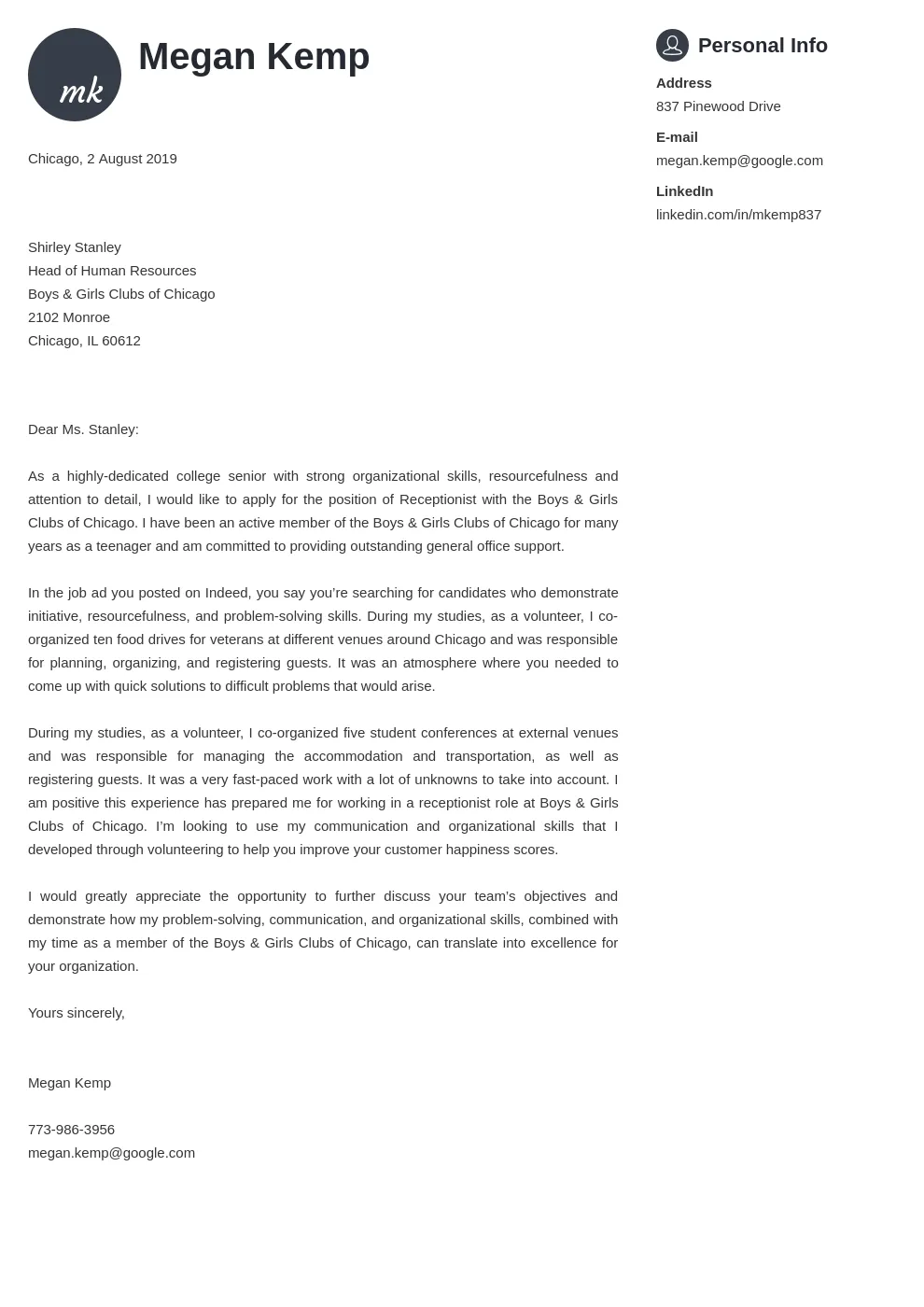
A strong receptionist cover letter includes several key components. These elements, when combined, paint a comprehensive picture of your qualifications and suitability for the role. Omitting any of these crucial elements can undermine your application, so make sure you include each one. The format should be clean and easy to read, using a standard business letter format. Remember to tailor each cover letter to the specific job and company you are applying for, reflecting the unique requirements and culture. Before submitting your cover letter, review it and revise it thoroughly to ensure it is free of errors.
Contact Information and Date

Begin by including your contact information at the top of the letter, including your name, phone number, email address, and optionally, your LinkedIn profile URL. This section should be aligned to the left. Below your contact information, include the date you are submitting the cover letter. Then, include the employer’s contact information, including the hiring manager’s name, title, company name, and address. Proper formatting here demonstrates your attention to detail and professionalism, making a positive first impression. Ensure accuracy in this section; otherwise, your cover letter may never reach the right person.
The Salutation
Address the hiring manager by name if possible. Researching the company website or LinkedIn can usually reveal this information. Addressing your cover letter to a specific person demonstrates that you have taken the time to learn about the organization and are genuinely interested in the opportunity. If you are unable to find a specific name, use a professional salutation such as “Dear Hiring Manager” or “Dear [Company Name] Hiring Team.” Avoid generic greetings such as “To Whom It May Concern,” as these can make your letter feel impersonal.
Writing a Compelling Opening Paragraph
Your opening paragraph should immediately grab the reader’s attention and clearly state the position you are applying for and where you found the job posting. Briefly mention your most relevant qualification or a specific skill that makes you stand out. Express your enthusiasm for the role and the company, demonstrating that you have researched the organization and understand its mission or values. The opening paragraph sets the tone for the rest of your letter, so make sure it is engaging and creates a strong first impression. Avoid generic opening lines and focus on making a statement to capture the reader’s interest.
Highlighting Relevant Skills and Experience

The body of your cover letter is where you highlight your skills and experience that align with the job requirements. Carefully review the job description and identify the key skills and qualifications the employer is seeking. Provide specific examples from your previous roles or experiences that demonstrate your abilities. Quantify your achievements whenever possible by using numbers, percentages, or data to show the impact you made in previous positions. This section should be tailored to the specific job, focusing on the most relevant aspects of your experience. Mention any specialized software you are experienced with, or anything relevant to the job.
Showcasing Soft Skills and Personality
Receptionist roles require strong interpersonal and communication skills. In your cover letter, showcase your ability to interact professionally with people, handle phone calls, manage schedules, and multitask effectively. Highlight your problem-solving skills and your ability to remain calm under pressure. Mention any customer service experience you have and how you provided excellent support. Demonstrate your proactive and friendly attitude. This is where your personality shines through. Provide real-life examples of how you used these skills to provide positive results.
Quantifying Achievements
Instead of simply listing your responsibilities, quantify your achievements whenever possible. Use numbers, percentages, or data to demonstrate the positive impact you made in your previous roles. For example, instead of saying “Managed phone calls,” state “Answered an average of 75 calls per day, providing excellent customer service and resolving issues efficiently.” Quantifying achievements shows the employer the value you can bring to their organization. Use action verbs to start each statement. Use a new line for each accomplishment to improve readability.
Expressing Enthusiasm for the Role

Throughout your cover letter, express your genuine enthusiasm for the role and the company. Show that you have researched the company and understand its mission, values, and culture. Explain why you are interested in this specific opportunity and how it aligns with your career goals. Showing enthusiasm demonstrates your passion for the job and increases your chances of being selected for an interview. Tailor your message to resonate with the company’s culture and values, which you can discover by visiting the company’s website or social media pages.
Closing Paragraph and Call to Action
In your closing paragraph, summarize your key qualifications and reiterate your interest in the position. Thank the employer for their time and consideration. Include a call to action by expressing your availability for an interview and providing your contact information again. This final step encourages the hiring manager to reach out to you. Be polite and professional. Keep the closing paragraph concise and impactful, leaving the hiring manager with a positive impression of your candidacy. End your letter with a professional closing, such as “Sincerely” or “Best regards.”
Formatting and Proofreading Your Cover Letter
Formatting and proofreading are essential to creating a professional cover letter. Use a standard business letter format with a clear font like Times New Roman or Arial, and a font size between 10 and 12 points. Keep the letter concise, ideally no more than one page. Proofread your letter carefully for any spelling, grammatical, or punctuation errors. Check the letter several times, or have someone else review it. Poorly written cover letters can make the candidate seem unprofessional and diminish their chance of being called for an interview. Ensure consistency in your formatting and style.
Key Skills to Include in Your Cover Letter

Receptionist roles require various skills, so include those most relevant to the job. Mention your communication skills, including verbal and written communication abilities. Highlight your ability to handle phones, email, and manage mail. Mention your experience with scheduling and calendar management, as well as your multitasking and organizational skills. Any experience with customer service should also be listed, as well as any software programs or office equipment you have worked with. Mention any ability to handle confidential information and a professional demeanor.
Common Mistakes to Avoid
Avoid common mistakes that can ruin your chances of getting an interview. Do not use generic cover letters; tailor each letter to the specific job and company. Proofread your cover letter carefully to ensure that it is free of spelling and grammatical errors. Avoid a passive tone, and use active verbs to describe your skills and achievements. Do not ramble, keep your letter concise. Don’t include irrelevant information. Finally, do not be negative about past employers.
Receptionist Cover Letter Template Example
Here is an example cover letter that you can use as a starting point. Remember to customize this template with your information. Adapt the template to best fit your skills, experience, and the specific requirements of the job. Make changes to reflect the company and its culture. Always proofread your letter, and ask a friend to review your draft.
Dear [Hiring Manager Name], I am writing to express my interest in the Receptionist position at [Company Name], as advertised on [Platform]. With my [Number] years of experience providing exceptional customer service and managing office operations, I am confident I can significantly contribute to your team. In my previous role at [Previous Company], I successfully managed the front desk, handled phone calls, scheduled appointments, and assisted in various administrative tasks. I am proficient in using Microsoft Office Suite and various office equipment. I am eager to learn more and discuss how my skills can benefit [Company Name]. Thank you for your time and consideration. Sincerely, [Your Name]