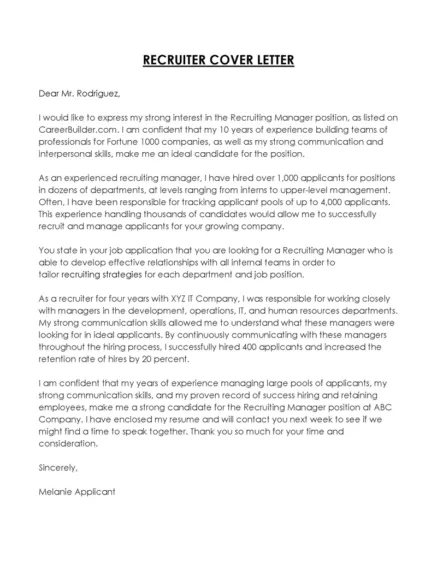
Key Elements of a Recruiting Cover Letter
A cover letter is a crucial document in the job application process, serving as your initial introduction to potential employers. Its primary purpose is to highlight your qualifications and demonstrate your suitability for the specific role. It provides an opportunity to expand on your resume, showcasing your personality, passion, and career goals beyond the basic facts. A well-crafted cover letter can significantly enhance your chances of securing an interview by capturing the hiring manager’s attention and encouraging them to delve deeper into your experience and skills. It’s your chance to make a strong first impression and set yourself apart from other candidates.
Highlighting Your Skills
When writing your cover letter, focus on the skills that directly match the job requirements. Begin by carefully reviewing the job description, identifying the key skills and qualifications the employer is seeking. Then, provide specific examples illustrating how you’ve demonstrated these skills in previous roles or projects. Avoid simply listing skills; instead, offer context. For instance, rather than stating ‘Proficient in applicant tracking systems,’ describe a situation where you used an ATS to improve the hiring process. This demonstrates not only your skills but also your ability to apply them effectively. Tailor the skills section for each application, ensuring you emphasize the most relevant abilities for that specific role. This personalization shows your genuine interest in the position and your capacity to contribute meaningfully.
Quantifiable Achievements

To truly impress a hiring manager, move beyond simply listing your responsibilities; quantify your accomplishments. Use data and metrics to demonstrate the impact you’ve made in your previous roles. For example, instead of stating, ‘Managed recruitment efforts,’ you could write, ‘Reduced time-to-hire by 15% through the implementation of a new sourcing strategy.’ Quantifiable achievements provide concrete evidence of your capabilities and make your cover letter more persuasive. They allow the hiring manager to see the direct value you brought to previous employers and understand the potential benefits of hiring you. When detailing your achievements, the STAR method (Situation, Task, Action, Result) can help structure your narrative to clearly convey your contributions and their impact.
Tailoring to the Job
Generic cover letters are easily recognizable and often overlooked. To make your application stand out, tailor your cover letter to the specific job you are applying for. Carefully review the job description and company website to understand the role’s requirements and the company’s values. Incorporate keywords and phrases from the job description throughout your letter. This shows the hiring manager that you understand the role and are a good fit. Personalize the letter by mentioning something specific about the company or the role that interests you. This demonstrates your genuine interest and initiative. If possible, address the hiring manager by name and research the company culture to align your tone and style with their values. Tailoring your cover letter shows that you’ve invested the effort, which greatly increases your chances of success.
Formatting and Presentation
The formatting and presentation of your cover letter are as important as the content itself. A clean, professional format enhances readability and demonstrates your attention to detail. Choose a standard, readable font like Arial or Times New Roman, and keep the font size between 10 and 12 points. Ensure consistent spacing throughout the document, with clear margins and paragraph breaks. Use bullet points to highlight key skills or achievements, making the information easy to scan. Carefully proofread your document for any grammatical errors or typos, as they can create a negative impression. Save the cover letter in a professional format like PDF to preserve formatting across different devices. A well-formatted cover letter conveys professionalism and highlights your attention to detail.
Researching the Company

Thorough research is essential before writing your cover letter. Gaining an understanding of the company’s mission, values, and recent initiatives will enable you to tailor your letter and demonstrate genuine interest. Visit the company’s website, read their ‘About Us’ section, and explore their social media profiles to gather information about their culture and recent news. If possible, research the hiring manager or recruiter, allowing you to address them directly. This level of detail shows that you are serious about the opportunity and have invested time in learning about the company. Understanding the company’s current challenges and goals allows you to highlight how your skills and experience can contribute to their success. This research helps your cover letter stand out from the competition.
Understanding Company Culture
Understanding a company’s culture is critical when applying for a job. Researching and comprehending the company’s values and work environment is vital to determining if you are a good fit. Look for information on the company’s website, social media profiles, and employee review sites, such as Glassdoor. Pay attention to the language they use, their approach to employees, and any mention of values such as teamwork, innovation, or customer service. Tailor your cover letter to reflect the company’s culture. For example, if the company emphasizes teamwork, highlight your collaborative experiences and team successes. If they value innovation, mention your experience with new technologies or approaches. Demonstrating an understanding of the company culture and how you align with it shows the hiring manager that you are a good fit and are likely to thrive in their work environment.
Showcasing Alignment
In your cover letter, clearly demonstrate how your skills, experience, and values align with the company’s needs and culture. Highlight the aspects of your background that directly relate to the job requirements and the company’s core values. Provide specific examples demonstrating your ability to meet those requirements. For instance, if the job description emphasizes strong communication skills, provide specific examples of how you’ve effectively communicated with different stakeholders in previous roles. If the company values innovation, share examples of innovative solutions you have implemented. Directly address how you can contribute to the company’s goals, mentioning specific projects or achievements that demonstrate your ability to succeed in the role. Showcasing alignment reassures the hiring manager that you are both qualified and a good fit for the company, thereby increasing your chances of getting an interview and securing the position.
Writing the Perfect Opening and Closing

The opening and closing sections of your cover letter are vital as they are the first and last impressions you make on the reader. A compelling introduction immediately grabs the hiring manager’s attention, while a strong closing leaves a lasting positive impact. The introduction should clearly state the position you are applying for and how you learned about it. Briefly mention something that makes you stand out or explain your interest in the company. Avoid generic openings; instead, aim to pique the reader’s interest from the start. A strong closing should summarize your key qualifications and reiterate your interest in the role. It should also include a clear call to action, such as expressing your availability for an interview or thanking the hiring manager for their time. These sections are crucial for making a positive impression and encouraging the reader to continue with your application.
Crafting a Compelling Introduction
Your introduction must be concise, engaging, and designed to immediately capture the reader’s interest. Start by stating the specific position you are applying for and how you found the job opening (e.g., through a job board, company website, or a referral). Then, provide a brief, attention-grabbing statement about why you are interested in the role and the company. You might mention a key skill, a significant achievement, or something that demonstrates your understanding of the company’s needs. Avoid generic phrases such as ‘I am writing to express my interest…’ Instead, aim for something more compelling, such as ‘With my proven track record of reducing time-to-hire by 20% and my passion for innovative recruiting strategies, I am excited to apply for the Recruiting Specialist position at [Company Name].’ The goal is to create an immediate positive impression and encourage the reader to continue reading your cover letter.
Summarizing Your Value
The body of your cover letter should clearly summarize your value proposition, highlighting your most relevant skills, experience, and achievements. Focus on the specific requirements detailed in the job description and tailor your examples to show how you meet these needs. Utilize the STAR method (Situation, Task, Action, Result) to provide a clear, concise narrative of your contributions. Quantify your accomplishments whenever possible, using data to demonstrate the impact you have made in previous roles. For example, you could mention how you improved candidate quality or reduced the cost-per-hire. Keep your paragraphs short and focused, and emphasize the key skills and experiences that set you apart. The body of the cover letter should effectively illustrate your ability to succeed in the role and the value you bring to the company.
Making a Strong Call to Action

The closing of your cover letter should include a strong call to action, prompting the hiring manager to take the next step. Express your interest in an interview, making it easy for the hiring manager to contact you. Make sure to thank the hiring manager for their time and consideration. Reiterate your enthusiasm for the role, highlighting your specific skills and how you align with the company’s values. Provide your contact information, including your email address and phone number. It is also appropriate to mention your availability for an interview and your eagerness to discuss your qualifications further. A strong call to action ensures the reader knows what to do next, facilitating the progression of your application. This final touch leaves a positive impression and significantly increases your chances of receiving an interview invitation.
Proofreading and Editing
Before submitting your cover letter, dedicate time to proofreading and editing. Errors in grammar, spelling, and punctuation can create a negative impression and suggest a lack of attention to detail. Even a single mistake can undermine your credibility and potentially disqualify you from consideration. Review your cover letter multiple times, reading it aloud to catch any awkward phrasing or typos. While grammar and spell-checking tools can be helpful, don’t rely on them entirely. They can miss errors or provide inaccurate suggestions. Consider having a friend, family member, or career advisor review your letter as well. A fresh perspective can often catch mistakes you may have overlooked. Proofreading and editing demonstrate professionalism and show the hiring manager that you approach your job search with seriousness.
Checking for Errors
Thoroughly check your cover letter for any errors in grammar, spelling, punctuation, and formatting. These seemingly minor details can significantly impact how a hiring manager views your application. Read your cover letter slowly, word-for-word, looking for common mistakes such as incorrect verb tenses, subject-verb disagreements, and misplaced modifiers. Ensure all names, titles, and company names are spelled correctly. Double-check for typos, and verify that you have used the correct form of words (e.g., ’there,’ ’their,’ and ’they’re’). Also, confirm that the formatting is consistent throughout the document, with correct spacing, margins, and font choices. Eliminate any unnecessary words or phrases that might distract from your message. Meticulous attention to detail is a mark of professionalism, so ensure every aspect of your cover letter is polished and error-free before submitting it.
Seeking Feedback

One of the most effective strategies for improving your cover letter involves soliciting feedback from others. Request that trusted friends, family members, career advisors, or professionals within your network review your letter and offer constructive criticism. A fresh perspective can help you identify areas for improvement that you might have overlooked. Provide your reviewers with the job description and ask them to assess how well your cover letter aligns with the role requirements. Request their evaluation of the clarity, conciseness, and overall impact of your writing. Are your skills and achievements clearly highlighted? Does your cover letter make a strong case for your candidacy? Be open to receiving feedback, even if it is critical. Utilize their suggestions to refine your cover letter, thereby enhancing its effectiveness and increasing your likelihood of success. Multiple revisions based on feedback will ultimately ensure your cover letter is the best it can be.