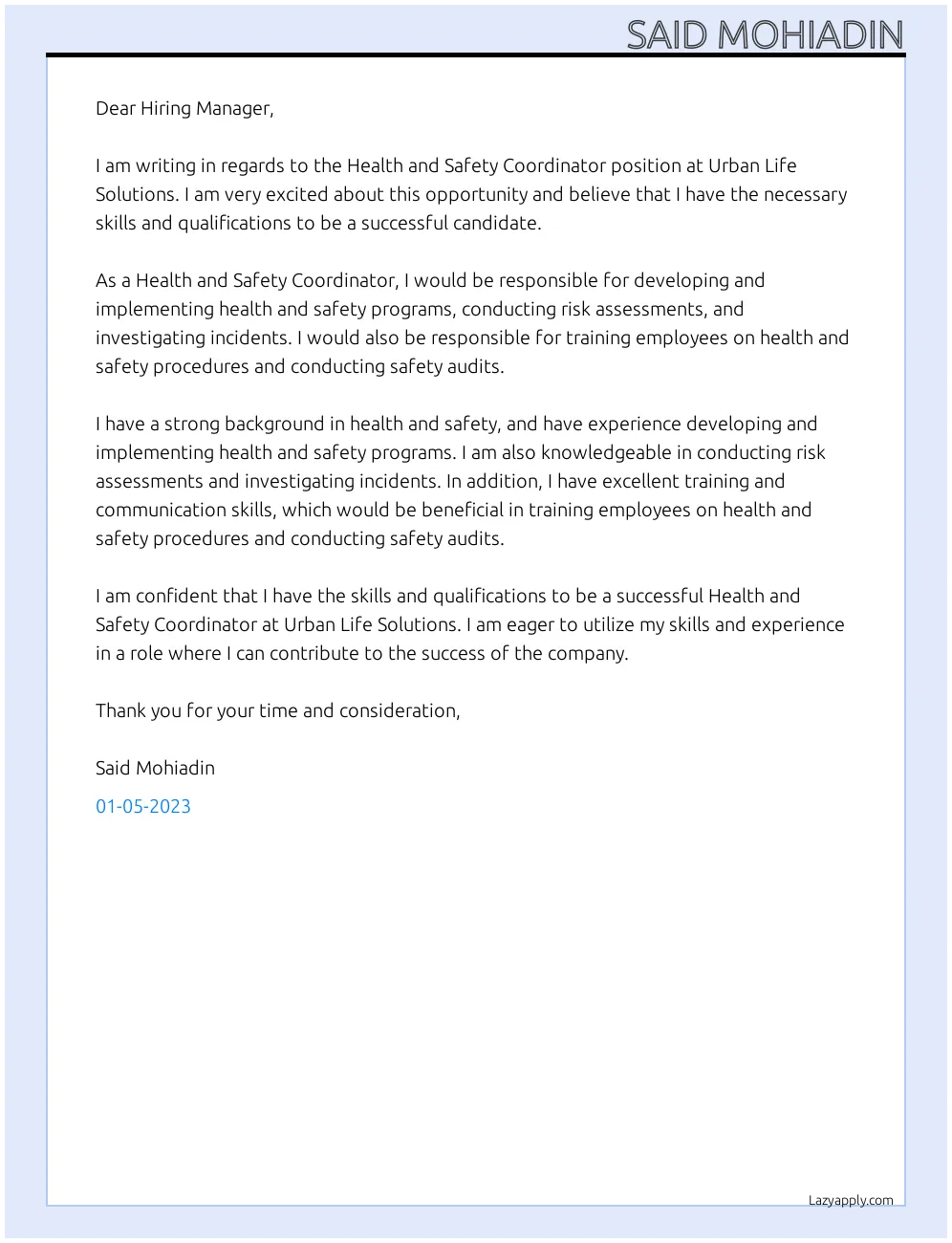
Crafting a Safety Coordinator Cover Letter
A well-crafted safety coordinator cover letter is your first opportunity to impress a potential employer and secure an interview. It serves as a vital introduction, showcasing your qualifications, experience, and passion for ensuring workplace safety. Unlike a resume, which provides a comprehensive overview of your background, a cover letter allows you to highlight specific skills, experiences, and achievements that directly align with the job requirements. It’s a chance to tell your story and explain why you are the ideal candidate for the position. Writing a compelling cover letter requires careful planning, attention to detail, and a clear understanding of the role and the company. In this guide, we’ll walk you through the process of creating a standout safety coordinator cover letter that grabs the reader’s attention and significantly increases your chances of getting hired.
Highlighting Your Skills and Qualifications
Your cover letter should be a targeted document, specifically tailored to the safety coordinator role you’re applying for. This means carefully reviewing the job description and identifying the key skills and qualifications the employer is seeking. Then, use your cover letter to demonstrate how your skills and experiences align with these requirements. Don’t just list your skills; provide specific examples of how you’ve used those skills to achieve positive outcomes in previous roles. Quantify your accomplishments whenever possible. For example, instead of stating “Improved safety protocols,” say “Reduced workplace accidents by 20% by implementing new safety protocols and conducting regular training sessions.” Highlighting your qualifications isn’t just about what you’ve done; it’s about demonstrating the value you can bring to the company and how you can contribute to a safer and more productive work environment.
Key Skills to Showcase in Your Cover Letter

Safety coordinator roles demand a diverse set of skills. When writing your cover letter, be sure to emphasize the following key skills: communication, attention to detail, problem-solving, leadership, training and presentation, and knowledge of safety regulations. Communication skills are critical for effectively conveying safety information to employees at all levels. Attention to detail is essential for identifying and mitigating potential hazards. Problem-solving abilities are necessary to address safety issues promptly and effectively. Leadership skills allow you to influence and motivate employees to adopt safe work practices. Strong training and presentation skills enable you to educate employees about safety procedures. Finally, in-depth knowledge of relevant safety regulations is paramount to ensure compliance and prevent accidents. Providing concrete examples of how you’ve successfully utilized these skills in previous roles will make your cover letter more impactful.
Demonstrating Your Knowledge of Safety Regulations
A successful safety coordinator must possess a thorough understanding of safety regulations. This includes knowledge of federal, state, and local laws related to workplace safety, such as OSHA (Occupational Safety and Health Administration) standards. In your cover letter, explicitly mention your familiarity with relevant regulations and your ability to ensure compliance. Describe any experience you have in conducting safety inspections, identifying hazards, and implementing corrective actions to address safety violations. Highlighting your experience with safety audits and your ability to develop and implement safety programs will demonstrate your commitment to creating a safe working environment. If you have specialized knowledge related to a particular industry or type of work (e.g., construction, manufacturing), make sure to mention it, as this will make your application even more appealing to employers within those sectors. Your knowledge of the regulations is crucial, it is also a tool to ensure compliance and mitigate accidents.
Emphasizing Your Experience
Your cover letter should focus on demonstrating your relevant experience and detailing your accomplishments. Instead of simply stating your job responsibilities, use the STAR method (Situation, Task, Action, Result) to provide context and showcase your achievements. Start by describing the situation or problem you faced, then explain the task you were assigned or the objective you had to achieve. Outline the actions you took to address the situation, and finally, highlight the results or outcomes of your actions. For example, instead of saying “Managed safety training programs,” you could write: “In my previous role, I identified a gap in employee safety training. My task was to develop and implement a new training program. I researched and designed a comprehensive training curriculum, including hands-on exercises and interactive sessions. As a result, we saw a 30% reduction in workplace incidents.” This approach effectively demonstrates your skills, experience, and the value you bring to the table. Tailoring your experience to the specific requirements of the job description is crucial to stand out from other candidates.
Showcasing Certifications and Training

Safety coordinator roles often require specific certifications and training. Ensure your cover letter prominently features any relevant certifications you hold, such as OSHA certifications, Certified Safety Professional (CSP), or other industry-specific credentials. Also, list any specialized training you’ve completed, such as first aid, CPR, or hazardous materials handling. Be sure to include the name of the certification, the issuing organization, and the date of completion. If you’re currently pursuing any certifications or professional development opportunities, mention this as well, highlighting your commitment to continuous learning and professional growth. Your certifications and training demonstrate your dedication to the safety profession and your readiness to take on the responsibilities of the role. When listing your qualifications, it is always advisable to verify that your certifications are up-to-date and compliant with any current regulations.
Formatting Your Safety Coordinator Cover Letter
The format of your cover letter is as crucial as its content. A well-formatted cover letter is easy to read and demonstrates professionalism. Use a standard business letter format, including your contact information, the date, the employer’s contact information, and a formal salutation. Choose a clear and legible font, such as Arial or Times New Roman, and use a font size between 10 and 12 points. Maintain consistent spacing and margins throughout the document. Break up long blocks of text into shorter paragraphs to improve readability. Proofread the entire document carefully to eliminate any errors in grammar, spelling, or punctuation. A well-formatted cover letter shows attention to detail, which is a critical skill for a safety coordinator.
Essential Elements of a Cover Letter
A compelling safety coordinator cover letter has several essential elements. Start with a professional header that includes your name, address, phone number, and email address. Include the date and the hiring manager’s name and title, if you know it, along with the company’s address. The salutation should be formal and address the hiring manager by name, if possible, using “Dear Mr./Ms./Mx. [Last Name]”. The opening paragraph should grab the reader’s attention by stating your interest in the position and briefly highlighting your key qualifications. The body paragraphs should provide details about your skills, experience, and achievements, with examples and quantifying data. The closing paragraph should reiterate your interest in the position, express your enthusiasm for an interview, and thank the reader for their time and consideration. Finally, proofread the entire document meticulously before submitting it.
Contact Information and Salutation

Begin your cover letter by providing your contact information, including your full name, address, phone number, and professional email address. Ensure your email address is professional and appropriate for the role. After your contact information, include the date and the hiring manager’s name and title if available. If you don’t know the hiring manager’s name, research the company’s website or LinkedIn to find it. Using the hiring manager’s name demonstrates that you have taken the time to research the company and the position. The salutation should be formal and respectful, such as “Dear Mr./Ms./Mx. [Last Name].” If you are unable to find a name, you can use a more general salutation like “Dear Hiring Manager” or “Dear [Company Name] Team.” However, always try to personalize your cover letter as much as possible. A personalized greeting shows that you’re invested in the opportunity and the company.
Opening Paragraph Grab Attention
The opening paragraph of your cover letter is your first chance to capture the reader’s attention. It should be concise, engaging, and clearly state your interest in the safety coordinator position. Start by mentioning the specific role you’re applying for and where you saw the job posting. Then, quickly highlight your most relevant qualifications and experience that align with the job requirements. Briefly explain why you are excited about the opportunity and what makes you a good fit for the company. Avoid generic opening statements like “I am writing to express my interest…” Instead, try a more compelling approach, such as “I am writing to express my enthusiastic interest in the Safety Coordinator position at [Company Name], as advertised on [Platform]. With my [Number] years of experience in developing and implementing safety programs, along with my proven ability to reduce workplace accidents, I am confident that I can contribute to a safer and more productive environment at your organization.” This opening immediately tells the reader what the letter is about and highlights your key strengths.
Body Paragraphs Detail Your Value
The body paragraphs are where you provide detailed information about your skills, experience, and accomplishments. Each paragraph should focus on a specific aspect of your qualifications and provide concrete examples to support your claims. Use the STAR method (Situation, Task, Action, Result) to describe your achievements. For each example, clearly state the situation you faced, the task you needed to accomplish, the actions you took, and the positive results you achieved. Quantify your accomplishments whenever possible, using numbers and data to demonstrate the impact of your work. For instance, instead of saying “Improved safety training,” say “Developed and implemented a new safety training program that resulted in a 25% reduction in workplace incidents within the first year.” Tailor each paragraph to the specific requirements of the job description, highlighting the skills and experiences that are most relevant to the position. The goal is to show the hiring manager why you are the best candidate for the role.
Closing Paragraph Call to Action
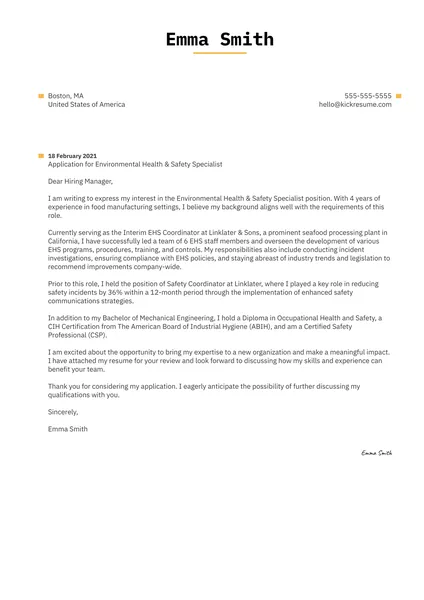
Your closing paragraph should reiterate your interest in the position and leave a strong lasting impression. Reiterate your enthusiasm for the opportunity and summarize why you are a good fit for the role. Express your eagerness to learn more about the position and the company, and indicate your availability for an interview. Thank the hiring manager for their time and consideration, and end with a professional closing, such as “Sincerely” or “Respectfully,” followed by your full name. Avoid phrases like “I look forward to hearing from you soon.” Instead, be proactive and suggest a specific call to action, such as “I am available for an interview at your earliest convenience and can be reached at [Phone Number] or [Email Address]. Thank you for considering my application.” This demonstrates your confidence and professionalism.
Proofreading and Editing
Before submitting your cover letter, meticulously proofread and edit it to ensure it is free of any errors in grammar, spelling, punctuation, and formatting. A cover letter filled with mistakes can damage your credibility and give the impression that you are not detail-oriented, a critical attribute for a safety coordinator. Read your cover letter multiple times, and consider asking a friend, family member, or career counselor to review it as well. They can often catch errors that you may have missed. Use a spell checker and grammar checker, but don’t rely on them entirely; always manually review the document to ensure accuracy. Check that all names, titles, and company information are correct. A polished cover letter shows that you pay attention to detail, are professional, and take pride in your work, all important traits for a safety coordinator.
Cover Letter Best Practices
Follow these best practices to create a compelling cover letter. Keep your cover letter concise and focused; aim for one page in length. Tailor your cover letter to each specific job application, highlighting the skills and experiences most relevant to the position. Use action verbs to describe your accomplishments and demonstrate your abilities. Quantify your achievements whenever possible, using numbers and data to show the impact of your work. Research the company and the role to demonstrate your interest and understanding of the organization. Proofread and edit your cover letter carefully to eliminate any errors. Maintain a professional tone and use clear and concise language. Demonstrate your enthusiasm for the opportunity and your eagerness to contribute to the company’s success. By following these practices, you can create a cover letter that stands out from the competition and increases your chances of getting hired.
Tailoring Your Cover Letter

One of the most crucial best practices is tailoring your cover letter to each job application. Do not use a generic cover letter for multiple positions. Customize your cover letter to match the specific requirements and expectations outlined in the job description. Carefully review the job description and identify the key skills, experiences, and qualifications the employer is seeking. Then, highlight your relevant skills and experiences, providing specific examples of how you have demonstrated those skills in previous roles. Research the company to understand its values, culture, and mission. Incorporate this knowledge into your cover letter to show that you understand the organization and are interested in becoming part of its team. By tailoring your cover letter, you demonstrate that you’ve invested the time and effort to understand the position and the company and that you are genuinely interested in the opportunity. This personalization significantly increases your chances of being selected for an interview.
Researching the Company and Role
Before writing your cover letter, conduct thorough research on the company and the specific role. This demonstrates your genuine interest in the opportunity and allows you to tailor your cover letter to the company’s needs. Visit the company’s website to learn about its mission, values, and culture. Research the company’s products or services, its industry, and its recent achievements. Identify the key challenges and opportunities the company faces and consider how your skills and experience can help address them. Also, research the specific role you are applying for. Review the job description carefully to understand the required skills, responsibilities, and expectations. Use your research to personalize your cover letter and highlight how your qualifications align with the company’s values and the role’s requirements. Showing that you understand the company and the role is a great way to distinguish your application from the competition.
Using Action Verbs
Action verbs are essential for creating a dynamic and impactful cover letter. Use strong action verbs to describe your accomplishments, skills, and experiences. Action verbs bring your achievements to life, making your cover letter more engaging and memorable. Instead of using passive phrases like “Responsible for,” use active verbs like “Managed,” “Developed,” “Implemented,” “Led,” “Trained,” or “Improved.” For example, instead of writing “My responsibilities included ensuring safety compliance,” write “Implemented a comprehensive safety program that ensured compliance with OSHA regulations.” Choose action verbs that are specific to the tasks you performed and the results you achieved. By using a variety of action verbs, you can create a more compelling cover letter that demonstrates your abilities and leaves a lasting impression on the hiring manager. Incorporate verbs that showcase leadership, such as “Directed,” “Oversaw,” or “Mentored.”
Reviewing Common Mistakes

Avoiding common mistakes can significantly improve the effectiveness of your cover letter. One of the most common errors is sending a generic cover letter that is not tailored to the specific job. Other common mistakes include using clichés, such as “I am a team player” or “I am a hard worker,” which are overused and lack impact. Not proofreading your cover letter is another significant error; typos and grammatical errors can undermine your credibility. Failure to quantify your accomplishments is another mistake; use numbers and data to demonstrate the impact of your work. Also, avoid including irrelevant information or information that is already in your resume. Make sure your cover letter is concise and focused on the most relevant information. Addressing the hiring manager by the wrong name or not addressing them by name at all is a big error, so always research the hiring manager if possible. By avoiding these common mistakes, you can increase your chances of creating a successful cover letter.
Avoiding Clichés
Clichés and overused phrases can make your cover letter sound generic and uninspired. Avoid using phrases that are common and lack originality, such as “I am a team player,” “I am a hard worker,” “I am detail-oriented,” or “I am a self-starter.” Instead of using these clichés, focus on providing specific examples that demonstrate your skills and abilities. For example, instead of saying “I am a team player,” describe a specific instance where you worked collaboratively to achieve a positive outcome. Instead of saying “I am detail-oriented,” describe a project or task where your attention to detail made a difference. Use descriptive language and strong action verbs to bring your achievements to life. By avoiding clichés and focusing on providing concrete examples, you can create a more compelling and memorable cover letter that captures the reader’s attention.
Review and Refinement
After completing your cover letter, review it multiple times and seek feedback from trusted sources. Start by reading the cover letter aloud to identify any awkward phrasing or grammatical errors. Check that the content accurately reflects your skills, experience, and qualifications. Ensure that your cover letter is tailored to the specific job description and that you have highlighted the most relevant information. Ask a friend, family member, or career counselor to review your cover letter and provide constructive criticism. They can often catch errors or suggest improvements that you may have missed. Consider asking someone with experience in human resources or the safety field to review your cover letter. They can offer valuable insights and suggestions for enhancing the impact of your application. Revise and refine your cover letter based on the feedback you receive, and make sure it is polished and ready for submission. A well-reviewed and refined cover letter is more likely to impress potential employers and increase your chances of landing an interview. Make sure the language is professional, concise, and easy to understand.